When your dog suddenly loses interest in food, starts vomiting, or seems unusually weak-especially after a stressful event-it’s easy to blame a bad meal or a passing bug. But if these symptoms stick around, or come back again and again, something deeper might be going on. For some dogs, it’s Addison’s disease: a quiet, dangerous condition that messes with their body’s ability to handle stress. It’s rare, but when it happens, knowing the signs could save your dog’s life.
What Exactly Is Addison’s Disease in Dogs?
Addison’s disease, or hypoadrenocorticism, happens when a dog’s adrenal glands don’t make enough of two key hormones: cortisol and aldosterone. These aren’t just random chemicals-they’re essential for survival. Cortisol helps your dog respond to stress-like a thunderstorm, a trip to the vet, or even a change in routine. Aldosterone keeps their body’s salt and water balance in check. Without them, the body starts to shut down.
This isn’t something that shows up overnight. Most dogs develop it slowly, which is why so many cases are missed. The adrenal glands, sitting right next to the kidneys, get damaged-usually by the dog’s own immune system attacking them. Less often, it’s caused by long-term steroid use being stopped too fast, or a tumor. But in over 90% of cases, it’s autoimmune. The body turns on itself.
It’s not contagious. It’s not caused by poor diet or lack of exercise. It’s a medical condition, and it can strike any breed-but some dogs are more at risk. Standard Poodles, Portuguese Water Dogs, Bearded Collies, and Nova Scotia Duck Tolling Retrievers have higher rates. Females are slightly more likely to be affected than males, and it most often shows up in dogs between 4 and 7 years old.
What Are the Real Signs of Addison’s Disease?
Here’s the problem: the symptoms look like so many other things. Diarrhea? Check. Lethargy? Check. Loss of appetite? Check. That’s why vets often think it’s gastroenteritis, kidney disease, or even just a nervous dog.
But there are patterns. Dogs with Addison’s often have episodes where they seem fine for weeks, then suddenly collapse. Their gums might feel cool and pale. Their heart rate slows. They might shake or seem confused. Vomiting and diarrhea come and go, but they don’t respond to typical treatments. Weight loss happens slowly. You might notice increased thirst and urination-not because of diabetes, but because their body can’t hold onto water properly.
One telltale sign? Symptoms get worse after stress. A move, a new pet, boarding, or even a loud fireworks night can trigger a crisis. That’s when the dog’s body has no cortisol left to handle the pressure. This is an emergency. Without treatment, a dog can go into an Addisonian crisis-shock, heart failure, and death within hours.
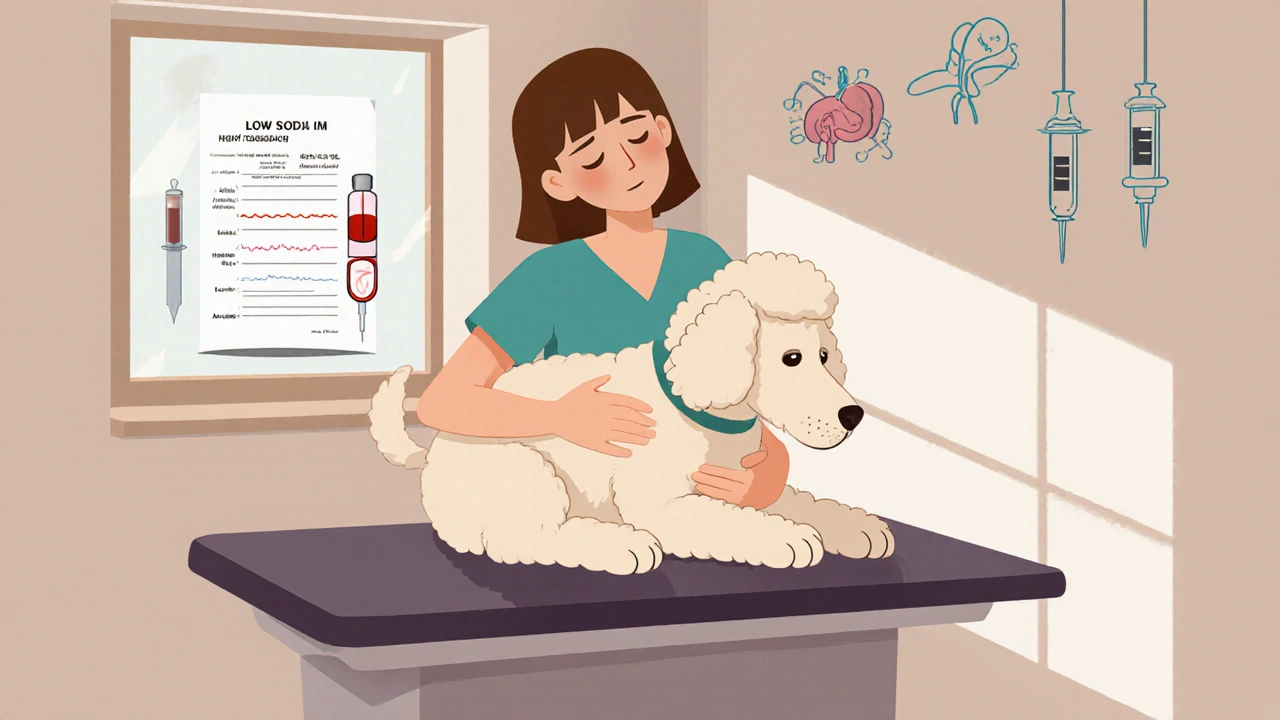
One owner I know in Brisbane noticed her 5-year-old Standard Poodle, Luna, would get sick every time she took her to the vet. She’d vomit, refuse food for two days, then bounce back. The vet thought it was anxiety. It wasn’t. It was Addison’s. Only after a blood test showing low sodium and high potassium did the diagnosis click.
How Is Addison’s Disease Diagnosed?
There’s no single test you can do at home. It takes a vet, bloodwork, and a special test called an ACTH stimulation test. This is the gold standard.
First, your vet will run a basic blood panel. Dogs with Addison’s usually have low sodium and high potassium. That imbalance is a huge red flag. They might also show elevated kidney values-not because the kidneys are failing, but because the body’s fluid balance is off.
Then comes the ACTH test. A small amount of synthetic ACTH (a hormone that tells the adrenals to release cortisol) is injected. Blood is drawn before and an hour after. In a healthy dog, cortisol spikes. In a dog with Addison’s, it barely moves. That’s the confirmation.
Some vets will also test for adrenal antibodies to check if it’s autoimmune. But that’s not always needed for treatment to begin.
Don’t delay testing if you suspect Addison’s. The longer it goes untreated, the more damage it does to the heart and kidneys.
How Is It Treated? Lifelong Medication Is Key
Addison’s disease can’t be cured-but it can be managed perfectly with the right treatment. Most dogs live normal, happy lives once stabilized.
There are two main medications:
- Fludrocortisone acetate (Florinef): A daily pill that replaces aldosterone and helps balance sodium and potassium.
- Desoxycorticosterone pivalate (DOCP, brand name Percorten-V): A monthly injection that does the same job as Florinef, but with fewer side effects and more stable results.
Both need to be paired with a daily corticosteroid like prednisone to replace cortisol. The dose is small-often just a fraction of a tablet-and it’s adjusted based on how your dog responds.
Some vets prefer DOCP because it’s easier to manage. No daily pills, just one injection every 25 to 30 days. But it’s more expensive. Florinef works well for many dogs, but some get stomach upset or need extra monitoring.
During an Addisonian crisis, your dog will need emergency IV fluids, electrolyte correction, and high-dose steroids. This is hospital-level care. Don’t wait.
What Does Daily Life Look Like With Addison’s Disease?
Once stabilized, most dogs act completely normal. They play, nap, chase squirrels, and beg for treats. But there are rules.
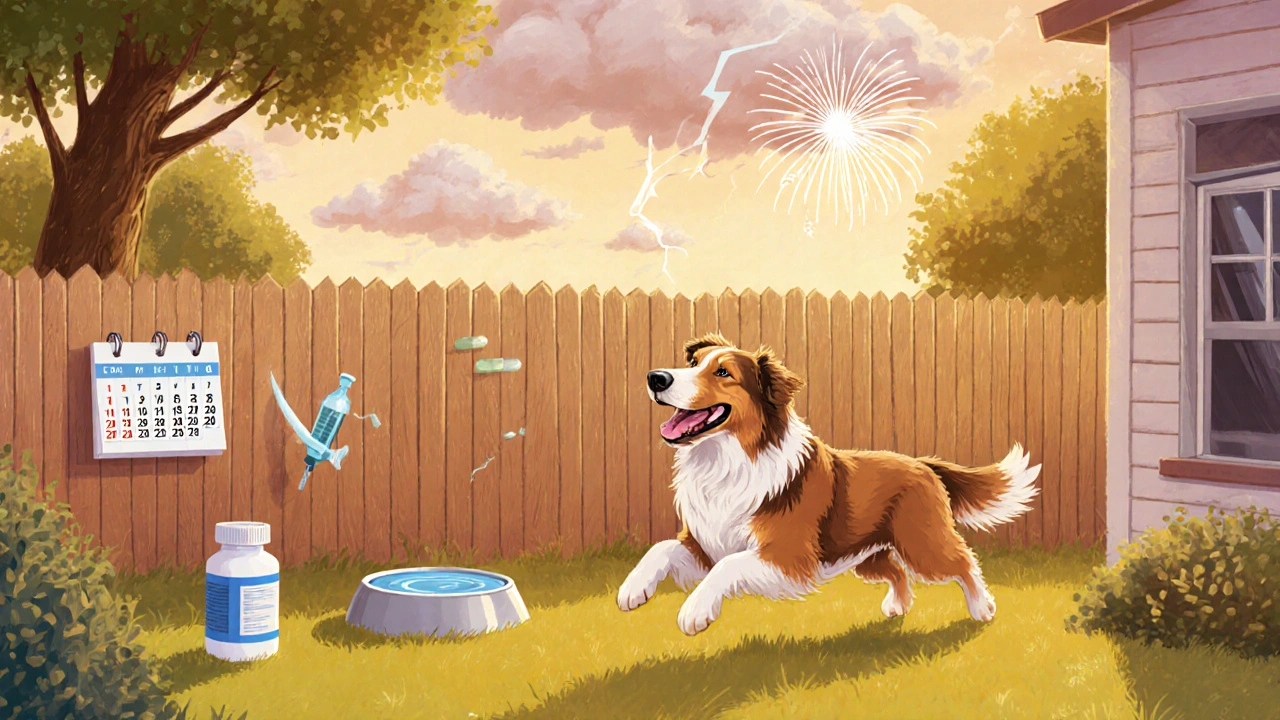
Medication must be given exactly on time. Missing a dose-even once-can trigger a crisis. If you’re traveling, plan ahead. Keep extra medication with you. Never stop steroids suddenly. Even if your dog seems fine, the body still needs them.
Stress is the enemy. If your dog is going to the groomer, a new baby is coming, or you’re moving, your vet might recommend a temporary increase in prednisone. This is called a "stress dose." It’s not optional. It’s life-saving.
Blood tests are needed every 3 to 6 months at first, then every 6 to 12 months once stable. You’ll be watching sodium and potassium levels. If potassium creeps up, the dose needs adjusting. If sodium drops, it’s a warning sign.
One owner told me her dog, Max, had been on DOCP for three years. He was fine until one weekend when he got scared during a storm. He didn’t eat for two days. She called the vet, got a prednisone boost, and he bounced back by Monday. "I used to panic every time it rained," she said. "Now I just have a plan."
What Should You Avoid?
There are a few big mistakes owners make:
- Stopping medication because "they seem fine." Addison’s doesn’t go away. The body still needs the hormones.
- Using over-the-counter supplements that claim to "boost adrenal function." There’s zero evidence they work. Some even interfere with treatment.
- Ignoring subtle changes. A dog that’s slightly less energetic, or drinks more water, might be signaling a problem.
- Assuming it’s just "old age." Addison’s hits middle-aged dogs hardest. It’s not something you just live with.
Also, avoid giving your dog NSAIDs like ibuprofen or naproxen. These can damage the kidneys, and dogs with Addison’s are already at higher risk.
Can It Be Prevented?
Not really. Since it’s usually autoimmune, there’s no known way to stop it from happening. But you can catch it early.
If you own a breed with higher risk-Poodles, Water Dogs, Collies-talk to your vet about baseline blood work at age 3 or 4. It’s cheap, non-invasive, and could catch it before symptoms start.
Also, never abruptly stop steroids if your dog was on them for another condition (like allergies or inflammation). Taper them slowly under vet supervision. That’s a known trigger for iatrogenic Addison’s.
What’s the Prognosis?
With proper treatment, dogs with Addison’s disease have a normal lifespan. Many live 10, 12, even 15 years. They can run agility, go on hikes, and sleep on your couch just like any other dog.
The key is consistency. Medication on time. Regular blood tests. Stress management. That’s it.
One of my clients has a 10-year-old Bearded Collie named Ruby who’s been on DOCP since she was 6. She still fetches tennis balls, eats three meals a day, and sleeps on the foot of the bed. Her owner says, "It’s not a death sentence. It’s just a new routine."
If your dog has been acting off, and nothing seems to fix it-don’t give up. Ask about Addison’s. Get the ACTH test. It’s not expensive, and it’s the difference between watching your dog fade… and seeing them thrive.
Can Addison’s disease in dogs be cured?
No, Addison’s disease cannot be cured. The damaged adrenal glands don’t regenerate. But it can be managed perfectly with lifelong hormone replacement therapy. With the right treatment, dogs live normal, healthy lives with no reduced lifespan.
Is Addison’s disease painful for dogs?
The disease itself isn’t painful, but the symptoms can be uncomfortable. Vomiting, diarrhea, weakness, and dehydration cause distress. During an Addisonian crisis, dogs can feel extremely unwell, even confused or in shock. Prompt treatment relieves these symptoms quickly.
How much does treating Addison’s disease cost?
Initial diagnosis costs $300-$600, mostly for bloodwork and the ACTH test. Monthly treatment ranges from $50 to $150, depending on whether you use daily pills (Florinef) or monthly injections (DOCP) plus prednisone. Emergency crisis care can cost $1,000-$2,500, so having a treatment plan in place saves money-and your dog’s life.
Can dogs with Addison’s disease live with other pets?
Yes, absolutely. Dogs with Addison’s can live happily with other pets. The condition doesn’t affect their temperament or ability to socialize. The only adjustment needed is managing stress-like loud noises or big changes-that might trigger symptoms.
What happens if I miss a dose of medication?
Missing one dose of prednisone or Florinef can cause lethargy or loss of appetite. Missing a DOCP injection or both medications increases the risk of an Addisonian crisis-shock, collapse, or even death. If you miss a dose, contact your vet immediately. Never double up on medication without advice.
Are there natural alternatives to medication for Addison’s disease?
No. There are no proven natural alternatives to hormone replacement therapy for Addison’s disease. Supplements, herbs, or diets cannot replace cortisol or aldosterone. Relying on unproven methods puts your dog’s life at risk. Always follow your vet’s prescribed treatment plan.

Bette Rivas
Addison’s disease in dogs is one of those conditions that flies under the radar until it doesn’t. I’ve seen it twice in my practice-both times in Standard Poodles. The key is recognizing the cyclical nature of the symptoms. Owners think their dog is just ‘sick sometimes,’ but it’s the stress triggers that give it away. A trip to the groomer, a thunderstorm, even a change in feeding time can send them into crisis. The ACTH stimulation test is non-negotiable if you suspect it. No home remedy, no supplement, no ‘natural approach’ will replace what the adrenal glands should be producing. And yes, it’s expensive-but not as expensive as losing your dog because you waited too long.
Florinef works, but DOCP is cleaner. Less GI upset, more stable electrolytes. Just make sure you’re tracking sodium and potassium every 3-6 months. I’ve had dogs on it for over a decade living full, happy lives. It’s not a death sentence. It’s a lifestyle adjustment. Treat it like diabetes in humans-manage it, don’t ignore it.
prasad gali
Let’s cut through the fluff. If your dog has low sodium and high potassium and you’re not running an ACTH stim test, you’re not a vet-you’re a gambler. Addison’s isn’t ‘maybe.’ It’s either present or it’s not. The autoimmune destruction of the adrenal cortex is well-documented. No amount of ‘maybe it’s anxiety’ or ‘maybe it’s a bug’ changes the biochemistry. Stop guessing. Run the test. Start treatment. Period. Your dog’s life isn’t a waiting game.
And don’t even get me started on ‘natural alternatives.’ That’s not holistic medicine-that’s animal abuse dressed up as wellness. Cortisol isn’t a suggestion. It’s a physiological imperative. If you’re skipping meds because your dog ‘seems fine,’ you’re just delaying the inevitable. Wake up.
Paige Basford
I just want to say-this post made me cry a little. My girl, Luna, was diagnosed at 5 with Addison’s after months of ‘mysterious’ sickness. She’d get sick every time we went to the vet, and we thought it was stress. Turns out it was her body screaming for help. She’s now on DOCP and prednisone, and she’s the happiest dog alive. She still chases squirrels, steals socks, and sleeps on my feet.
One thing I wish I’d known sooner: stress doses. When we went on vacation last year and stayed in a noisy hotel, I called our vet and got a prednisone boost for a few days. She was fine. No meltdown. No crisis. It’s not overkill-it’s prevention. If you’re on the fence about testing, just do it. You won’t regret it.
Also, thank you for mentioning the breeds at risk. I never would’ve guessed Poodles were more prone. So glad I found this.
Ankita Sinha
OMG I JUST LEARNED THIS TODAY AND I’M SO GLAD I DID!! My pup, Rocky, is 6 and has been super lethargic since winter. We thought he was just getting old. But now I’m like-wait, he’s been vomiting every 3 weeks like clockwork. And he gets weird after fireworks!! I’m calling my vet tomorrow to ask for the ACTH test. I’m not waiting another day. This is life or death. I’m so thankful someone wrote this. I feel like I just got a superpower.
Also-DOCP sounds way easier than daily pills. My brain already hurts thinking about giving pills every morning. One shot a month? Yes please. I’m telling all my dog mom friends. This is huge.
Kenneth Meyer
It’s strange how medicine forces us to confront the fragility of life. We treat our dogs like family, yet we assume their bodies are invincible. Addison’s disease doesn’t care about our love or our routines. It operates in the silent spaces between heartbeats, in the imbalance of sodium and potassium, in the absence of cortisol when the world gets loud.
What we call ‘behavior’ is often biology. A dog who won’t eat isn’t being stubborn. A dog who trembles isn’t just ‘nervous.’ Their body is failing to respond to the world because the machinery that keeps them alive has been quietly broken. Treatment isn’t about control. It’s about restoration. Giving back what was taken. That’s not medicine. That’s mercy.
And yes-this is why we keep showing up. Even when it’s hard. Even when it’s expensive. Even when it’s inconvenient. Because love isn’t just a feeling. It’s a commitment to keep the machine running.
Donald Sanchez
ok so i just read this and like… WTF why is no one talking about this?? my dog has been acting weird since last summer and i thought it was just the heat or bad kibble 😭 i’m literally crying rn. i’m calling the vet tomorrow. i’m so scared but also so relieved to know what it might be. i’ve been googling ‘dog tired all the time’ for months and got nothing. this post is a miracle. 🙏🫂
also DOCP sounds like a vibe. one shot a month?? i can handle that. no more pill battles. i’m so done with fighting my dog for meds. 🤯
Abdula'aziz Muhammad Nasir
Thank you for this comprehensive and compassionate overview. In my region, many pet owners are unaware that chronic, recurring gastrointestinal symptoms in dogs may stem from endocrine dysfunction rather than diet or infection. Addison’s disease is frequently misdiagnosed as ‘simple’ gastroenteritis, leading to prolonged suffering.
I encourage all caregivers of middle-aged dogs, particularly those of predisposed breeds, to request baseline electrolyte panels during routine wellness visits. Early detection saves lives and reduces long-term costs. The treatment protocol is straightforward once diagnosed. What requires vigilance is consistency-medication timing, stress management, and regular monitoring. This is not a burden; it is an act of devotion.
To those newly diagnosed: your dog’s quality of life can be excellent. Many live beyond 12 years with proper care. You are not alone.
Brad Samuels
I read this and immediately thought of my neighbor’s dog. She’d been going to the vet every few weeks for ‘stomach bugs.’ They kept giving her antibiotics. Nothing helped. Then one day she collapsed after a thunderstorm. Turns out it was Addison’s. She’s on DOCP now and runs around like a puppy again.
I just want to say-if you’ve been told your dog is ‘just anxious’ or ‘has a sensitive stomach’ and nothing’s working, don’t accept that. Push for the ACTH test. It’s not a stretch. It’s basic. Your dog deserves that much.
And if you’re scared about the cost-talk to your vet. Some clinics have payment plans. Others have nonprofit partnerships. Don’t let money be the reason you wait. This isn’t a luxury. It’s a lifeline.
Jeff Moeller
I didn’t know this existed until I lost my dog to it. He was 7. We thought he had the flu. He got worse after a move. We didn’t test. We didn’t ask. We just cried. Don’t make our mistake. Run the test. Even if it’s expensive. Even if you’re scared. It’s not a maybe. It’s a must. I wish I’d known sooner.
Herbert Scheffknecht
Think about it-our dogs don’t have words. They can’t say, ‘I feel weak,’ or ‘I can’t handle stress.’ All they have are symptoms. Vomiting. Lethargy. Shaking. And we interpret them through our own human lens: ‘He’s just tired.’ ‘She’s being dramatic.’ ‘It’s probably nothing.’
Addison’s is a silent rebellion of the body. It doesn’t shout. It whispers. And if you’re not listening, it screams-too late.
Maybe this isn’t about medicine. Maybe it’s about paying attention. About learning to read the quiet language of a creature who loves you more than they love themselves. The hormones aren’t the miracle. The vigilance is.
Greg Knight
If you’re reading this and you’re worried about your dog, I want you to know-you’re not failing. You’re trying. That’s enough.
Addison’s doesn’t happen because you didn’t feed the right food or didn’t take your dog to the vet often enough. It’s not your fault. It’s biology. And the fact that you’re here, reading this, means you care enough to learn. That’s the biggest win.
Start with the blood panel. Don’t wait for a crisis. Don’t wait for your dog to collapse. Just ask. Just test. And if you’re overwhelmed? Write down the next step. One thing. Just one. Call the vet. Schedule the test. That’s your mission today.
You’ve got this. Your dog already knows you love them. Now let’s give them the chance to keep living like they deserve.
Hannah Machiorlete
Okay so I’m gonna be real-I thought this was just another ‘dog health scare’ blog post until I read the part about Luna in Brisbane. That’s MY DOG. I’m the owner. I’m the one who thought it was anxiety. I’m the one who cried in the vet’s office when they said ‘Addison’s.’ I didn’t know what it was. I didn’t know how to spell it. I Googled it at 3 a.m. and cried harder.
Now she’s on DOCP. I set phone alarms. I carry extra prednisone in my purse. I panic when it rains. But I don’t panic about her dying anymore. Because I know what to do.
This post saved me. Thank you. I’m sharing it with everyone. I’m begging people to read it. Don’t let anyone else go through what I did.
Tara Stelluti
Okay but WHY is this not common knowledge?? Why do vets not just test for this automatically in at-risk breeds?? I feel like this is being hidden. Like it’s some dirty secret. Why do we only hear about this after someone’s dog dies??
And why do people keep saying ‘natural remedies’ like it’s a thing?? Are they trying to kill their dogs?? I swear if I see one more post about ‘adrenal support supplements’ I’m going to lose it.
This is medical. This is science. This is not a yoga retreat. Stop pretending it’s not.
Danielle Mazur
I’ve been researching this for weeks. I’m not convinced this is real. I think it’s a pharmaceutical scam. Why would a dog’s body suddenly attack its own adrenal glands? Sounds like GMOs or 5G. And why is DOCP so expensive? Who owns the patent? Who profits? I’ve seen patterns-vets push expensive tests, then expensive lifelong meds. It’s too convenient.
My dog has had ‘episodes’ since he was 3. I’ve tried raw food, CBD, acupuncture. He’s better. I don’t need their drugs. I don’t trust their labs. I’m not giving him cortisol from a lab. I’m not playing their game.
Bette Rivas
Just saw Danielle’s comment. I’m a vet. I’ve treated 37 dogs with Addison’s. I’ve seen the bloodwork. I’ve held the vials. I’ve watched dogs die because their owners believed in ‘natural healing.’
You don’t need to trust the pharmaceutical industry to trust science. Cortisol is a molecule. Aldosterone is a hormone. They are not metaphors. They are not conspiracies. They are life-or-death chemicals your dog’s body makes-and if it can’t, you have to replace them.
There’s no ‘alternative.’ There’s only survival or loss. I’m not trying to sell you anything. I’m trying to save a life. Please, for the love of everything good, get the ACTH test. Don’t gamble with your dog’s life because you’re scared of Big Vet.