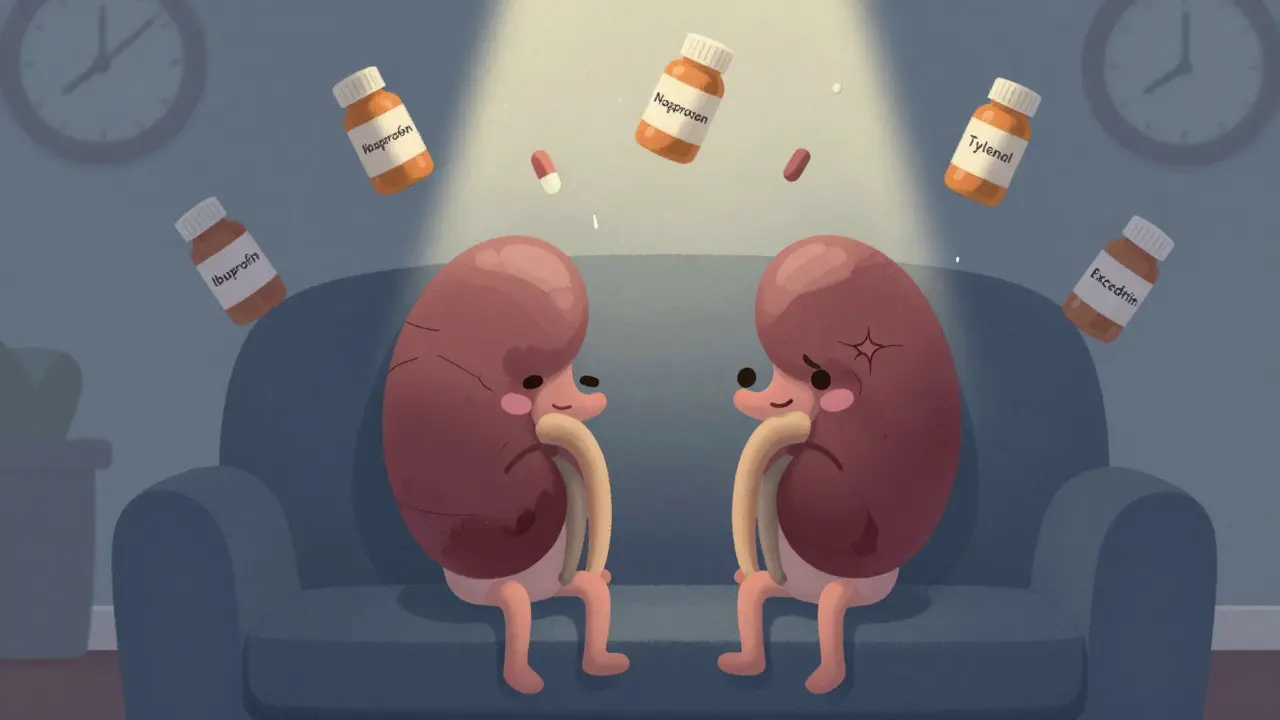
For decades, people have reached for over-the-counter painkillers like ibuprofen, naproxen, or Excedrin without a second thought. But what if those pills, taken daily for years, were quietly damaging your kidneys? This isn’t a rare scare tactic-it’s analgesic nephropathy, a preventable form of chronic kidney disease caused by long-term use of common pain medications. And it’s happening more often than you realize.
What Exactly Is Analgesic Nephropathy?
Analgesic nephropathy is kidney damage caused by taking large amounts of painkillers over many years. It’s not from a single overdose. It’s from the slow, silent buildup-taking 6 or more pills a day for 3 years or more. The kidneys don’t scream. They don’t hurt at first. Instead, they just… stop working as well, one tiny capillary at a time.
The damage starts in the inner part of the kidney, where the filtering units (nephrons) get their blood supply. Over time, the tiny blood vessels around them harden and die. This leads to renal papillary necrosis, where parts of the kidney tissue begin to rot away. By the time symptoms show up, the damage is often advanced.
It used to be tied mostly to combination pills with phenacetin-a painkiller banned in the U.S. in 1983. But today, the main culprits are NSAIDs like ibuprofen, naproxen, and aspirin, along with high-dose acetaminophen. Even if you think you’re being careful, taking 4 extra-strength Tylenol daily for headaches for 5 years? That’s enough to raise your risk.
Who’s Most at Risk?
It’s not just older adults. While the average patient is over 45, women between 30 and 55 are hit hardest. Why? Many manage chronic headaches, menstrual pain, or arthritis with daily pills. A 2021 study found that 72% of diagnosed cases were women. They’re often the ones taking the most OTC meds-sometimes multiple types at once.
People with existing conditions like high blood pressure, diabetes, or early kidney disease are at even higher risk. Their kidneys are already working harder. Adding NSAIDs on top? That’s like revving a car with a leaky radiator.
And here’s the kicker: most people don’t know they’re at risk. A Cedars-Sinai survey in 2022 found that 62% of patients diagnosed with analgesic nephropathy had no idea OTC painkillers could hurt their kidneys. They thought, “It’s just Tylenol.”
How Do You Know If It’s Happening to You?
The worst part? There are no early symptoms.
You won’t feel pain. You won’t notice swelling. The first sign is often a routine blood test showing elevated creatinine-or a urine test revealing small amounts of protein. That’s it. No warning. No alarm.
Later stages bring fatigue, high blood pressure, anemia, and trouble concentrating. Some people pass pieces of dead kidney tissue in their urine-called renal papillae-which can block the urinary tract and cause sudden, severe pain. By then, the damage is often irreversible.
Doctors use noncontrast CT scans to spot calcifications in the kidney papillae. That’s the gold standard for diagnosis. But by the time those show up, the disease has been brewing for years.
A new FDA-approved urine test called NephroCheck, launched in January 2023, can detect early signs of papillary damage with 92% accuracy. It’s not widely used yet-but it’s a game-changer for catching this before it’s too late.
NSAIDs vs. Acetaminophen: Which Is Worse?
It’s not black and white.
NSAIDs (ibuprofen, naproxen, aspirin) reduce blood flow to the kidneys by 25-40% even at normal doses. That’s enough to stress a damaged kidney. Long-term use increases the risk of chronic kidney disease by 30-50% compared to non-users.
Acetaminophen used to be considered the “safe” choice. But a 2020 study in Kidney International Reports found that taking more than 4,000 mg daily for five years raised chronic kidney disease risk by 68%. That’s 8 extra-strength pills a day. Many people take that much for migraines or back pain.
The real danger? Combination products. Excedrin, Goody’s Powders, Midol-these often contain caffeine, acetaminophen, and aspirin all in one pill. A 2018 meta-analysis showed these combos are 3.7 times more likely to cause kidney damage than single-ingredient pills. Caffeine makes the kidneys work harder. Codeine adds another layer of risk. And people don’t realize they’re taking three drugs at once.
How Many People Are Affected?
In the 1980s, analgesic nephropathy caused up to 10% of end-stage kidney disease cases in Australia. Today, it’s down to about 2-3% in the U.S.-but that still means 15,000 to 20,000 new cases every year.
Each case costs the system $18,500 a year if caught early. If it progresses to dialysis? That jumps to $90,000 annually. That’s over $1 billion in healthcare costs each year from a condition that’s almost entirely preventable.
And the numbers are rising again. A 2023 CDC report found that 41% of American adults exceed recommended NSAID dosages. Among people with chronic pain, that number hits 67%. We’re backsliding.
What Does Safe Pain Relief Look Like Now?
It’s not about avoiding painkillers. It’s about using them smarter.
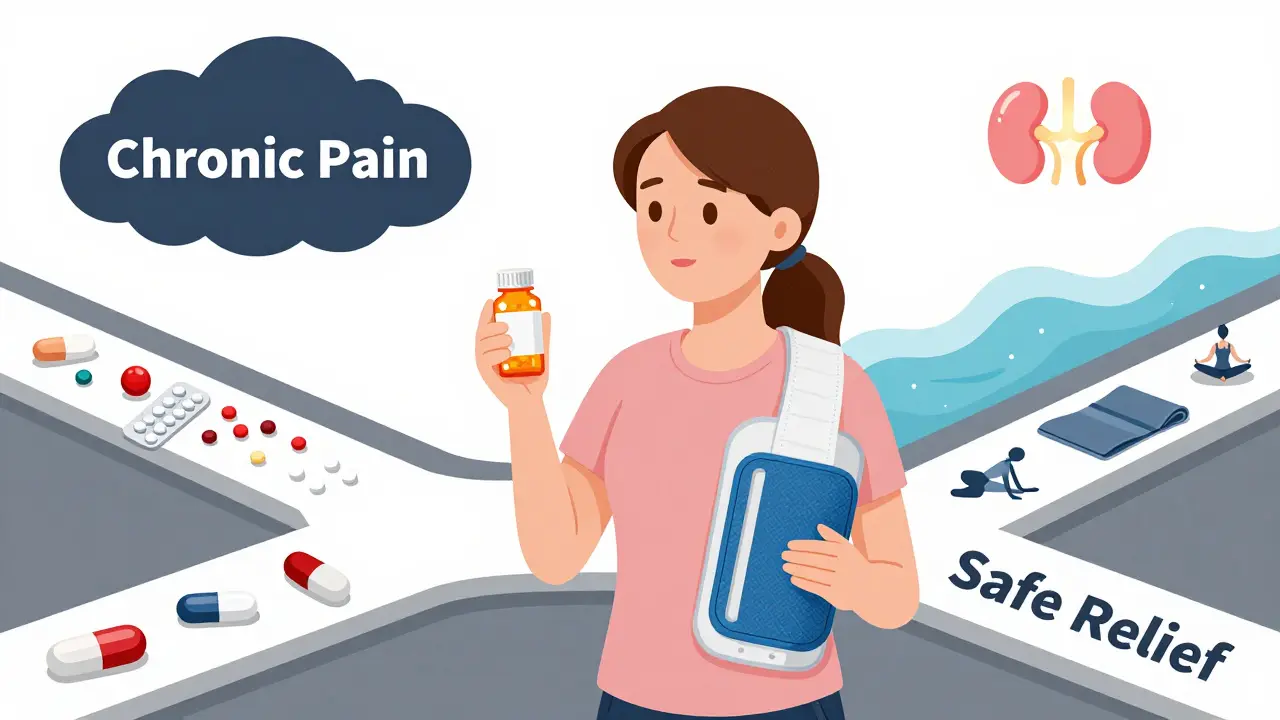
The American College of Rheumatology’s 2023 guidelines say this: Start with non-drug options first. Physical therapy. Heat wraps. Cognitive behavioral therapy. Give it 4-6 weeks. Many people find their pain improves without a single pill.
If you need medication:
- Use the lowest dose possible.
- Use it for the shortest time possible.
- Never take NSAIDs more than 3 days a week without talking to your doctor.
- Never exceed 3,000 mg of acetaminophen daily.
- Avoid combination pills with caffeine or codeine.
Topical NSAIDs-gels or patches-are a big win. A 2021 study showed they deliver the same pain relief as oral pills but with 90% less kidney exposure. For arthritis or muscle pain, a gel on your knee is far safer than popping a pill.
Heat therapy works too. FDA-cleared products like ThermaCare HeatWraps reduce osteoarthritis pain by 40-60% with zero kidney risk. They’re cheap, easy, and available at any pharmacy.
For migraines, newer prescription drugs like CGRP inhibitors (e.g., Aimovig, Emgality) have no kidney impact-but they cost $650 a month. For many, that’s not an option. But for those with chronic pain and early kidney damage? It’s life-changing.
What Happens If You Stop?
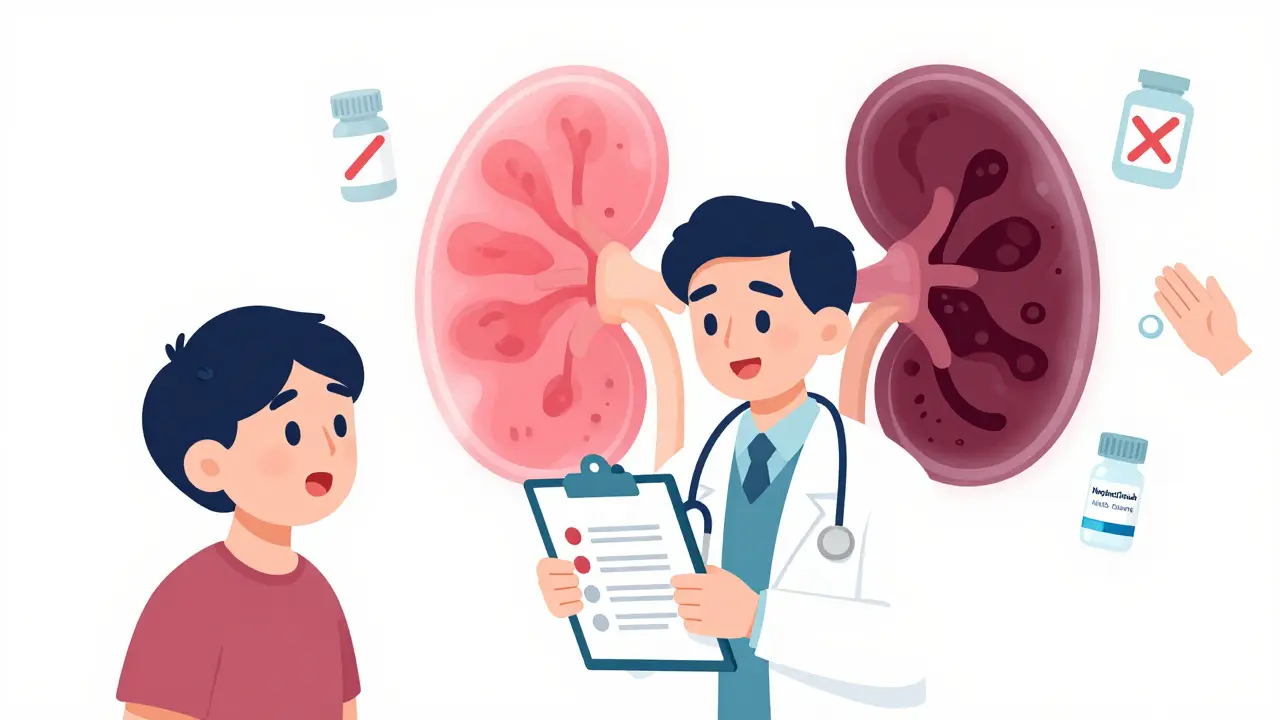
Here’s the good news: if you catch it early, your kidneys can recover.
A 2022 study followed 142 patients who stopped all analgesics after early diagnosis. After five years, 73% had stable kidney function. None got worse. Some even improved slightly.
That’s the power of stopping early. Your kidneys aren’t dead-they’re stressed. Remove the stress, and they can heal.
But stopping isn’t easy. A 2023 PatientsLikeMe survey found that 41% of patients struggled to manage pain after quitting NSAIDs. They felt abandoned. Their doctors didn’t have alternatives ready. That’s the gap we need to fix.
What Should You Do Right Now?
If you take painkillers regularly:
- Check your pill bottles. Are you taking combination products? Stop.
- Count your daily intake. Are you hitting 3,000+ mg of acetaminophen? Cut back.
- Track your NSAID use. Are you taking them more than 3 days a week? Talk to your doctor.
- Ask for a simple blood test: serum creatinine and eGFR. It takes 5 minutes. It could save your kidneys.
- Try heat therapy or physical therapy before reaching for the next pill.
And if you’re a doctor, nurse, or pharmacist? Don’t assume your patient knows the risks. Ask them: “How many pain pills do you take each week?” That one question could catch a case before it becomes a transplant.
Is There Hope for the Future?
Yes. The American Society of Nephrology has dedicated $12 million to developing “kidney-sparing analgesics”-new painkillers that don’t hurt the kidneys. AstraZeneca’s selepressin, tested in 2022, reduced kidney blood flow drops by 35% without losing pain relief. It’s not on the market yet, but it’s coming.
Meanwhile, the FDA has already updated NSAID labels to include kidney risk warnings. Manufacturers like Bayer and Johnson & Johnson have reformulated their combo pills to reduce acetaminophen and remove caffeine.
But technology alone won’t fix this. Education will. Awareness will. The next time you reach for a pill, ask: “Is this really necessary?”
Your kidneys don’t ask for much. Just a little respect. And a break from the daily grind of pills.
Can over-the-counter painkillers really cause kidney damage?
Yes. Taking NSAIDs like ibuprofen or naproxen daily for 3+ years, or more than 3,000 mg of acetaminophen daily for 5+ years, can cause chronic kidney damage known as analgesic nephropathy. This isn’t rare-it’s one of the most preventable causes of kidney disease.
Is acetaminophen safer than NSAIDs for the kidneys?
It’s less risky, but not safe. While NSAIDs reduce kidney blood flow directly, long-term high-dose acetaminophen (over 4,000 mg daily) still raises chronic kidney disease risk by 68%. The myth that acetaminophen is “kidney-safe” has led to widespread overuse.
What are the early signs of analgesic nephropathy?
There are usually no early symptoms. The first sign is often an abnormal blood test showing elevated creatinine or low eGFR. Later signs include high blood pressure, fatigue, swelling, or blood in the urine. By then, damage may already be advanced.
Can kidney damage from painkillers be reversed?
If caught early and you stop taking the painkillers, kidney function can stabilize-and in many cases, improve. A 2022 study found 73% of patients who stopped analgesics after early diagnosis had no further decline in kidney function over five years.
What are the best alternatives to NSAIDs for chronic pain?
Topical NSAID gels reduce kidney exposure by 90%. Heat therapy devices like ThermaCare HeatWraps reduce pain by 40-60% with zero kidney risk. Physical therapy, CBT, and low-impact exercise are proven long-term solutions. For migraines, CGRP inhibitors are effective and kidney-safe-but expensive.
Should I get tested if I take painkillers regularly?
Yes. If you take NSAIDs or acetaminophen more than 3 days a week for over a year, ask your doctor for a serum creatinine test and eGFR calculation. It’s simple, cheap, and could catch damage before it’s irreversible. The FDA recommends this for anyone on chronic pain meds.

Kevin Kennett
Man, I’ve been popping ibuprofen like candy for my back pain-3-4 a day for years. Never thought it’d wreck my kidneys. This post scared the shit out of me. Just got my creatinine checked this morning. Thank god I read this before it was too late.
Howard Esakov
Of course the FDA didn’t warn us properly. 🤦♂️ Big Pharma doesn’t want you to know that your Tylenol is slowly turning your kidneys into Swiss cheese. They’d rather sell you a $650 monthly drug than fix the damn system. Wake up, people.
Rhiannon Bosse
So let me get this straight-women are the main victims because they’re ‘managing pain’? 😂 Like, are we just supposed to suffer silently while men get to be the ‘strong’ ones who don’t take meds? Also, why is it always women who get blamed for overusing OTC stuff? My mom took Excedrin for migraines for 20 years and now she’s on dialysis. Who’s really to blame here? The woman who needed relief? Or the system that sold her poison as ‘safe’?
Ambrose Curtis
Just wanna say-this is real. My uncle had analgesic nephropathy. He took 6 Advil a day for 8 years for his arthritis. No symptoms till he passed out at the grocery store. eGFR was 22. They told him to stop everything cold turkey. He cried for weeks. No one gave him alternatives. Now he uses heat wraps and does yoga. His kidneys improved from 22 to 38 in 18 months. It’s not magic. It’s just stopping the poison. Also, topical NSAIDs? Game changer. I got the gel for my knee and I’m not popping pills anymore. Try it.
Linda O'neil
You got this. Seriously. If you’re reading this and you’re taking painkillers daily-don’t panic, just pause. Swap one pill for a heating pad. Try 10 minutes of stretching. Call your doc and ask for that creatinine test. Small steps. You don’t have to quit everything tomorrow. Just start being smarter. Your kidneys will thank you in 10 years.
James Dwyer
Just stopped my nightly ibuprofen. First night was rough, but I used a ThermaCare wrap and it actually worked better. Feels good to take control. No more guessing if I’m killing my kidneys.
jonathan soba
Interesting that the CDC data shows a rise in NSAID overuse, yet no public health campaign has been launched to address it. Meanwhile, pharmaceutical companies quietly reformulate products to reduce acetaminophen content-not because they care about kidneys, but because litigation risk is rising. The real issue isn’t patient ignorance. It’s corporate negligence masked as consumer choice.
Jeffrey Carroll
While the data presented is compelling and the recommendations are clinically sound, it is worth noting that individual variability in renal metabolism of NSAIDs and acetaminophen remains poorly characterized in the literature. The 68% increased risk cited for acetaminophen derives from a cohort with significant comorbidities and concurrent medication use, which may confound causality. A more nuanced approach to risk stratification-perhaps incorporating genetic markers like UGT1A6 polymorphisms-may be warranted before universal recommendations are issued. Nonetheless, the emphasis on non-pharmacological interventions is both prudent and aligned with current guidelines.