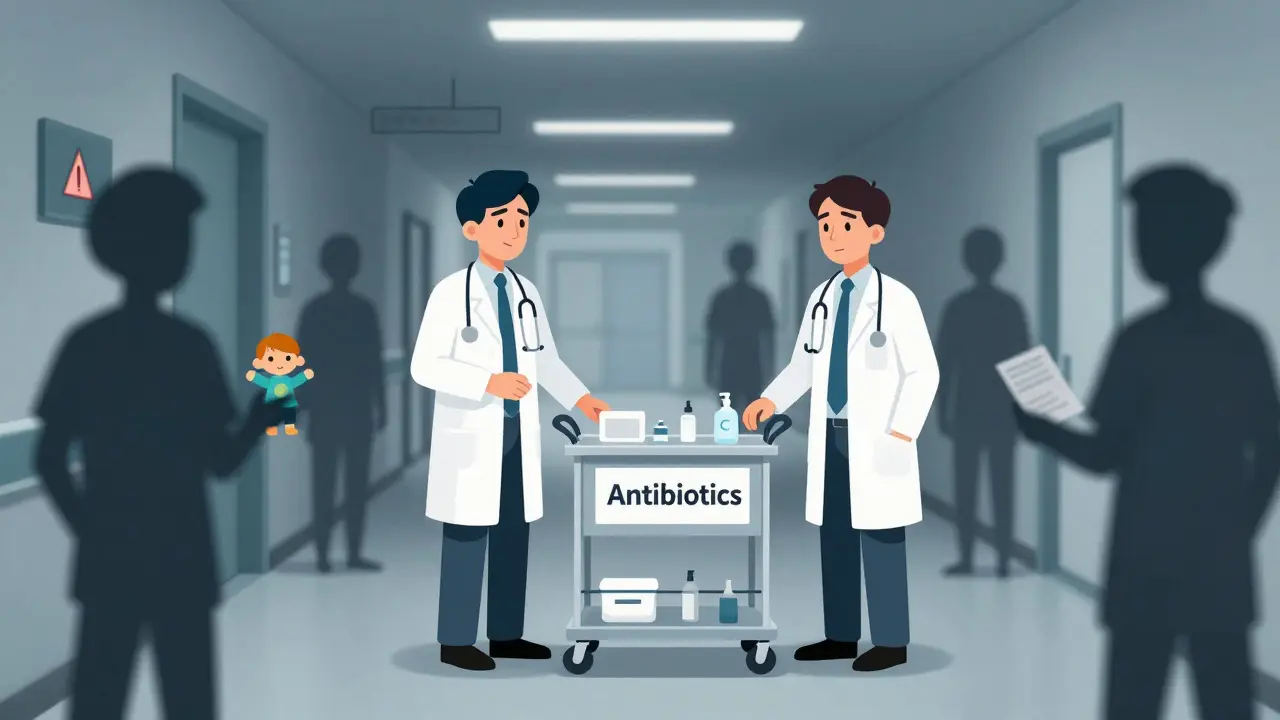
When antibiotics run out, lives are on the line. It’s not a hypothetical scenario - it’s happening right now. In hospitals from Brisbane to Bangalore, doctors are making impossible choices because the drugs they need to treat simple infections just aren’t available. A routine urinary tract infection, a child’s pneumonia, a post-surgery wound - all of these used to be manageable. Now, they’re becoming life-threatening because the antibiotics that should save them are in short supply.
Why Antibiotics Are Drying Up
Antibiotics aren’t like other medications. They’re cheap, mass-produced, and often generic. That sounds good - until you realize how little profit they make. Manufacturers don’t invest in them because the return is too low. While other drugs sell for hundreds or thousands of dollars per dose, a single dose of penicillin or amoxicillin costs pennies. With manufacturing costs rising - especially for sterile injectables - companies walk away. The result? Only a handful of factories worldwide make the most critical antibiotics. One breakdown. One regulatory shutdown. One geopolitical disruption - like Brexit - and supply chains snap.
Between 2019 and 2024, the global antibiotic market grew by just 1.2%. Compare that to the rest of the pharmaceutical industry, which grew at 5.7%. That gap isn’t an accident. It’s a system failure. The European Court of Auditors found that manufacturers simply don’t see the point in upgrading facilities when they can’t make enough money to cover the cost. In the U.S., the FDA tracked 147 active antibiotic shortages by the end of 2024. Globally, 37 antimicrobials were officially listed as in short supply as of May 2024. That’s not a glitch - it’s a pattern.
What Happens When Antibiotics Disappear
When penicillin G benzathine vanishes - a drug used to treat syphilis and prevent rheumatic fever - doctors have no substitute. Same with amoxicillin. When it disappeared in early 2023, use dropped by 55% across 22 databases. What replaced it? Broader-spectrum antibiotics like azithromycin and carbapenems. These are stronger. More expensive. And far more dangerous to use casually.
Here’s the real problem: using stronger antibiotics when you don’t need to is like using a sledgehammer to crack a nut. It kills off more bacteria - including the good ones - and pushes the bad ones to evolve. The World Health Organization found that in 2023, one in six bacterial infections worldwide were already resistant to antibiotics. For urinary tract infections? One in three. That’s not a future threat. That’s today’s reality.
Doctors are being forced into last-resort options. In California, a specialist told the APHA forum she had to use colistin - a toxic, kidney-damaging antibiotic - for a simple UTI because nothing else was available. In the UK, one physician wrote on Reddit that since Brexit, their hospital had to ration amoxicillin. Patients with ear infections got delayed treatment. Others were sent home with no antibiotics at all. In rural Kenya, nurses say they now send children home without treatment, knowing they might die from what should be a fixable infection.
The Global Divide
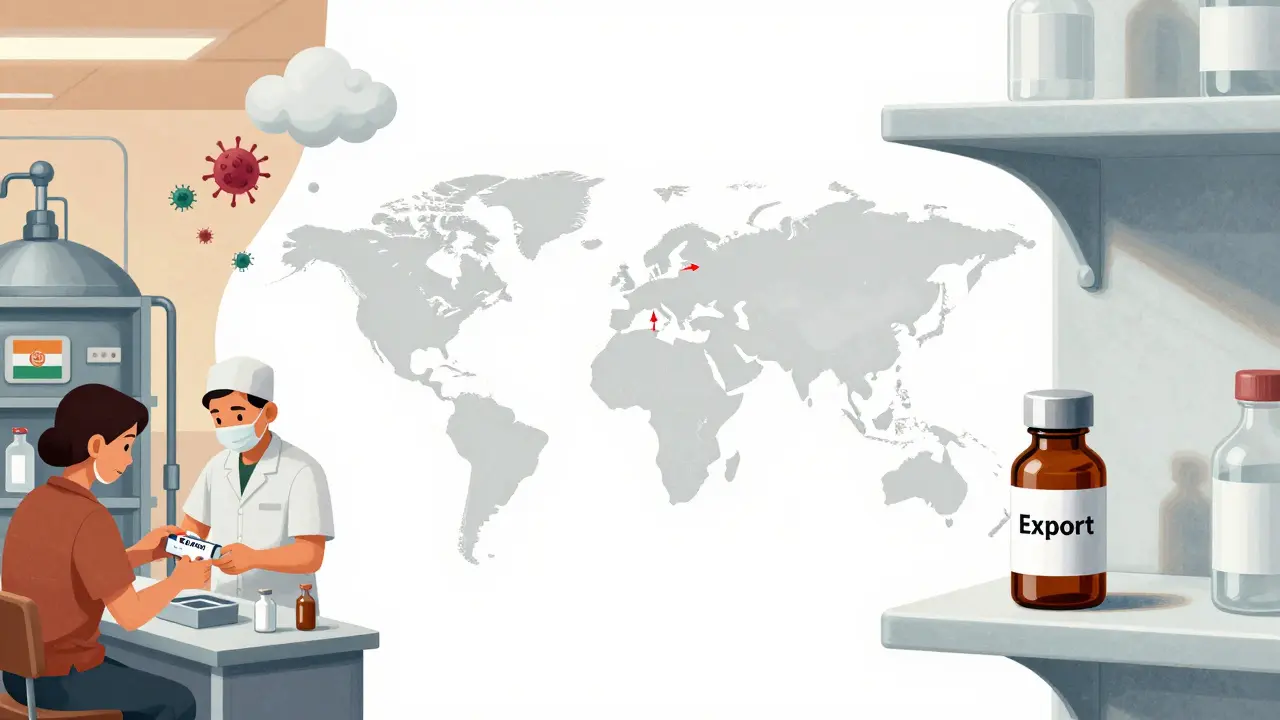
This isn’t just a rich-country problem. It’s worse where it hurts most. In low- and middle-income countries, 70% of antibiotics are already inaccessible. When shortages hit, there’s no backup. No import pipeline. No stockpile. The WHO calls this a "syndemic" - a deadly mix of antibiotic resistance and lack of access. In Mumbai, a mother reported her child’s pneumonia treatment was delayed 72 hours because azithromycin wasn’t available. The child ended up in intensive care.
Meanwhile, high-income nations scramble to import drugs from India and China - but those countries are also under pressure. Their factories are overworked. Their supply chains are stretched thin. And when they cut back, it ripples globally. The U.S. imported 60% of its antibiotics in 2024. When one supplier falters, entire hospitals go dark.
How Hospitals Are Trying to Cope
Some hospitals are adapting. Johns Hopkins set up an antimicrobial stewardship program (ASP) that uses rapid diagnostic tests to identify infections within hours, not days. That meant they could avoid broad-spectrum antibiotics 37% more often during shortages. Other hospitals created regional sharing networks. California’s network, launched in 2024, cut critical shortage impacts by 43% across 12 hospitals.
But these fixes are rare. A 2025 survey found that 78% of U.S. hospital pharmacists had to change treatment protocols because of shortages. 62% saw more patient complications. Pharmacists spent 22% more time just managing the crisis - not treating patients, but rationing pills, calling other hospitals, and pleading with distributors.
Even the best systems have limits. Rationing decisions are agonizing. Who gets the last dose? A 78-year-old with sepsis? A 5-year-old with pneumonia? There’s no algorithm for that. And every delay - every day a patient waits - increases the chance of death.
Who’s Responsible? And What’s Being Done?
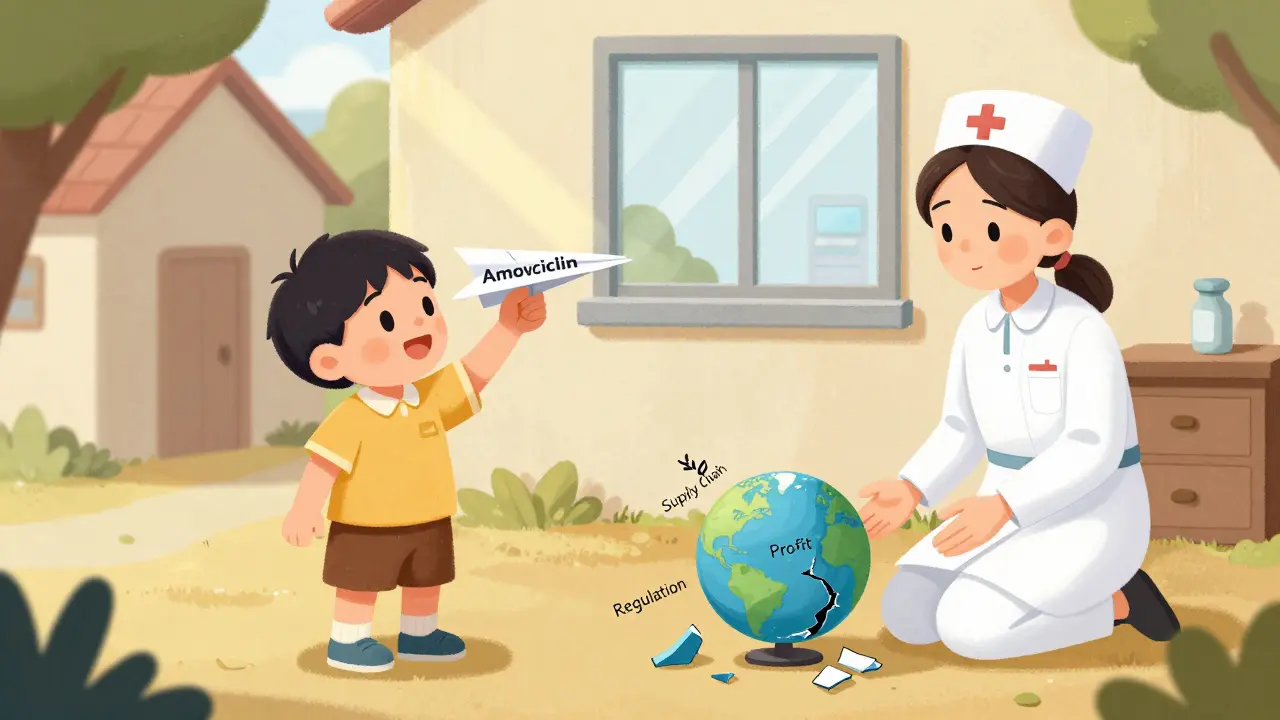
The problem isn’t just lack of supply. It’s lack of will. Regulatory agencies know the risks. The WHO, the FDA, and the European Medicines Agency have all warned that manufacturing facilities need upgrades. But no one pays for them. The industry says: "We can’t make money on these drugs." Governments say: "We can’t force companies to lose money."
There are glimmers of change. In October 2025, the WHO announced a five-point action plan, including a $500 million Global Antibiotic Supply Security Initiative funded by G7 nations. The U.S. FDA approved two new manufacturing facilities in January 2025 - expected to restore 15% of lost supply by late 2025. The European Commission is rolling out new rules to guarantee minimum stockpiles by 2026.
But these are baby steps. The Review on Antimicrobial Resistance predicts that without major intervention, global shortages will grow by 40% by 2030 - leading to 1.2 million extra deaths each year from infections we know how to treat. Right now, only 58% of global antibiotic use comes from the "Access" group - the safer, cheaper, first-line drugs the WHO wants to prioritize. Their goal? 70% by 2030. We’re falling short.
The Real Cost
Every time an antibiotic runs out, it’s not just a delay. It’s a domino effect. Patients get sicker. Hospitals get overcrowded. Costs rise. Resistance spreads. And the cycle gets worse.
It’s not about politics. It’s not about profit margins. It’s about the woman in Brisbane whose child can’t get amoxicillin because it’s been rationed for three months. It’s about the nurse in Nairobi who has to tell a mother, "We don’t have the medicine." It’s about the doctor who knows the right drug is in a warehouse - but the truck never arrived.
Antibiotics are the foundation of modern medicine. Without them, surgeries become dangerous. Chemotherapy becomes deadly. Even a cut on your hand can turn fatal. We’ve taken them for granted for decades. Now, we’re paying the price.

Laura Gabel
This is why we need to stop outsourcing everything. We used to make antibiotics in America. Now we're begging India for pills. Pathetic.
Jeremy Van Veelen
Let me be blunt: this isn't a supply chain issue-it's a moral collapse. We've turned life-saving drugs into commodities to be optimized away by VCs who think 'margin expansion' is a real word. The fact that we're rationing penicillin in 2025 is the equivalent of letting fire extinguishers rust because they're 'not profitable enough.' We're not just failing healthcare-we're failing humanity.
Kal Lambert
Hospitals are doing what they can. Stewardship programs work. But they need funding. Not just talk.
jerome Reverdy
The real issue is systemic. We’ve built a pharma model that incentivizes blockbuster drugs over essential meds. It’s not that companies are evil-it’s that the market structure is broken. We need push-pull incentives: advance market commitments, public manufacturing hubs, and mandatory stockpiles. This isn’t rocket science. It’s economics 101.
MALYN RICABLANCA
I'm not saying this is a conspiracy... but have you ever noticed how every time a shortage hits, the price of azithromycin spikes 300% on the gray market? Coincidence? I think not. Someone's making bank off suffering. And no one's问责.
Justin Archuletta
We can fix this. Let's just do it. 🙏
Sanjana Rajan
America's problem. You guys have money but you're too lazy to make your own meds. Meanwhile, we in India are actually producing them. Stop whining.
Amadi Kenneth
This is all a WHO-CDC-FDA-Pfizer collusion. They want you dependent. They want you afraid. They want you to believe you need their pills. The truth? Your body can heal itself. Antibiotics are a scam. I’ve cured my UTI with garlic and prayer. 🌿🪄
Andrew Mamone
I’m not surprised. We’ve been treating antibiotics like toilet paper-use it, throw it, never think about where it came from. Now we’re out. And it’s not just about drugs. It’s about how we value life. 🤕💔
Melissa Starks
I just want to say, as someone who’s been in the ER for 18 years, this is the most heartbreaking thing I’ve seen. Not the trauma, not the overdoses-this. Watching a 4-year-old with pneumonia because mom couldn’t get amoxicillin? I cried. I cried so hard I had to go to the bathroom. And then I called three other hospitals. And then I cried again. We’re not just losing drugs. We’re losing our soul.
Emily Hager
It is, however, imperative to note that the structural underpinnings of pharmaceutical capitalism have, in fact, precipitated a cascading failure of public health infrastructure, wherein the commodification of essential therapeutics has rendered their availability contingent upon profit-driven decision-making matrices, which are inherently antithetical to the ethical imperatives of medical necessity.
Lauren Volpi
I mean, if we just stopped having kids, we wouldn't need antibiotics. Problem solved. 😌
Kyle Young
It's curious how we treat antibiotics as disposable, yet we build monuments to people who invented them. We venerate Fleming, but we let his discovery rot on warehouse shelves because it doesn't generate a 20% ROI. What does that say about our values? Are we a civilization that honors life-or just the metrics of it?
Melissa Stansbury
I just read this and I feel so sad. Like, physically sad. Like my chest hurts. I don't know why. Maybe because I had pneumonia as a kid and my mom got me amoxicillin and I'm alive today? I don't know. But I just want someone to fix this. Please. 💔
cara s
While it is undeniably true that the current paradigm of pharmaceutical manufacturing is predicated upon profit maximization, one must also consider the broader sociopolitical implications of global supply chain fragility. The confluence of regulatory fragmentation, geopolitical instability, and the erosion of domestic manufacturing capacity has created a perfect storm wherein even the most rudimentary antibiotics are subject to systemic vulnerability. This is not merely a medical issue; it is a civilization-level failure of foresight.