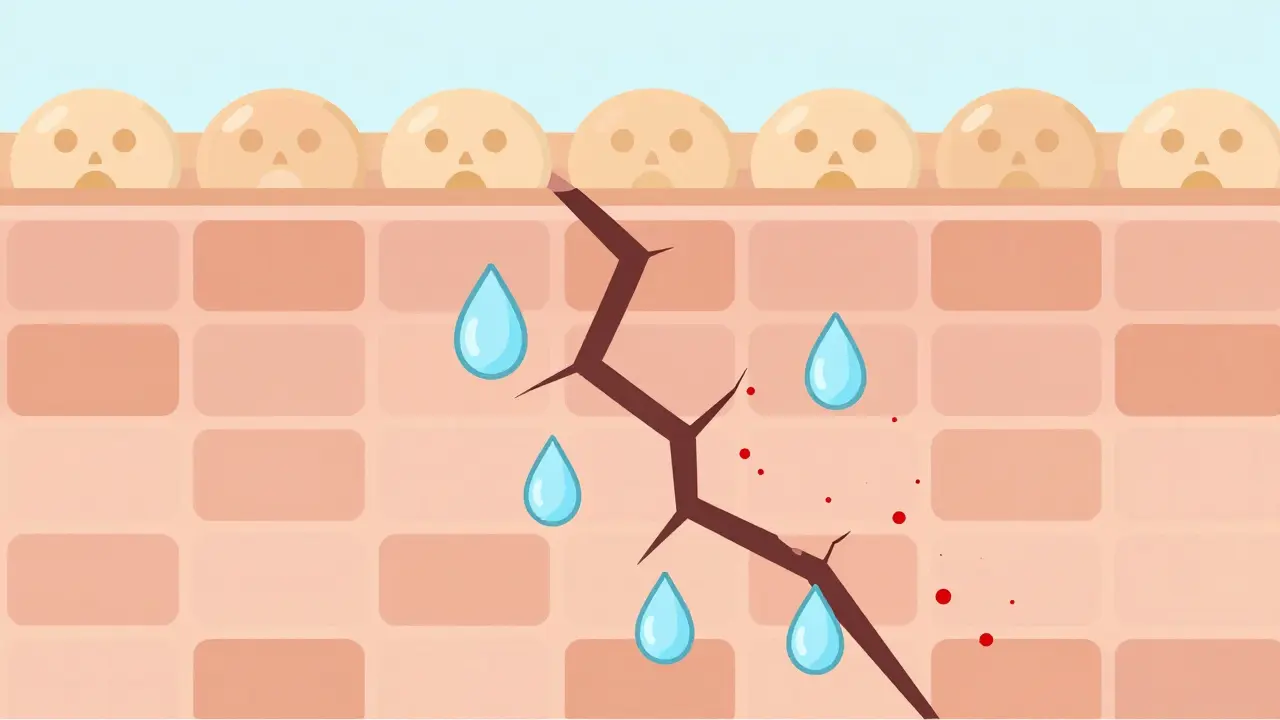
Your skin is not just a covering; it is a fortress. In people with eczema, also known as atopic dermatitis, that fortress has cracks. Water escapes through these gaps, causing dryness, while irritants and allergens slip in, triggering inflammation and itching. This isn't just about being "dry." It is a structural failure of the stratum corneum, the outermost layer of your skin.
Think of healthy skin like a brick wall. The "bricks" are dead skin cells called corneocytes. The "mortar" holding them together is a complex mix of lipids-fats-that keep everything tight and sealed. In eczema, this mortar is missing key ingredients. Specifically, you are low on ceramides. Research shows that people with atopic dermatitis have 30-50% fewer ceramides than those with healthy skin. Without enough of this glue, your skin barrier leaks. Transepidermal water loss (TEWL) spikes by 40-60%, leaving you parched and vulnerable to infection.
The Science of the 3:1:1 Ratio
You might think any moisturizer will do, but the chemistry matters more than you realize. The lipid mortar isn't just random fat. It requires a precise mixture of three components: ceramides, cholesterol, and free fatty acids. Studies published in the Journal of Investigative Dermatology confirm that the optimal molar ratio for repairing the skin barrier is 3:1:1. That means three parts ceramide, one part cholesterol, and one part free fatty acid.
Why does this specific ratio matter? Because applying these ingredients individually can actually hurt your progress. Research by Menon et al. (2012) found that using ceramides alone, or cholesterol alone, can encumber barrier recovery by 15-25% compared to doing nothing. The molecules need each other to form the proper lamellar bilayers-the layered sheets that create the waterproof seal. When you use a product with the correct physiological ratio, you aren't just coating your skin; you are rebuilding its architecture.
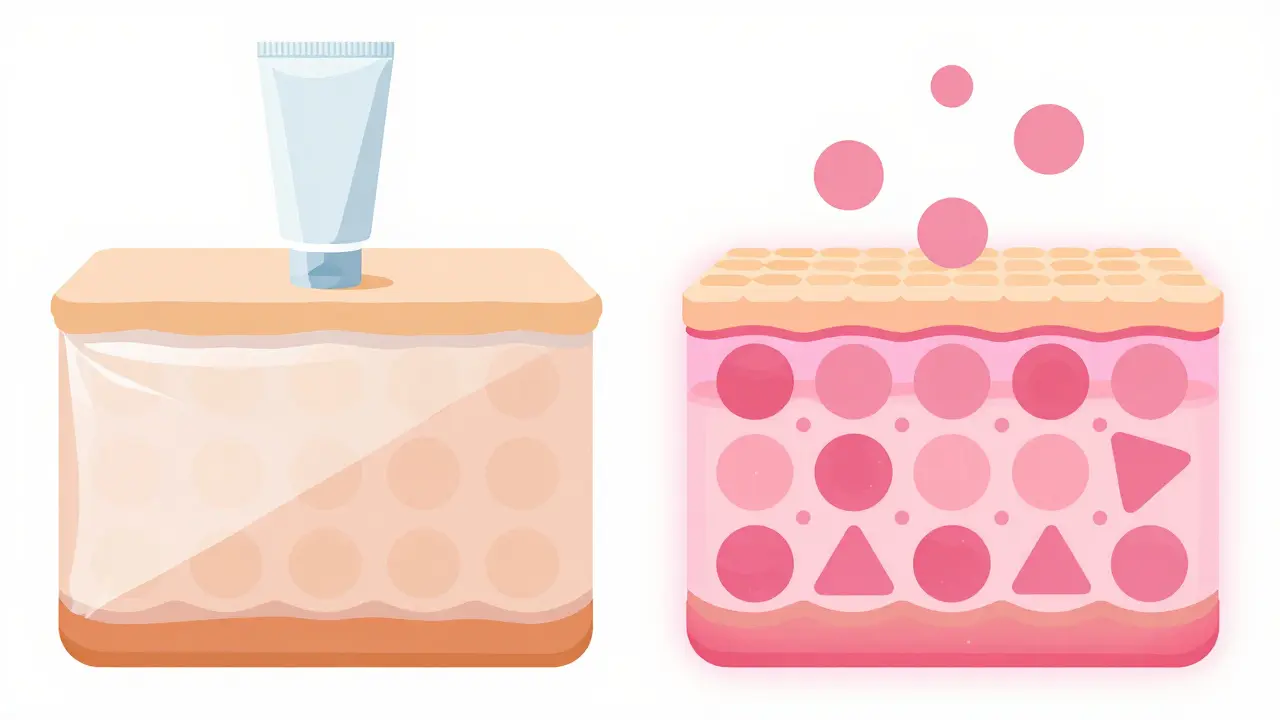
Not all ceramides are created equal, either. There are natural physiological ceramides and synthetic versions often called pseudo-ceramides. A 2021 review in the journal Cells highlighted that formulations using true physiological ceramides demonstrated 40% greater barrier repair capacity than traditional petrolatum-based moisturizers. Petrolatum works as an occlusive-it sits on top of the skin to trap water-but it doesn't fix the underlying structural defect. Ceramide-dominant emulsions go deeper, integrating into the skin matrix to provide sustained repair for over 72 hours.
Bathing Right: The Soak and Seal Method
Even the best ceramide cream won't work if your bathing habits are stripping your skin. Many people with eczema avoid baths because they feel worse afterward, but the problem usually lies in how they bathe, not the bath itself. The gold standard protocol recommended by dermatologists is the "soak and seal" method.
Here is how to do it correctly:
- Keep it lukewarm: Hot water strips natural oils and increases inflammation. Aim for a temperature no higher than 32°C (90°F). If it feels hot to the touch, it’s too hot.
- Limit the time: Stay in the water for only 10-15 minutes. Longer soaks can lead to maceration, where the skin gets too soggy and weak.
- Choose the right cleanser: Use a fragrance-free, pH-balanced cleanser (around pH 5.5). Avoid products with high concentrations of sodium lauryl sulfate (SLS), which can increase TEWL by up to 40% within an hour. Look for formulas with less than 0.5% SLS or none at all.
- Pat, don’t rub: When you get out, gently pat your skin dry with a soft towel. Leave it slightly damp.
- Seal immediately: This is the critical step. Apply your ceramide-rich emulsion within three minutes of getting out of the bath. Applying product to damp skin increases absorption by 50-70% according to research by Choi et al. (2016). You are trapping that water inside your newly repaired barrier.
This routine takes some discipline. A survey by Galderma noted that 32% of new users find applying thick creams to wet skin difficult. But sticking to this schedule twice daily, or three times during flares, leads to visible improvement in 21-28 days.

Creams vs. Lotions: What Actually Works?
Walking down the skincare aisle can be overwhelming. You see dozens of brands promising relief. How do you know which one helps your barrier? Let's look at the data comparing traditional moisturizers with specialized barrier repair agents.
| Feature | Traditional Petrolatum | OTC Ceramide Creams (e.g., CeraVe) | Prescription Barrier Repair (e.g., EpiCeram®, TriCeram®) |
|---|---|---|---|
| Mechanism | Occlusive (blocks water loss temporarily) | Lipid replacement (variable ratios) | Physiological lipid restoration (3:1:1 ratio) |
| TEWL Reduction | 20-30% | Variable | 35-50% |
| Duration of Effect | Short-term | Moderate | 72+ hours |
| Clinical Evidence | Basic hydration | Consumer satisfaction | FDA-cleared medical device status |
| Cost (approx.) | $5-$15 per tube | $15-$25 per tube | $25-$35 per tube |
Products like EpiCeram® and TriCeram® are classified as Class II medical devices by the FDA. This means they underwent rigorous testing to prove they repair the barrier, not just moisturize it. In clinical trials, TriCeram showed 30% greater improvement in stratum corneum hydration compared to conventional emollients. However, there is a catch: cost and coverage. As of 2023, only 42% of US commercial insurance plans cover these prescription products. For many, over-the-counter options like CeraVe are a practical middle ground, capturing 60% of the sensitive skin market. Just remember Dr. Amy Paller’s warning: check the ingredient list. If the ceramides are buried deep in the list, the concentration might be too low to make a real difference.
Managing Expectations and Flares
If you are having a severe flare-up with open, weeping, or intensely inflamed skin, barrier repair creams alone may not be enough. These products are designed for long-term maintenance and structural healing, not acute symptom suppression. Topical corticosteroids still play a role in calming sudden inflammation, providing relief within 3-7 days. Barrier repair agents take 4-6 weeks of consistent use to show significant clinical improvement.
The goal is to use the steroid to put out the fire, and the ceramide cream to rebuild the house. One case study documented in the Dermatology Online Journal followed a patient who reduced her steroid use from daily to once weekly after eight weeks of consistent EpiCeram application. Her SCORAD index (a measure of disease severity) dropped from 42 to 18. This synergy is key. Don't stop your prescribed medications without talking to your doctor, but add the barrier repair strategy to reduce your reliance on steroids over time.
User experiences online reflect this timeline. On Reddit’s r/eczema community, 78% of commenters reported significant improvement in dryness and itching within 2-4 weeks. Common complaints include the greasy texture of some prescriptions and the slow initial results. But those who stick with the routine often report breaking the cycle of itch-scratch-damage. You are essentially retraining your skin to function normally again.
Future Trends in Barrier Repair
The science of eczema management is moving fast. We are seeing a shift toward personalized medicine. New developments include biomarker-guided formulations that target specific ceramide deficiencies. For example, some patients lack ceramide 1 specifically, while others are short on different types. Phase II trials by companies like LEO Pharma suggest that targeting these specific deficits could yield 30% greater efficacy than broad-spectrum treatments.
Delivery systems are improving too. Encapsulated ceramides in multi-vesicular emulsions are now shown to deliver 45% more active ingredient to the stratum corneum than older formulas. And packaging matters-new pump dispensers for prescription creams have reduced product waste by 22%, making expensive treatments last longer. As Dr. Thomas Bieber predicted in Nature Reviews Immunology, within five years, biomarker-guided barrier repair could become as standard as biologic selection for moderate-to-severe cases.
For now, focus on what you can control. Get the ratio right. Keep your baths cool and short. Seal in moisture while your skin is damp. Your skin barrier is resilient; give it the right tools, and it will heal.
How long does it take for ceramide creams to work on eczema?
Most patients see visible improvement in skin hydration and reduction in itching within 21 to 28 days of consistent twice-daily use. Significant structural repair of the skin barrier typically requires 4 to 6 weeks. They are not instant fixes like topical steroids, which work in days, but they provide longer-lasting results.
What is the "soak and seal" method?
The soak and seal method involves taking a short (10-15 minute) lukewarm bath to hydrate the skin, gently patting it dry until slightly damp, and then immediately (within 3 minutes) applying a moisturizer or barrier repair cream. This traps water in the skin and enhances product absorption by up to 70%.
Are prescription ceramide creams worth the extra cost?
Prescription creams like EpiCeram and TriCeram contain the clinically proven 3:1:1 ratio of ceramides, cholesterol, and fatty acids required for optimal barrier repair. They have been tested as medical devices and show superior TEWL reduction compared to many OTC options. If insurance covers them, they are highly effective. If not, high-quality OTC brands that list ceramides early in their ingredients can be a viable alternative.
Can I use ceramide creams during an acute eczema flare?
Yes, but they may not provide immediate relief for intense inflammation or pain. During a severe flare, doctors often recommend combining barrier repair creams with topical corticosteroids or calcineurin inhibitors. The steroid calms the immune response quickly, while the ceramide cream begins the long-term process of fixing the skin structure.
Why is the 3:1:1 ratio important?
The skin's natural lipid barrier consists of ceramides, cholesterol, and free fatty acids in a specific 3:1:1 molar ratio. Research shows that applying these lipids in this exact proportion allows them to integrate properly into the skin's layers. Using them in incorrect ratios or individually can actually hinder barrier recovery.
