
For decades, people with migraine had to make do with drugs not even designed for their condition. Antidepressants. Blood pressure pills. Seizure meds. These were the go-to options when headaches became too frequent, too painful, too life-stealing. Then, in 2018, everything changed. The first CGRP inhibitors hit the market - the very first migraine-specific preventive medications ever developed. No more guessing. No more off-label use. Just science built for one thing: stopping migraine before it starts.
What Exactly Are CGRP Inhibitors?
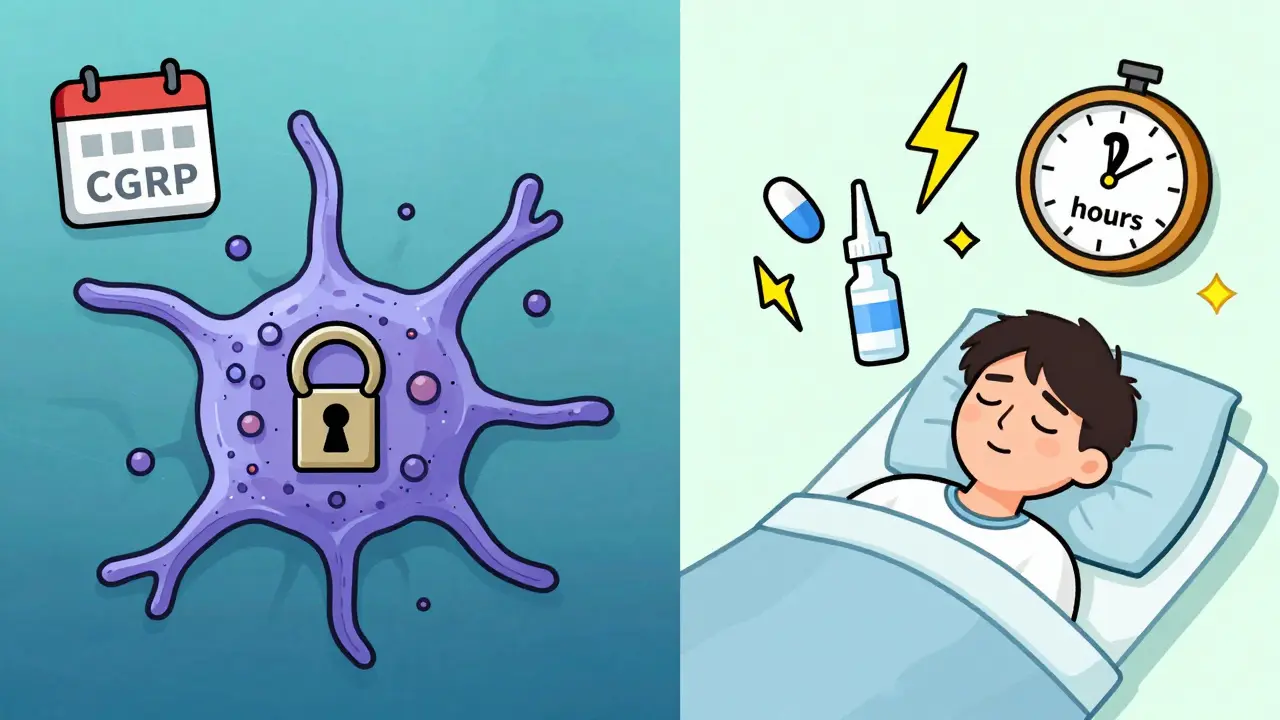
CGRP stands for Calcitonin Gene-Related Peptide. It’s a tiny protein in your nervous system that becomes overactive during a migraine attack. Think of it like a fire alarm that won’t stop ringing. When CGRP floods your brain and blood vessels, it triggers inflammation, pain signals, and the throbbing, nausea, and light sensitivity that define a migraine. CGRP inhibitors block this signal - either by locking onto the CGRP protein itself or by blocking its receptor so the signal can’t get through. There are two main types:- Monoclonal antibodies (mAbs): These are injected under the skin. They’re big molecules that last weeks in your body. Examples include Aimovig (erenumab), Ajovy (fremanezumab), Emgality (galcanezumab), and Vyepti (eptinezumab).
- Gepants: These are small pills or nasal sprays. They work faster and are used for both preventing migraines and treating them when they strike. Examples: Nurtec ODT (rimegepant), Ubrelvy (ubrogepant), Zavzpret (zavegepant).
Before these drugs, if your migraine count was eight days a month, you might’ve hoped to get it down to five. With CGRP inhibitors, many patients drop to four or fewer. Some go from chronic (15+ days a month) to episodic (fewer than 15). That’s not just a reduction - it’s a life reset.
How Effective Are They?
The numbers speak for themselves. In clinical trials, about half of all users cut their migraine days by at least half. That’s a 50% responder rate - higher than any older preventive drug. For chronic migraine sufferers, 84% saw fewer headache days. For those with episodic migraine, it was 88%.One head-to-head study compared Aimovig to topiramate, a common old-school preventive. Result? 41% of people on Aimovig cut their migraine days by 50% or more. Only 24% did on topiramate. And topiramate comes with brain fog, tingling, weight loss - side effects that make people quit. CGRP inhibitors? Most tolerate them well.
Real-world data backs this up. A 2023 survey of over 1,200 migraine patients found 78% rated CGRP inhibitors as “very effective” or “effective.” On Reddit’s r/migraine community, 82% of posts were positive. One user wrote: “Went from 20 migraine days to 5 with Aimovig.” Another: “After 15 years of chronic migraine, Emgality got me down to episodic in 3 months. Life-changing.”
How Do You Take Them?
It’s not one-size-fits-all.- Monoclonal antibodies: Injected monthly or quarterly. Aimovig is a monthly shot. Ajovy can be monthly or every three months. Vyepti is an IV infusion every three months. No daily pills. No remembering to take something every morning.
- Gepants: Nurtec ODT is a dissolving tablet you take every other day for prevention. You can also use it to stop a migraine in its tracks. Ubrelvy is an oral tablet for acute attacks. Zavzpret is a nasal spray you use when a migraine hits.
Some people prefer the convenience of a monthly shot. Others like the flexibility of a pill they can take only when needed. The choice depends on your lifestyle, your migraine pattern, and what your doctor thinks will work best.
How Do They Compare to Old Treatments?
Old preventives - like beta-blockers (propranolol), antiseizure drugs (topiramate, valproate), or antidepressants (amitriptyline) - were never meant for migraine. They were repurposed. And they came with baggage: weight gain, memory issues, fatigue, dizziness, even liver damage.CGRP inhibitors don’t cause those problems. They don’t constrict blood vessels like triptans, so they’re safe for people with heart disease or stroke risk. They don’t interact badly with most other medications. And they don’t cause medication overuse headache - a common trap with daily painkillers.
But they’re not magic. If you only get two migraines a month, you probably won’t see a big difference. They work best for people with four or more headache days a month. And they’re not meant to stop an attack once it’s already raging - unless you’re using a gepant like Nurtec or Zavzpret, which can do both.
Cost and Insurance: The Big Hurdle
Let’s be real: these drugs are expensive. Monoclonal antibodies cost $650-$750 per month. Gepants run $800-$1,000. That’s three to five times more than a generic beta-blocker.But here’s the catch: most U.S. insurance plans cover them - if you jump through hoops. Prior authorization is almost always required. You might need to try and fail on two older drugs first. That’s frustrating. But manufacturers have patient assistance programs. If you qualify, they can cover 80% or more of your out-of-pocket cost. Some even help with insurance appeals.
And it’s getting easier. In 2023, 87% of neurologists said they now consider CGRP inhibitors a first-line option - no need to fail on older drugs first. That’s a huge shift. More doctors are pushing back on insurance denials. More patients are winning appeals. The tide is turning.
Who Benefits the Most?
These drugs shine brightest for:- People with chronic migraine (15+ headache days a month)
- Those with medication overuse headache (taking pain meds too often)
- Patients with heart disease or stroke risk who can’t use triptans
- People who’ve tried at least two other preventives and failed
- Anyone who wants to avoid daily pills with side effects
They’re less helpful for people who only get migraines once or twice a month. And they’re not for everyone. If you’re pregnant, breastfeeding, or under 18, use is limited (though pediatric trials are underway). Liver issues? Avoid ubrogepant and rimegepant unless your doctor monitors you closely.

What About Side Effects?
Most people feel nothing. The most common issue? Injection site reactions - redness, itching, or soreness where you poke yourself. About 1 in 4 people report this. It’s usually mild and fades.Constipation happens in a small number of people on monoclonal antibodies. Rarely, there’s a risk of allergic reaction. For gepants, liver enzymes can rise slightly - so blood tests are recommended if you’re on them long-term.
And here’s the good news: only 0.8% of people in trials stopped taking these drugs because of side effects. Compare that to topiramate, where up to 20% quit due to brain fog or tingling.
The Future: What’s Next?
CGRP inhibitors are still young. But the research is exploding.- Combination therapy: Some doctors now pair CGRP mAbs with Botox. One 2022 study showed 63% of patients hit the 50% reduction mark with both - far better than either alone.
- New delivery methods: Nasal sprays and patches are in testing. Imagine a CGRP patch you stick on once a week.
- Pediatric use: Erenumab is being tested in teens. Early results look promising.
- Expanded uses: Trials are underway for vestibular migraine, post-concussion headaches, and cluster headaches.
By 2030, experts predict CGRP inhibitors will be the standard of care for most migraine patients. And if current trends hold, we’ll see cheaper biosimilars after 2028 - when patents expire.
Getting Started
If you’re considering CGRP inhibitors:- Track your headaches for at least a month. Use an app or journal. Note frequency, duration, triggers.
- See a neurologist or headache specialist. Not all doctors know these drugs well - find one who does.
- Ask about insurance coverage. Most manufacturers have support teams that help with prior auth.
- Try one. Give it three months. These aren’t instant. They build up over time.
- Be patient. If one doesn’t work, another might. There are seven FDA-approved options. You’re not stuck with the first one.
This isn’t just another drug. It’s the first time migraine has been treated like the neurological disease it is - not a bad headache you just need to push through. For millions of people, CGRP inhibitors mean fewer missed workdays, less fear of the next attack, and the quiet joy of waking up without pain.
Are CGRP inhibitors safe for long-term use?
So far, yes. Data from clinical trials and real-world use show no major safety concerns after five years. No increased risk of heart attack, stroke, or liver damage. The most common side effects - like injection site reactions or mild constipation - are manageable. Long-term studies are still ongoing, but experts consider them among the safest migraine preventives available today.
Can I use CGRP inhibitors with other migraine meds?
Yes. CGRP inhibitors don’t interact badly with most other drugs. You can still use triptans, NSAIDs, or anti-nausea meds for acute attacks. Some people even combine them with Botox for chronic migraine. The only exception is with gepants - don’t take more than one gepant at a time. Always check with your doctor before mixing treatments.
Do I have to take CGRP inhibitors forever?
Not necessarily. Many patients stay on them long-term because they work so well. But if your migraines improve significantly, your doctor might suggest trying to taper off. Some people successfully stop and stay in remission. Others relapse and restart. It’s a personal decision based on your history and how your body responds.
Why are these drugs so expensive?
They’re biologics - complex molecules made using living cells. Manufacturing them is costly. Plus, they’re new, with patents protecting them until 2028. No biosimilars exist yet. While the price seems high, many patients pay far less thanks to insurance and manufacturer assistance programs. In 2023, 80% of eligible patients got their out-of-pocket cost reduced to under $50 a month.
Do CGRP inhibitors work for migraine with aura?
Yes. Clinical trials included patients with and without aura, and the drugs worked equally well for both. Aura doesn’t make them less effective. In fact, many patients with aura say these are the first preventives that truly helped them - because older drugs often made aura worse.
Can I use CGRP inhibitors if I’m pregnant or planning to get pregnant?
There isn’t enough data yet to say they’re safe during pregnancy. Most doctors recommend stopping them if you’re trying to conceive or already pregnant. If you’re on one and want to get pregnant, talk to your doctor about switching to a safer option. Research is underway, and pediatric trials are already showing promise for teens - so future data may change recommendations.
How quickly do CGRP inhibitors start working?
It varies. Some people notice a difference in the first week. For most, it takes 2-3 months to see full effect. Monoclonal antibodies build up slowly in your system. Gepants work faster - Nurtec can reduce migraine frequency within days when taken every other day. Don’t give up if you don’t feel better right away. These drugs need time to work.

Ben Harris
finally something that actually works why did it take this long
my mom used to force me to take topiramate and i swear i forgot how to speak for six months
Jason Jasper
I’ve been on Aimovig for 11 months. Migraines dropped from 18 to 3 a month. No brain fog. No weight loss. Just... quiet. I didn’t realize how loud my life had been until it stopped.
Zabihullah Saleh
you know what’s wild? this isn’t just medicine. it’s validation. for decades we were told it was stress or bad posture or just being dramatic. now we have a protein named after us. that’s power.
Winni Victor
oh great another $800 pill for rich people who can afford to not work
my insurance made me try 7 other drugs first and then denied it anyway
so now i’m just sitting here with a headache and a coupon for expired ibuprofen
Lindsay Hensel
The clinical data is unequivocal. Efficacy rates surpass prior pharmacological interventions by a statistically significant margin. Safety profiles remain favorable across longitudinal observation.
Harbans Singh
in india we still use aspirin and hope. but i read this and i cried. not because i can’t afford it. because someone finally listened to people like us.
Justin James
they say it’s science but have you seen the patent filings? the same pharma execs who pushed opioids are pushing this. they want you hooked on monthly shots so they can charge $900 a month forever. it’s not medicine. it’s a subscription model disguised as hope.
Rick Kimberly
The mechanism of action is elegant. By targeting CGRP receptors with monoclonal antibodies, the pathophysiological cascade is interrupted at a molecular level without systemic immunosuppression. This represents a paradigm shift.
Terry Free
so you’re telling me i’m supposed to pay a thousand bucks to not feel like my skull is being split open
but i’m not allowed to take tylenol because i might get a rebound headache
cool. thanks for the life hack
sagar patel
I used Nurtec for three months. Migraine days dropped from 16 to 4. No side effects. No drama. Just relief. I’m not impressed. I’m just grateful.
Linda B.
they’re testing it on teens now but they won’t tell you the real reason
they’re preparing for the next generation of migraine slaves
they want us to grow up thinking this is normal
and then they’ll sell us the patch version next year
Christopher King
you think this is progress? this is just capitalism wearing a lab coat. they took a protein we didn’t even know about five years ago and turned it into a billion-dollar product. meanwhile the people who can’t afford it are still sleeping in dark rooms wondering if they’ll ever wake up without pain. this isn’t science. it’s exploitation dressed up as hope.
Bailey Adkison
if you’re not on a gepant you’re doing it wrong
monoclonals are for people who like needles and waiting
if you can take a pill that stops an attack AND prevents them
why are you still injecting yourself every month
Michael Dillon
i’ve been on Emgality for 8 months. used to miss 20 days of work a year. now i’m at 3. i’m not crying. i’m not celebrating. i’m just... alive. and that’s enough.