
More than half of people taking opioids for chronic pain experience constipation so bad they consider stopping their medication. It’s not just opioids-antihistamines, blood pressure pills, antidepressants, and even iron supplements can slow your gut to a crawl. This isn’t normal aging or poor diet. This is medication-induced constipation, a direct side effect of drugs designed to help you, not hurt you. The problem? Most doctors don’t warn you about it. And most over-the-counter remedies won’t fix it.
Why Your Pills Are Slowing You Down
Not all constipation is the same. When you’re constipated because you ate too little fiber or didn’t drink enough water, a prune or a fiber supplement might help. But when it’s caused by medication, the issue is deeper. Your gut nerves are being blocked, your muscles aren’t contracting, and your body isn’t secreting the fluids needed to move stool along. Opioids like oxycodone and morphine bind to receptors in your intestines. These same receptors that dull pain in your brain also tell your gut to stop moving. Result? Food takes longer to pass, water gets sucked out of your stool, and you’re left with hard, painful pellets. Studies show 40-60% of people on long-term opioids develop this. It’s so common, it’s practically expected. Anticholinergic drugs-like diphenhydramine (Benadryl), some antidepressants, and bladder medications-block acetylcholine, a chemical your gut needs to contract. That’s why you get dry mouth and constipation from the same pill. Antipsychotics like clozapine do the same, plus they mess with dopamine signals in your gut. Calcium channel blockers like verapamil relax the smooth muscle in your intestines, slowing transit by 20-25%. Diuretics? They dehydrate you. Iron supplements? They irritate the gut lining and kill off helpful bacteria. The result? Slower movement, harder stool, and a gut that feels like it’s asleep.What Doesn’t Work (And Why You’re Wasting Time)
If you’ve tried Metamucil, FiberCon, or eating more bran and nothing changed, you’re not alone. Bulk-forming laxatives are often the first thing people try. But they don’t work for medication-induced constipation. Why? Because they add bulk without stimulating movement. In opioid users, they can make things worse-up to 15% more bloating and discomfort, according to GoodRx’s clinical review. Same goes for just drinking more water or eating more vegetables. Sure, hydration and fiber help with general constipation. But when your gut’s nerves are shut down by a drug, no amount of kale is going to restart the engine. A 2023 MedCentral analysis found that diet alone helps only 20-30% of people with drug-related constipation. Combine it with the wrong laxative? You might end up more uncomfortable than before.What Actually Works: Targeted Solutions by Drug Type
You can’t treat medication-induced constipation like regular constipation. You need to match the treatment to the mechanism.For Opioids: PAMORAs Are Game-Changers
Peripheral μ-opioid receptor antagonists (PAMORAs) are the only class of drugs designed specifically to reverse opioid-induced constipation without touching pain relief. Methylnaltrexone (Relistor) and naloxegol (Movantik) block opioid receptors in the gut but not in the brain. That means your pain stays controlled, but your bowels start moving again. Clinical trials show PAMORAs trigger a bowel movement within 4-6 hours in 30-40% of users. In one study of 713 patients, over half had at least one spontaneous bowel movement within 24 hours. That’s fast. That’s effective. And it’s backed by the American Gastroenterological Association as a first-line option for long-term opioid users who don’t respond to standard laxatives.For Everyone Else: Osmotic and Stimulant Laxatives
If you’re not on opioids, start with osmotic laxatives like polyethylene glycol (PEG 3350, brand name MiraLAX). They pull water into the colon, softening stool without irritating the gut. Dose: 17g daily. Works for opioid users too, and is recommended by Harvard-affiliated gastroenterologists as a first step. Stimulant laxatives like sennosides (Senokot) trigger muscle contractions in the colon. Dose: 17-34mg daily. They’re cheap, effective, and fast-usually work in 6-12 hours. BC Cancer guidelines recommend starting sennosides on day one of opioid therapy, not after constipation starts.For Anticholinergics: Switch the Drug
If you’re on diphenhydramine for sleep or allergies, switch to loratadine (Claritin) or cetirizine (Zyrtec). These second-generation antihistamines cause constipation in only 2-3% of users versus 15-20% with Benadryl. Same relief, no gut shutdown. For blood pressure meds, if you’re on verapamil and constipated, ask about switching to amlodipine. Constipation rates drop from 10-15% to 5-7%.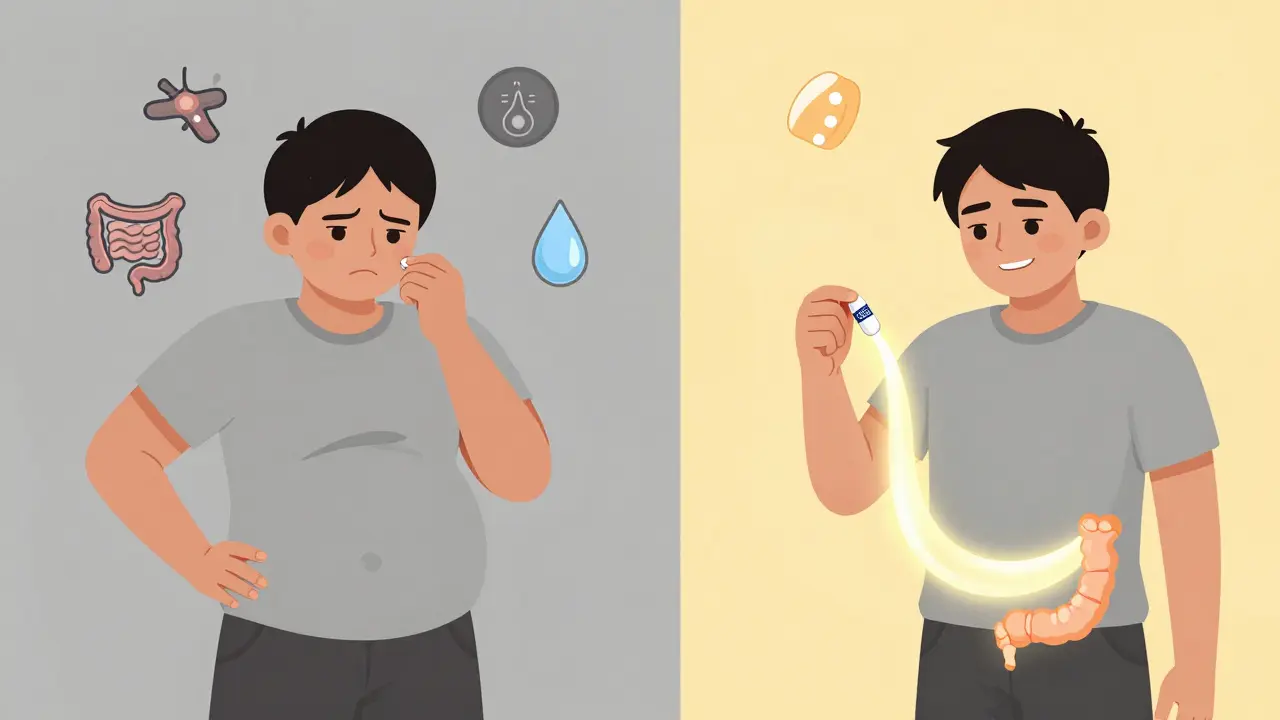
When to Start Treatment-Don’t Wait
The biggest mistake? Waiting until you’re stuck. Studies show 60% of patients only start laxatives after constipation becomes unbearable. That’s too late. By then, your gut is already sluggish, and you’re in pain. The best practice? Start a laxative on the same day you start the medication that causes constipation. BC Cancer’s protocol is simple: for anyone starting opioids, begin sennosides 17mg daily or PEG 17g daily immediately. No waiting. No symptoms first. Prevention beats treatment every time.Cost, Access, and the Hidden Barrier
PAMORAs work-but they’re expensive. Relistor costs around $1,200 a month without insurance. Many patients wait months before their doctor prescribes it, often because their provider doesn’t know it exists or thinks it’s too costly. But here’s the truth: the cost of not treating it is higher. People quit their pain meds. They end up in the ER. They lose sleep, lose appetite, lose quality of life. A Kaiser Permanente study showed that automated alerts for high-risk prescriptions cut MIC-related ER visits by 22%. That’s prevention saving money and suffering. Talk to your doctor. Ask: “Is there a cheaper alternative to this drug?” or “Can we start a laxative now to prevent this?” Most won’t bring it up unless you do.
What’s Coming Next
The future of managing medication-induced constipation is personal. Mayo Clinic is already using AI in its electronic health records to flag patients at high risk and auto-suggest prophylactic laxatives. Clinical trials are testing microbiome-targeted therapies like SER-287, which showed 40-50% symptom improvement in early studies. But right now, the tools we have work-if you know how to use them. You don’t need a miracle. You need the right match between drug and treatment.Key Takeaways
- Constipation from meds isn’t normal-it’s a direct side effect of how the drug works.
- Don’t rely on fiber or prunes. They rarely fix drug-related constipation and can make it worse.
- For opioids: Start PEG or sennosides on day one. If that fails, ask about PAMORAs like Relistor or Movantik.
- For anticholinergics: Switch to non-sedating alternatives like loratadine instead of diphenhydramine.
- For calcium channel blockers: Amlodipine causes less constipation than verapamil.
- Never wait for symptoms. Prevent it from day one.
Can I just take more fiber if I’m constipated from medication?
No. Bulk-forming fiber like psyllium doesn’t fix the root problem-your gut’s nerves are being blocked by the medication. In fact, studies show fiber can worsen bloating and discomfort in opioid users by 10-15%. It works for general constipation, but not for drug-induced cases. Stick to osmotic or stimulant laxatives instead.
How long does it take for laxatives to work with medication-induced constipation?
It depends. Osmotic laxatives like PEG usually take 1-3 days. Stimulant laxatives like sennosides work in 6-12 hours. But if you’re on opioids, PAMORAs like Relistor can trigger a bowel movement in as little as 4 hours. That’s why they’re preferred for fast relief. Standard laxatives are slow because they don’t reverse the nerve-blocking effect of the drug.
Are PAMORAs safe to use long-term?
Yes. PAMORAs like methylnaltrexone and naloxegol are designed for long-term use in chronic pain patients. They don’t cross the blood-brain barrier, so they don’t interfere with pain control. Clinical trials lasting over a year show no serious side effects beyond mild abdominal cramping or diarrhea in some users. They’re FDA-approved for long-term use in opioid-induced constipation.
Why doesn’t my doctor know about PAMORAs?
Many primary care doctors aren’t trained in pain management or gastroenterology. A 2022 JAMA Internal Medicine audit found only 35-40% of primary care providers follow evidence-based guidelines for medication-induced constipation. Even worse, 65-75% of patients on opioids aren’t even told about constipation as a side effect. You may need to bring up PAMORAs yourself with your doctor-ask if they’ve heard of Relistor or Movantik.
Can I use laxatives if I’m on multiple medications?
Yes, but be careful. Laxatives like PEG and sennosides are generally safe with most drugs. But avoid stimulant laxatives if you’re on diuretics or have kidney issues-they can worsen electrolyte imbalances. Always check with your pharmacist or doctor before combining laxatives with other meds, especially if you’re on heart meds, antidepressants, or blood thinners.
Is constipation from medication permanent?
No. Once you stop the medication, your gut usually returns to normal within days to weeks. But if you’re on long-term drugs like opioids or antipsychotics, you may need ongoing management. That doesn’t mean you’re broken-it means you need the right tools. With the right laxative strategy, you can keep taking your meds without suffering.
Next Steps
If you’re on a medication that causes constipation and you’re not already on a laxative:- Write down all your medications-prescription and over-the-counter.
- Identify which ones are known to cause constipation: opioids, anticholinergics, calcium channel blockers, diuretics, iron.
- Call your doctor or pharmacist and say: “I’m concerned about constipation from my meds. What’s the best way to prevent it?”
- Ask specifically about starting PEG 3350 or sennosides right away.
- If you’re on opioids and nothing’s working after a week, ask about PAMORAs.

Mandy Kowitz
So let me get this straight-I’m supposed to take a $1,200/month drug just so I can poop while on pain meds? Meanwhile, my insurance won’t cover a $10 bottle of Miralax but somehow thinks Relistor is ‘medically necessary’? Thanks, capitalism.
Also, why does every article like this sound like a pharmaceutical ad? ‘PAMORAs are game-changers!’ Yeah, if you’re rich and have a doctor who actually reads journals.
I’ll stick with prunes and guilt. At least prunes don’t come with a co-pay that makes me cry.
Also, who the hell wrote this? A rep from Pfizer? Because I’m convinced this was ghostwritten by someone whose commission depends on PAMORA prescriptions.
Michael Rudge
Oh, so now we’re treating constipation like a medical emergency? Next they’ll be prescribing IV hydration for people who forget to drink water after a night out.
You know what’s really ‘medication-induced’? The delusion that modern medicine can solve every minor bodily inconvenience with a new $1,000 pill. Your gut isn’t broken-it’s just adapting to opioids. Maybe try moving more. Or eating something that isn’t a pill.
And no, I don’t care that ‘studies show’-I’ve seen people on Miralax for 12 years. You don’t need a PAMORA. You need a life change. Or at least a better diet.
Also, why is everyone acting like this is a new discovery? I’ve been constipated since 2010. No one cared then. Now it’s a ‘clinical trial’? Please.
Vicki Yuan
This is one of the most clinically accurate and urgently needed articles I’ve read in years. Thank you for breaking down the mechanisms by drug class-it’s rare to see this level of specificity.
For anyone reading this and thinking ‘I’ll just eat more fiber’-please don’t. I’m a GI nurse, and I’ve watched patients worsen with psyllium while on opioids. The science here is solid: bulk-forming laxatives are not just ineffective-they’re counterproductive.
Start with PEG 3350 (MiraLAX) at 17g daily, and if no improvement in 3–5 days, escalate to sennosides. For opioid users, don’t wait for symptoms. Prophylaxis is non-negotiable. BC Cancer’s protocol is gold standard.
And yes, PAMORAs are expensive, but they’re cheaper than ER visits, opioid discontinuation, or depression from chronic discomfort. Advocate for yourself. Your gut deserves better than ‘just drink more water.’
Jennifer Glass
I’ve been on oxycodone for 5 years. I started sennosides on day one, like the article says. No issues.
But I also switched from verapamil to amlodipine after my cardiologist mentioned the constipation link. It helped. Not a miracle, but noticeable.
What I find weird is how nobody talks about the mental toll. It’s not just physical-it’s the shame. The hiding. The way you avoid social plans because you’re scared you’ll be stuck.
I’m glad this article exists. Not because it’s revolutionary, but because it says what doctors won’t. You’re not broken. You’re medicated. And there’s a fix.
Also, I didn’t know about PAMORAs until I read this. Now I’m asking my doctor. Thanks.
Joseph Snow
Let me guess: this was funded by AstraZeneca, Merck, or some PAMORA manufacturer. The entire narrative is engineered to push expensive drugs while vilifying fiber and hydration-two of the most basic, proven, and cost-free interventions in medicine.
Why is no one asking why these drugs are being prescribed in the first place? Opioids are overprescribed. Anticholinergics are overused for sleep. Diuretics are dumped on elderly patients like candy.
Instead of creating a $1,200/month pill to fix the side effect of a $20/month drug, why not reduce the root cause? You’re treating symptoms, not systems.
And the ‘AI alerts’? That’s just surveillance dressed as innovation. They’re not helping you-they’re profiling you.
This isn’t medicine. It’s a profit engine wrapped in clinical jargon.
John Ross
Let’s contextualize this within the neurogastroenterological framework. The ENS-enteric nervous system-is a neurobiological substrate heavily modulated by mu-opioid receptor agonism, which leads to reduced peristalsis, decreased secretory activity, and increased sphincter tone. This is not ‘constipation’ in the functional sense-it’s pharmacodynamic ileus.
Conventional osmotic agents like PEG act via colonic osmotic gradient modulation, while stimulants like sennosides activate 5-HT4 receptors to enhance motility. Neither addresses the primary receptor blockade.
PAMORAs, as peripherally restricted antagonists, are the only class that restores physiological motility without CNS interference. The clinical data is robust: NNT for first spontaneous bowel movement within 24h is 2.8 for naloxegol.
Cost is a systemic failure, not a therapeutic one. The real issue is healthcare fragmentation and prescriber education gaps. We need EHR-integrated clinical decision support, not just patient advocacy.
jigisha Patel
Let’s analyze the data. The article cites a 2023 MedCentral analysis that diet alone helps 20-30% of patients with drug-induced constipation. But MedCentral is not a peer-reviewed journal-it’s a blog with no editorial board. The 40-60% opioid constipation statistic? From a 2018 meta-analysis with high heterogeneity. PAMORA trials? Small sample sizes, industry-funded, short duration.
Meanwhile, the article ignores the fact that many patients develop tolerance to stimulant laxatives, leading to dependency. And PEG? Long-term use can cause osmotic diarrhea and electrolyte shifts in elderly patients.
Also, switching verapamil to amlodipine? That’s not a solution-it’s a workaround. Both are calcium channel blockers. The constipation mechanism is class-wide.
This is not evidence-based medicine. It’s anecdotal marketing dressed in footnotes.
Jack Wernet
I’ve been a hospice nurse for 18 years. I’ve seen people on opioids who haven’t had a bowel movement in 10 days. They’re not just uncomfortable-they’re terrified.
One woman, 82, told me she’d rather stop her pain meds than deal with it anymore. That’s when I realized: this isn’t about laxatives. It’s about dignity.
I’ve handed out Miralax, sennosides, and even helped patients get Relistor through charity programs. The difference is night and day. One person went from crying every morning to laughing at her grandkids again.
I don’t care if it’s expensive. I care that someone can sit at the table without pain.
Thank you for writing this. It’s not just medical advice. It’s a lifeline.
Charlotte N
i started oxycodone last year and didnt know about any of this... i tried prunes and fiber and it just made me bloated and worse... then i read this and asked my dr about miralax and she said oh yeah that’s fine... i started it and within 2 days i felt like a new person
but i still dont know if i should ask about the other one... what’s it called again... the expensive one? i’m scared to ask because i don’t want to sound like a drug seeker
also i’m on benadryl for allergies and i think that’s making it worse too... should i switch?
thank you for this
Catherine HARDY
They’re not telling you the real reason PAMORAs are expensive.
It’s not because they’re hard to make.
It’s because they’re a trap.
Big Pharma knows if they make the fix too cheap or too easy, people will stop taking the opioids. And opioids? That’s where the real money is.
They don’t want you to stop the pain meds.
They want you to take the pain meds AND the $1,200 pill.
That’s the business model.
They’re selling dependency. Two layers of it.
And the ‘AI alerts’? That’s just a way to get more people hooked on the system.
They don’t care if you poop.
They care if you keep buying.
bob bob
Man, I wish I’d read this 3 years ago. I was on tramadol and just thought I was ‘getting old.’ Ended up in the ER with a bowel obstruction because I waited too long.
Now I take Miralax every day. No shame. No guilt. My gut’s happy. My pain’s managed.
And yeah, I switched from Benadryl to Zyrtec. Best decision ever. No more brain fog or constipation.
To anyone reading this: don’t wait until you’re screaming in pain. Start the laxative on day one. Your future self will thank you.
Also, your doctor doesn’t know everything. Ask questions. You’re not being annoying. You’re being smart.
Uzoamaka Nwankpa
I have been on antidepressants for 8 years. Constipation is my constant companion. I do not speak of it. I do not ask for help. I suffer silently. I have lost weight because I am afraid to eat. I am tired of being told to drink water. I am tired of being told to eat fiber. I am tired of being told it is normal.
My body is not broken. My medicine is.
But I am too afraid to ask for change.
Thank you for writing this. I am not alone.
Oluwapelumi Yakubu
Listen, my friend-your gut ain’t a machine that breaks when you pop pills. It’s a sacred garden, man. When you flood it with opioids and anticholinergics, you’re not just slowing it down-you’re poisoning the soil.
But here’s the truth: the body’s got rhythm. It remembers. It knows how to move. You just gotta give it back its voice.
PEG? It’s like watering the roots. Sennosides? That’s the drumbeat that wakes the earth.
And PAMORAs? That’s the whisper of the ancestors saying, ‘Come back, child. We still love you.’
Don’t fight your body. Reconnect with it.
And if your doctor don’t get it? Find someone who does. The medicine ain’t in the bottle-it’s in the balance.
Terri Gladden
OKAY SO I JUST TOOK MIRALAX FOR THE FIRST TIME AND I THINK I’M DYING?? LIKE I WAS JUST ON THE TOILET FOR 45 MINUTES AND NOW I’M CRYING AND MY STOMACH IS ON FIRE AND I THINK I’M HAVING A HEART ATTACK OR SOMETHING?? IS THIS NORMAL?? I’M SO SCARED I THINK I’M GOING TO DIE??
WHY DID NO ONE TELL ME THIS WOULD HAPPEN?? I JUST WANTED TO POOP AND NOW I’M IN A TERROR HOLE??
MY DR SAID IT WAS SAFE?? WHAT DO I DO??
Vicki Yuan
Charlotte-this is not normal. Miralax doesn’t cause pain or burning. You may be experiencing a reaction to something else, or possibly an impaction that’s now partially dislodged. Stop taking it for now.
Call your doctor or go to urgent care. This isn’t ‘just constipation’-this could be an obstruction or severe cramping from a high dose. You’re not overreacting.
And for anyone else reading: always start with half-dose (8.5g) if you’re new to PEG. Don’t jump to 17g on day one unless your doctor says so. Slow and steady wins the race.
You’re not alone. But you do need help. Please reach out.