
Medication Switch Decision Aid
Your Priorities Matter Most
Adjust the sliders below to indicate how important each factor is to your daily life. This helps us see if the new medication aligns with your values.
Research shows that understanding these specific trade-offs can increase patient confidence by 40%.
Imagine sitting in a doctor's office, handed a new prescription, and feeling unsure if you're making the right call. You're told the old medicine isn't working well anymore, so you must switch to something new. Suddenly, you face a wall of jargon about "side effect probabilities" and "risk reduction." It's overwhelming. More than half of people stop their prescribed medications within the first year, often because they never truly understood the trade-offs involved. This is where Decision Aids come in.
These aren't just brochures left on a table. They are interactive tools designed to sit right in the middle of that conversation. They help you weigh the risks and benefits of switching medications against your own life priorities. We'll walk through exactly what these tools are, why they matter, and the real-world pros and cons of using them when your treatment plan changes.
What Exactly Is a Medication Decision Aid?
A medication decision aid is a structured resource built to support shared decision-making between you and your healthcare provider. Think of it as a roadmap for navigating complex medical choices. Unlike standard patient education pamphlets that tell you what to do, a decision aid presents balanced information. It lays out the good stuff-like how much a drug might lower your heart attack risk-and the bad stuff, such as the chance of weight gain or fatigue.
The concept gained traction after the 2001 Institute of Medicine report highlighted informed patient participation as vital for quality care. Pioneering work by organizations like the Ottawa Hospital Research Institute established frameworks back in the late 1990s, but modern versions are now largely digital. Current iterations often appear as web-based apps or integrated portal tools. For instance, the VA's MIRECC program maintains a library of these resources, updated as recently as September 2023. These tools move beyond generic advice to give specific, personalized estimates. If you're considering switching antidepressants, the tool doesn't just list side effects; it shows you how many out of 100 people might experience nausea versus how many benefit from mood stabilization.
Why Switching Medications Requires Careful Support
Changing meds isn't just swapping one pill for another. Every medication has a unique profile. Sometimes you switch because the first line of defense failed, sometimes due to intolerable side effects, and other times because a newer drug offers better protection. A 2022 study in JAMA Internal Medicine found that unaddressed concerns lead to 25-50% of patients stopping medications within a year. That's a huge portion of treatments failing before they can work.
Decision aids tackle this head-on by visualizing risk. Imagine seeing an icon array where 10 out of 100 shapes turn red to represent bleeding risk. Seeing 10 red dots is far more powerful than hearing a doctor say, "There's a small risk of bleeding." This visualization makes abstract statistics concrete. It forces a dialogue rather than a monologue. Instead of the doctor deciding for you, the tool helps clarify what matters most to you personally. Do you mind taking three pills a day? Does the cost outweigh the potential benefit? The tool asks you to rank these factors.
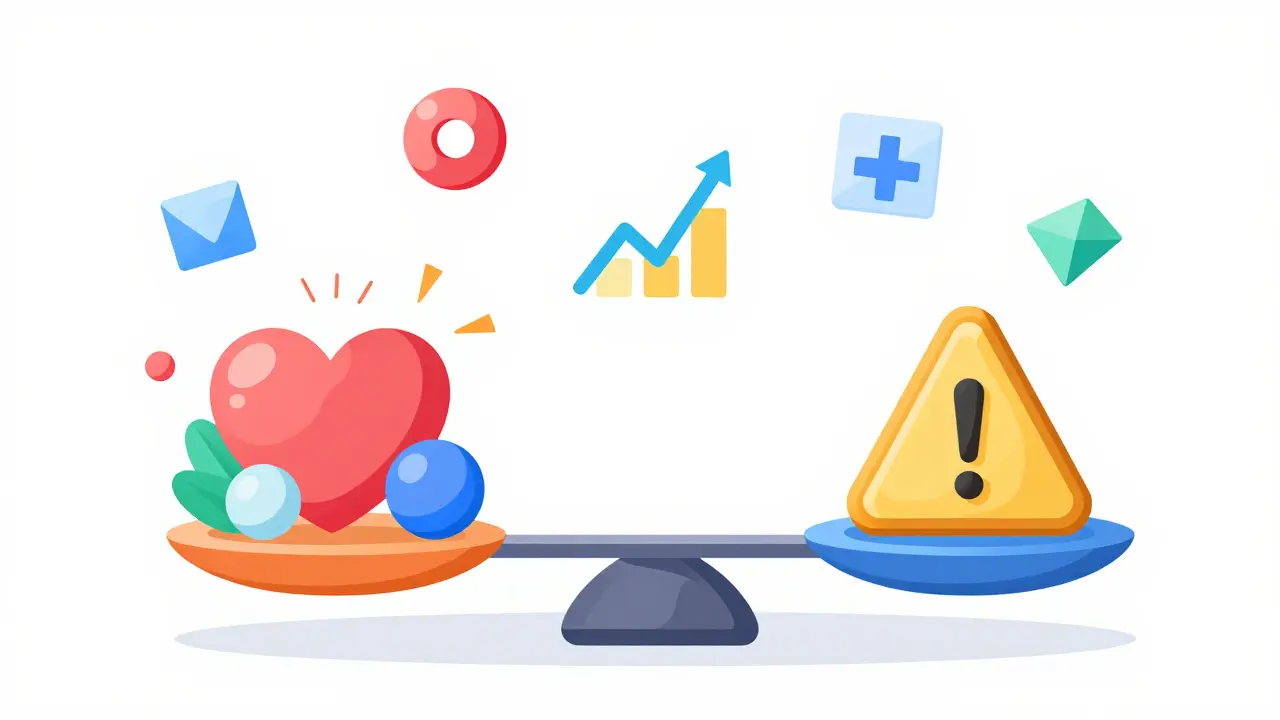
The Proven Benefits of Using Decision Tools
When patients use these aids, the outcomes improve measurably. A systematic review analyzed 18 interventions regarding medication switching and found significant wins. Knowledge retention was 32% higher at a six-month follow-up compared to standard care. In plain terms, people remembered more about their options long after the visit. More importantly, "decisional conflict" dropped by 28%. This means fewer people felt anxious, pressured, or unsure about their choice later down the road.
We see this in action with anticoagulant therapy. Veterans using decision aids to choose between warfarin and direct oral anticoagulants reported higher confidence levels. One veteran noted online that seeing the actual number of bleeding events per 100 users made the difference clear. When you understand the trade-off between stroke prevention and bleeding risk, you own the decision. Ownership leads to better adherence. If you accept the risk knowingly, you're less likely to quit when minor side effects appear.
| Feature | Traditional Counseling | Decision Aids |
|---|---|---|
| Knowledge Retention | Baseline (Lower) | +15-25% Improvement |
| Decision Conflict | Frequently High | Reduced by ~28% |
| Alignment with Values | Varies | 41% Better Alignment |
| Patient Confidence | Moderate | High |
Real Risks and Limitations to Consider
These tools aren't perfect magic wands. There are genuine downsides you need to know before you expect to use one. Time is the biggest factor. Adding a decision aid to a consultation adds roughly 7 to 12 minutes to an appointment. For busy primary care practices, this creates a bottleneck. Some doctors hesitate to use them simply because the clinic schedule can't handle the delay. A survey of over 1,200 clinicians showed that 68% cited workflow disruption as a barrier to adoption.
There's also the issue of information overload. While some want details, others find too many numbers confusing. A usability study from the Mayo Clinic noted that 31% of users reported feeling overwhelmed by the statistics presented. Probabilities don't always translate perfectly to personal intuition. Expert Dr. John Ioannidis warned in a 2021 commentary that relying too heavily on tools without clinical context can mislead patients. For example, if a patient sees a 2% risk reduction, they might misunderstand it as a guarantee of safety when it's actually still a non-zero risk.
Furthermore, keeping these tools current is expensive and difficult. Medical evidence evolves fast. The average decision aid needs updating every 18 to 24 months to match FDA label changes. If the tool relies on data from two years ago, it might recommend a switch that is no longer best practice. Maintenance is a constant battle for healthcare systems.

How Implementation Works in Practice
If your provider uses these aids, here is the typical workflow. First, the clinician identifies a preference-sensitive decision point, like switching from metformin to an SGLT2 inhibitor for diabetes management. Ideally, you receive the digital aid 24 to 72 hours before the visit. This gives you time to read and process the numbers without pressure.
During the appointment, the conversation shifts. Instead of debating facts, you discuss values. "You marked cost as high priority, does the generic version look better?" or "Since avoiding weight gain is critical to you, let's look at option B." Finally, the joint decision gets documented directly into your Electronic Health Record (EHR). Systems like Epic now host multiple integrations for this exact purpose. Studies show that after 10 uses, clinicians become proficient, cutting the extra time needed down significantly.
Choosing the Right Tool for Your Situation
Not every medication switch needs a full-blown decision aid. These tools shine best when there are multiple reasonable options with different trade-offs. They are highly recommended for situations like choosing a blood thinner, managing diabetes meds, or switching antidepressants. They work less effectively in emergencies where immediate action is required, or if you have severe cognitive impairment. A 2022 study noted no significant benefit for patients with low memory scores when processing probabilistic data.
Currently, the landscape includes major players like the Mayo Clinic and various academic health centers. The market for these tools is growing fast, driven by Medicare requirements for shared decision-making on high-cost drugs. However, access varies. Some insurance plans provide free portals with these embedded, while others require seeking external resources. Always verify that the specific aid you are using is certified by a reputable body like the Ottawa Hospital Research Institute or meets WCAG accessibility standards.
Are decision aids covered by insurance?
Generally, the tools themselves are not billed separately. They are part of the consultation service code. However, digital access may depend on your provider's setup. Most public libraries or hospital portals offer them free of charge.
Can I use these aids if I'm not seeing a doctor yet?
Yes, though ideally you discuss results with a professional. Many are publicly available online. Just ensure the source is credible, like a university hospital or government health agency, rather than a commercial ad.
Do decision aids replace my doctor's advice?
No, they complement it. They organize information so your doctor can spend time focusing on your specific values and health history rather than reading basic facts.
How accurate are the risk percentages shown?
Reputable aids cite primary sources like clinical trials. Look for citations within the tool. Updates usually happen every 18-24 months to stay aligned with the latest FDA labels.
Will using a decision aid speed up my appointment?
Initially, no. It takes about 7-12 minutes extra. Over time, as both you and your doctor get used to the process, decision-making becomes faster and clearer.
As we move forward in healthcare, the shift toward shared decision-making looks irreversible. Quality payments are increasingly tied to whether patients participate actively in their care. By March 2026, most value-based care settings are expected to have adopted these tools. For you as a patient, knowing how these aids work empowers you to ask for them. If your doctor hasn't brought one up during a medication switch discussion, asking "Is there a decision aid available for this change?" can transform the interaction.

Rod Farren
The implementation of Electronic Health Record integrations for these decision tools is becoming increasingly vital for operational efficiency. Clinicians need streamlined workflows to avoid the noted time penalties mentioned in the post. Interoperability with existing EMR systems ensures that data capture happens automatically during the visit. This reduces administrative burden while preserving the decision aid utility for the patient. Standardized metrics from these interactions feed back into quality reporting dashboards seamlessly. It creates a closed loop of evidence-based practice refinement over time. We must ensure APIs are robust enough to handle real-time updates from FDA databases too.
Eleanor Black
Furthermore, the integration of shared decision-making tools fundamentally alters the power dynamic within the traditional physician-patient consultation framework. We must consider how cognitive load affects retention during high-stress health episodes. It is crucial to acknowledge that statistical literacy varies significantly across diverse demographic groups. Consequently, visual aids serve as necessary bridges for those lacking formal medical education backgrounds. The reduction of anxiety described in the literature aligns with broader psychological principles of control perception. Patients feel more empowered when they actively participate in selecting their own therapeutic pathways. Moreover, the longitudinal impact on medication adherence rates cannot be overstated in chronic care management contexts. System-wide adoption would require substantial investment in clinician training regarding these digital interfaces. Yet, the ethical imperative of patient autonomy outweighs the logistical friction encountered in busy primary care environments. I recall reading recent studies indicating that visualization reduces perceived risk severity more effectively than raw percentages alone. This phenomenon suggests that our brains process graphical information faster than numerical probabilities presented in tabular formats. Therefore, designing these aids requires collaboration between data scientists and behavioral psychologists. Without such interdisciplinary input, the tools may inadvertently introduce bias rather than eliminate confusion. We also need to ensure accessibility standards are met for users with visual or hearing impairments utilizing screen readers. Ultimately, the goal is to foster a partnership where information flows bidirectionally between provider and recipient. :)
Molly O'Donnell
Most people still ignore the fine print regardless of how pretty the chart looks.
Christopher Beeson
The existential dread of mortality often clashes with the cold hard data presented in these aids. People want magic cures not probability distributions quantified in red and blue dots. It reveals a deep disconnect between medical rationality and human emotion. We seek certainty in a universe that operates purely on chance and biological variance. The tool merely exposes the chaos we try desperately to order through prescription labels. True wisdom comes from accepting the uncertainty rather than solving it mathematically.
Callie Bartley
Another expensive solution to fix problems caused by understaffed clinics and rushed appointments. The system keeps telling us we need to do more with less time. Why add another barrier when patients already struggle to get basic coverage? It feels like another way to offload doctor responsibility onto vulnerable individuals. These tools might look nice but do they actually lower costs or just shift liability?
Sharon Munger
we need to remember that every patient brings unique values to the table no matter what the numbers say. sometimes the best choice is the one that fits your life not just your charts. taking time to listen is still the most important medicine available today.
Arun Kumar
In many parts of the world resources are scarce so digital portals are a luxury we cannot always rely upon. Community health workers play a bigger role in bridging this gap for underserved populations globally. We must advocate for low-tech versions that function without internet access entirely. Education remains the universal key regardless of platform sophistication. Let us support initiatives that make these concepts accessible offline for rural areas.
James DeZego
Glad to see this discussion getting traction with the right stakeholders involved! 😊 Knowledge sharing helps everyone make safer choices eventually. Keep checking sources though accuracy matters so much here. 💪
Rocky Pabillore
Unfortunately most individuals lack the requisite analytical capacity to interpret complex datasets accurately. Relying on simplified visuals often results in significant misunderstandings of actual clinical risk profiles. Only the educated minority will utilize these sophisticated instruments with proper comprehension. The rest will simply choose options based on superficial aesthetics rather than evidence. It remains an elitist approach disguised as empowerment.
Jenny Gardner
Precisely!;;!!! It is absolutely critical!!! That we maintain rigorous standards!!! For all educational materials!!!; Otherwise we invite dangerous misinformation!!! Which leads to poor outcomes!!!!
Julian Soro
This is such a positive step forward for how we think about patient care! Everyone deserves to feel heard and respected in their treatment journey. Small changes like this build up to huge improvements in trust over time. Let's keep supporting doctors who prioritize listening to their patients.
Cara Duncan
Absolutely love seeing this kind of progress happening 🌟🙏 It gives me hope for the future of healthcare for us all 😊💕 Together we can make it better for everyone involved ❤️
Cullen Zelenka
Practical advice like this really helps cut through the noise online. Just focus on asking your doctor about having these tools ready before you switch meds. Being prepared is half the battle won already.
Owen Barnes
that's a great point abt being prepared thier. i think alot of ppl forget to ask ahead of time. becuse they assume the doc will just tell them. but u have to be proactive to get the best help. its good to know there are tools out thier for free. thanks for sharing this info it made me think about my next visit. definitely gonna bring this up next week. hopefully my dr has some apps loaded up too. better safe then sorry when its about ur health. keeping things simple helps everyone understand better.