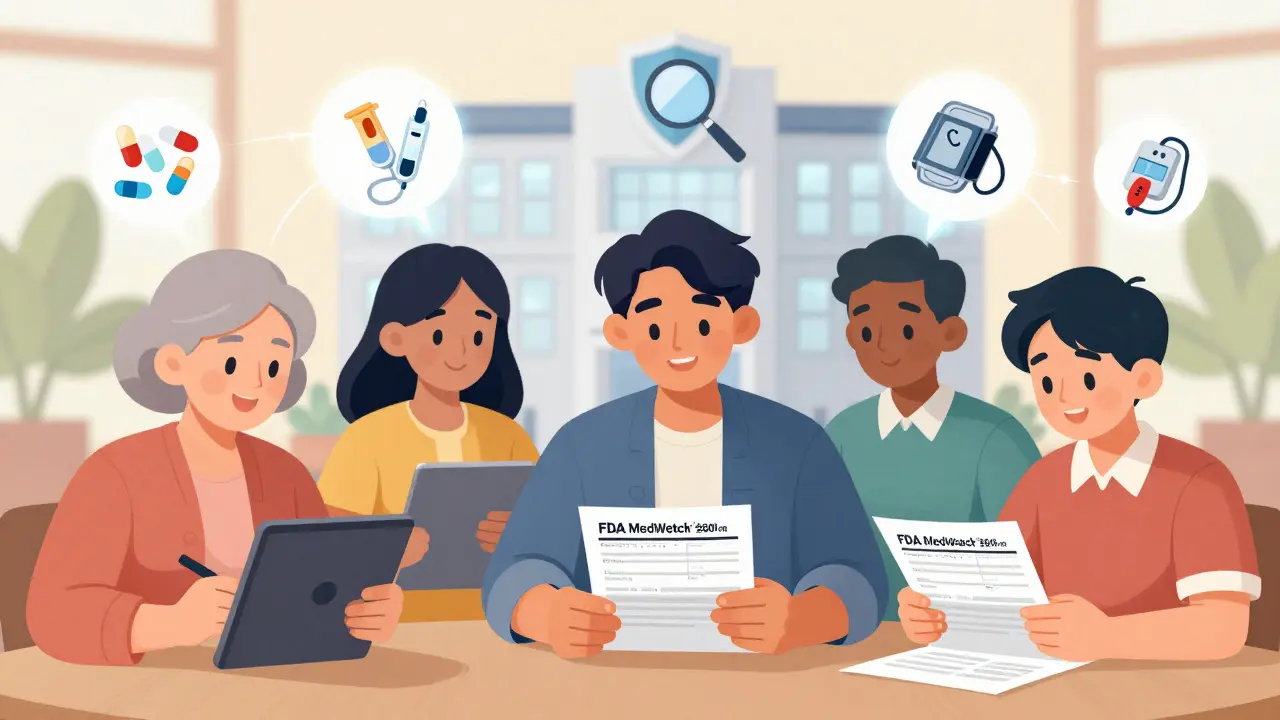
Every year, millions of people take prescription drugs, over-the-counter medicines, and medical devices. Most of them work as expected. But for some, things go wrong. A medication causes a dangerous reaction. A glucose monitor gives wrong readings. A cream leads to severe skin damage. When this happens, FDA MedWatch is the one system that can help make things safer for everyone else.
MedWatch isn’t just a form you fill out. It’s the U.S. Food and Drug Administration’s main tool for catching problems with medical products after they’ve been approved and sold. The FDA doesn’t know everything before a drug hits the market. Clinical trials involve thousands, not millions, of people. Rare side effects, interactions with other drugs, or failures in devices often only show up once they’re in wide use. That’s where you come in. Your report could be the one that triggers a warning, a label change, or even a recall.
What Exactly Does MedWatch Cover?
MedWatch doesn’t just track prescription pills. It covers almost everything the FDA regulates: over-the-counter medicines like pain relievers and allergy meds, biologics such as blood transfusions and gene therapies, medical devices like insulin pumps and home blood pressure cuffs, combination products like prefilled syringes, and even some cosmetics and CBD products. The only things it doesn’t handle are vaccines (those go to VAERS), animal drugs, and tobacco products.
If you or someone you know had a serious reaction - like being hospitalized, having a life-threatening event, losing a body function, or needing emergency care - it counts. Even if you’re not sure, report it. The FDA doesn’t need proof. They need clues. One report might seem small. Ten thousand? That’s a pattern.
Who Can Report? And How?
Anyone can report to MedWatch. You don’t need to be a doctor. You don’t need to be a pharmacist. If you took a pill and felt strange, or your child had a reaction to a bandage, you can report it. The system has two main paths: voluntary reporting and mandatory reporting.
Voluntary reports come from patients, caregivers, and healthcare workers. These are the most common. There are two forms:
- Form FDA 3500 - for healthcare professionals like doctors, nurses, and pharmacists. It asks for your license, specialty, and contact info. It’s detailed, but if you’re used to medical records, it’s straightforward.
- Form FDA 3500B - for patients and family members. It’s shorter, simpler, and available in English and Spanish. You just need to describe what happened, what product was involved, and your basic contact info.
Mandatory reports come from companies - drug makers, device manufacturers, and hospitals. They’re legally required to report deaths, serious injuries, or malfunctions within 10 to 30 days. This part of MedWatch runs quietly in the background, but it’s critical. Without it, the FDA wouldn’t know about systemic failures.
How Long Does It Take? What Do You Need?
For patients, filling out Form FDA 3500B usually takes 10 to 20 minutes. You don’t need medical records. But having these details handy helps:
- The name of the product (brand and generic, if you know it)
- When you started using it
- When the problem started
- What symptoms you had (e.g., chest pain, rash, dizziness, swelling)
- What happened after - did you go to the ER? Did it get better? Did you stop using it?
- Any other drugs or supplements you were taking
Don’t worry if you don’t have all the details. The FDA says incomplete reports are better than none. They’ll follow up if they need more.
For healthcare workers, Form FDA 3500 asks for more: your profession, license number, whether you reported to the manufacturer, and sometimes the patient’s age and medical history. If you’re a nurse or doctor, you’ve probably seen this before. It’s designed to fit into your workflow. Most complete it in under 15 minutes.
Why Do So Few People Report?
The FDA estimates that only 1% to 10% of serious adverse events are ever reported. Why? Because the system is confusing.
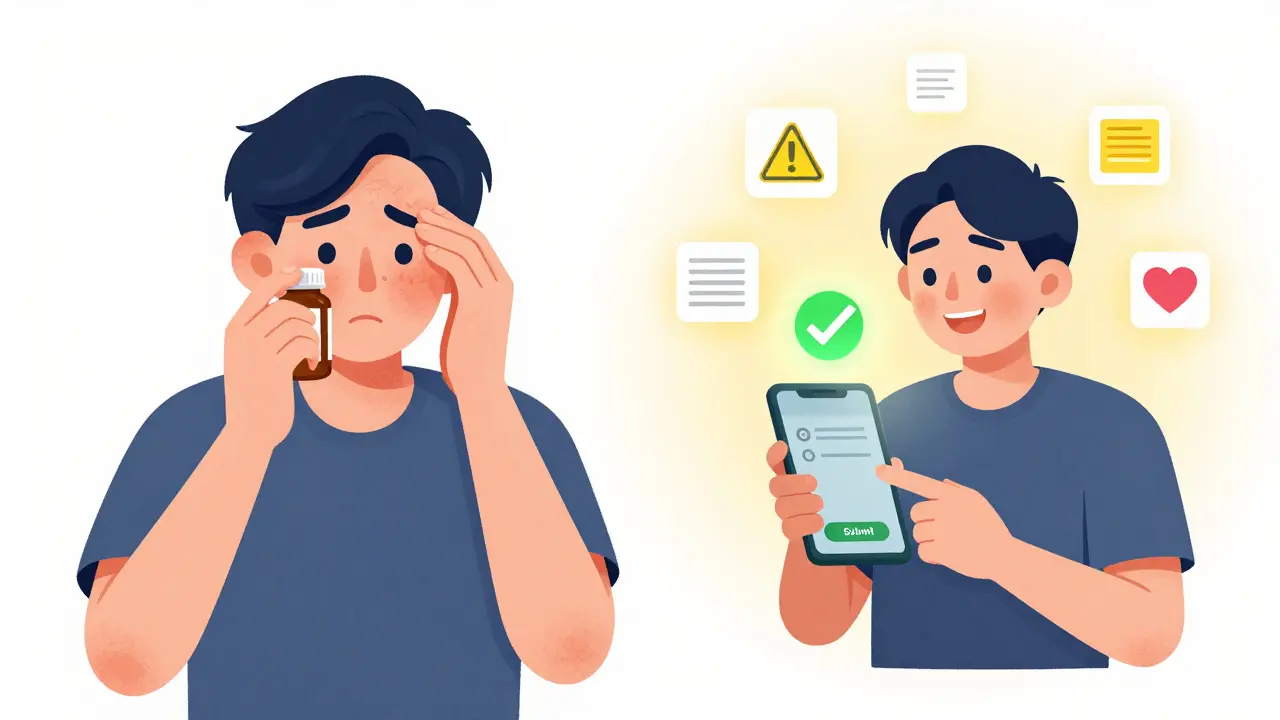
Patients often get stuck on terms like "event abated," "dose frequency," or "medical pathway." These aren’t everyday words. A 2019 FDA study found that 62% of consumers needed help understanding at least three terms on the form. One Reddit user wrote: "I had to Google half the phrases just to fill out the form." The FDA admits this. Their own guidance says: "Your health care provider can provide clinical information based on your medical record that can help FDA evaluate your report." That’s the key. If you’re unsure, take the form to your doctor. They can help you fill it out. And no - they’re not required to report it themselves. But they can help you do it right.
What Happens After You Submit?
Once you submit your report - whether online, by mail, or fax - you’ll get an automated confirmation. It’s not a thank-you note. But it’s proof they got it. Then, the FDA’s analysts review it. They look for patterns. If five other people report the same reaction to the same drug, that’s a signal. If ten devices from the same company fail the same way, that’s a red flag.
These signals don’t lead to instant bans. But they can lead to:
- Updated warning labels
- Changes in dosing instructions
- Recalls or market withdrawals
- Required studies to investigate further
In 2021, a MedWatch report helped trigger a safety review of a popular diabetes medication after multiple users reported severe joint pain. The label was updated within six months. That’s the power of one report.
How to Report: Step-by-Step
Here’s how to do it right:
- Go to FDA MedWatch Online (the official portal)
- Choose Form FDA 3500B if you’re a patient, or Form FDA 3500 if you’re a professional
- Fill in the product name - use the exact name on the bottle or box
- Describe what happened in plain language: "I took this pill on Monday. On Wednesday, I had trouble breathing and broke out in hives. I went to the ER."
- Include dates - when you started, when symptoms started, when they ended
- Answer whether you stopped using the product
- Enter your contact info (email or phone - you can stay anonymous if you want)
- Submit. Done.
You can also download the form, fill it out, and mail or fax it. But online is fastest. The redesigned portal (updated in 2021) works on phones, has larger buttons, and saves your progress if you get interrupted.
What If You’re Not Sure It’s Serious?
The FDA defines a serious adverse event as one that results in:
- Death
- Life-threatening condition
- Hospitalization
- Permanent disability
- Birth defect
- Requires intervention to prevent permanent damage
If it’s just a mild rash or a headache that went away? You don’t have to report it. But if you’re unsure - report it anyway. The FDA says: "When in doubt, report."
What’s New in MedWatch?
The system is getting smarter. In 2023, the FDA started testing AI tools that help patients pick the right terms. A pilot program now suggests phrases like "I felt dizzy after taking this" and matches them to medical codes. It’s not perfect - but it’s a step forward.
Also, you can now sign up for free email alerts. Get notified when your favorite drug gets a new warning, or when a device you use is recalled. The Drug Labeling section lets you see changes back to 2002. You can even track updates by month.
Why This Matters
MedWatch isn’t about blame. It’s about safety. Every report adds to a puzzle. The FDA doesn’t have eyes everywhere. But millions of patients do. Your report might be the one that saves someone else from the same reaction. It might lead to a warning on a drug your sister takes. Or a fix for a device your dad uses.
It’s not glamorous. It’s not easy. But it’s necessary. And you don’t need a medical degree to do it.
Frequently Asked Questions
Do I need to be a doctor to report to MedWatch?
No. Anyone can report - patients, family members, caregivers, or even bystanders. The FDA created a simple form (FDA 3500B) just for consumers. You don’t need a license or medical training. Just describe what happened.
Can I report anonymously?
Yes. You can leave your name and contact info blank. The FDA doesn’t require it. But if you leave your email, they can follow up if they need more details. That can help them understand your report better.
How long does it take for the FDA to act on a report?
There’s no set timeline. Some reports are reviewed within days. Others take months. The FDA looks for patterns. One report rarely triggers action. But if 50 people report the same issue, they investigate. It’s about numbers, not single cases.
What if I report a problem with a medical device?
Same process. Use Form FDA 3500 or 3500B. Include the device name, model number, and manufacturer. Describe what went wrong - did it break? Give wrong readings? Cause injury? The FDA tracks device failures closely. They’ve recalled dozens of products based on MedWatch reports.
Is MedWatch the only way to report to the FDA?
Yes, for human medical products. There are separate systems for vaccines (VAERS), animal drugs, and tobacco. But for drugs, devices, and most other FDA-regulated products, MedWatch is the only official channel. Don’t use other websites - they won’t reach the FDA.
Next Steps
If you’ve ever had a bad reaction to medicine or a device, consider reporting it. Even if it happened years ago. The FDA keeps records indefinitely. A report from 2020 could still help today.
Set a reminder. Next time you pick up a new prescription, or start using a new glucose monitor, think: "What if this goes wrong?" Keep the box. Write down the date you started. If something strange happens, you’ll be ready.
You don’t need to be an expert. You just need to care. And that’s enough.

Danielle Arnold
Wow. So the FDA wants me to fill out a form after nearly dying from a drug? Cool. I'll just hop on my horse and ride to the nearest fax machine. 🙃
James Moreau
This is actually one of the most useful public health tools we have. I work in pharmacy and I file these regularly. Even if it feels pointless, your report adds to the data pool. Small actions, big impact.
J. Murphy
form fda 3500b? more like form fda 3500boring. who even wrote this thing. its like reading a manual for a toaster that also runs your life.
Jesse Hall
You can make a difference. Seriously. I reported my mom's reaction to a blood pressure med last year. Six months later, the label changed. 💪❤️ You're not just a patient-you're part of the system.
Sean Bechtelheimer
they're tracking us. they know which drugs we take. they're building a profile. next thing you know, insurance will deny you based on a medwatch report. 🤔👁️
Seth Eugenne
If you're unsure whether to report, just do it. It takes 15 minutes. You're not burdening anyone-you're helping. And if you need help filling it out? Talk to your pharmacist. They've got your back. 🙌
Namrata Goyal
this is why america is a joke. you expect ordinary people to decode medical jargon like its a phd exam. in india we just say 'it made me sick' and the doctor fixes it. no forms. no bureaucracy. just care.
Alex Arcilla
I filled out the form after my knee implant started vibrating like a cell phone. No one ever called. But I did it. And now I feel like I did my part. 🤷♂️
Brandon Shatley
i dont know much about medicine but i know when something feels wrong. i reported a rash after a new painkiller. i didnt even know what to call it. just said 'red spots, itchy, no clue'. they still used it. thats all that matters.
Blessing Ogboso
In Nigeria, we don’t have MedWatch, but we have something better: community. When someone has a bad reaction, we talk. We share stories at the market, over tea, on WhatsApp. Someone remembers a similar case. Someone else knows a doctor. No form needed. Just truth passed hand to hand. The FDA system is a machine. Our system is a network. One is bureaucratic. The other is human. And sometimes, human wins.
Jefferson Moratin
The underlying assumption of MedWatch is that the individual is both competent and responsible enough to interpret clinical outcomes. Yet, the form's design contradicts this premise by requiring medical literacy. Therein lies the paradox: a system built on civic duty that assumes civic competence it does not foster.
Caroline Dennis
Adverse event reporting = pharmacovigilance 101. The granularity of patient-reported data fills gaps in RCTs. Real-world evidence > controlled environments. Don't underestimate the power of a single narrative.
Zola Parker
they're using this to build a database for next-gen drug pricing. next thing you know, your report gets used to raise your premiums. 'oh, you reported a reaction? that's a pre-existing condition now.' 🤖
florence matthews
I reported my daughter's reaction to a children's allergy med. It was a tiny rash. I didn't think it mattered. But weeks later, the FDA updated the label to say 'may cause mild skin irritation in sensitive individuals.' That's the power of one person. 💕