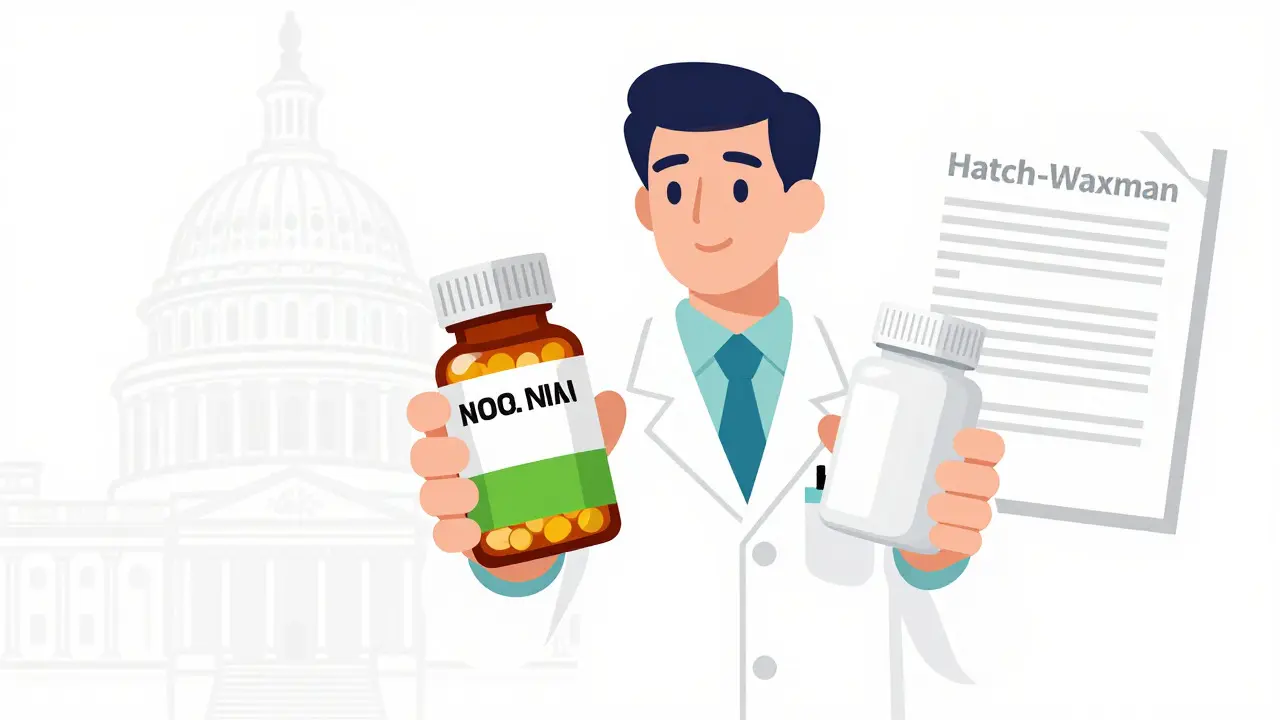
Have you ever looked at your prescription bottle and wondered if the cheaper white pill inside works exactly like the expensive branded version? It is a common question, especially when pharmacists routinely swap brand names for generics to save money. The short answer is yes, but the reason why lies in a rigorous scientific and legal framework that many people overlook. The U.S. Food and Drug Administration (FDA) does not just guess that these drugs are similar; it demands hard proof.
The system we use today was born from the Drug Price Competition and Patent Term Restoration Act of 1984, commonly known as the Hatch-Waxman Act. This legislation created a pathway for generic manufacturers to prove their products are equivalent to existing brand-name drugs without repeating all the costly clinical trials. Today, this system ensures that while prices drop, safety and efficacy remain locked in place.
The Core Requirement: Bioequivalence Testing
The heart of the FDA's generic approval process is bioequivalence. This is not a vague comparison; it is a precise mathematical standard. When a company wants to sell a generic version of a drug, they must show that the body absorbs it at the same rate and to the same extent as the brand-name original, which is called the Reference Listed Drug (RLD).
To pass this test, the generic drug must meet strict statistical limits. The FDA requires that the 90% confidence interval for two key metrics-Cmax (the maximum concentration of the drug in the blood) and AUC (the total amount of drug absorbed over time)-falls within an 80-125% range compared to the brand-name drug. In simpler terms, the generic might be slightly faster or slower to absorb, but it cannot differ by more than a tiny margin that would affect how well it treats your condition.
- Cmax: Measures how high the drug levels peak in your bloodstream.
- AUC: Measures the total exposure to the drug over time.
- Acceptance Range: 80% to 125% for most drugs.
This standard applies to the active pharmaceutical ingredient (API), which is the part of the medicine that actually fights the disease. The API in the generic must be identical in strength, dosage form, and route of administration to the brand-name version. If the brand is a 10mg tablet taken orally, the generic must be exactly that too.
Manufacturing Quality and Impurity Controls
Getting the right amount of drug into your body is only half the battle. The other half is ensuring the pill itself is safe to swallow. The FDA mandates that all generic manufacturers follow Current Good Manufacturing Practices (cGMP). These are detailed rules covering everything from cleaning equipment to calibrating machines. Records of every step must be kept for inspection, ensuring that the pill you get today is made the exact same way as the one made last year.
Impurities are another major focus. During manufacturing, unwanted chemicals can sometimes end up in the final product. The FDA regulates these strictly using guidelines like ICH Q3B and ICH M7. For example, there is a specific Threshold of Toxicological Concern (TTC) for genotoxic impurities, set at 1.5 micrograms per day. If a generic drug exceeds this limit, it is rejected. Stability testing also plays a crucial role here. Manufacturers must provide 12 to 24 months of data showing that the drug remains potent and safe throughout its shelf life, even under varying temperature and humidity conditions.
| Feature | Brand Name Drug | Generic Drug |
|---|---|---|
| Application Type | New Drug Application (NDA) | Abbreviated New Drug Application (ANDA) |
| Clinical Trials | Extensive Phase I-III human trials required | Bioequivalence studies with healthy volunteers |
| Active Ingredient | Original formulation | Identical to Reference Listed Drug (RLD) |
| Inactive Ingredients | Proprietary mix | Can differ (fillers, dyes, flavors) |
| Labeling | Full prescribing information | Must match RLD labeling (with minor exceptions) |

Narrow Therapeutic Index: Stricter Rules for Sensitive Drugs
Not all drugs are treated equally. Some medications have a "narrow therapeutic index," meaning the difference between a helpful dose and a harmful one is very small. Drugs like warfarin (a blood thinner) and levothyroxine (for thyroid issues) fall into this category. For these critical medications, the FDA tightens the bioequivalence window significantly.
Instead of the standard 80-125% range, generics for narrow therapeutic index drugs must fall within a 90-111% confidence interval. This tighter control aims to prevent fluctuations in drug levels that could lead to serious health risks. Despite these stricter rules, patient experiences can vary. A survey of neurologists found that while most were confident in generic antiepileptics, fewer felt equally secure about complex multiple sclerosis medications. This highlights that while the science is sound, individual patient sensitivity to inactive ingredients can still play a role.
Complex Generics: The New Frontier
As drug delivery systems become more sophisticated, proving equivalence gets harder. Complex generics include inhalers, eye drops, topical creams, and extended-release capsules. These products rely on special mechanisms to deliver the drug, making simple blood tests insufficient to prove they work the same way.
The FDA has noted a higher rejection rate for these complex ANDAs. For instance, metered-dose inhalers require proof that the particle size distribution is identical to the brand name, ensuring the medication reaches the lungs effectively. To address this, the FDA launched the Complex Generic Drug Products Initiative. They now accept additional demonstration methods, such as comparative clinical endpoint studies or mechanistic *in vitro* testing, to ensure these complex devices perform identically to their branded counterparts.

Real-World Evidence and Patient Feedback
Does the theory hold up in practice? Data suggests it does. A 2022 study published in JAMA Internal Medicine analyzed 38,000 Medicare beneficiaries and found no statistically significant difference in clinical outcomes between brand and generic statins. Similarly, analysis of patient reviews on Drugs.com showed that 87% of users reported equivalent effectiveness for cardiovascular medications.
However, concerns persist. Discussions in online pharmacy communities reveal that some patients feel differences in symptom control, particularly with levothyroxine. While the FDA maintains that the strict 90-110% bioequivalence requirement should prevent this, individual reactions to fillers or dyes can cause perceived differences. The FDA acknowledges this tension, balancing the need for affordable access with the reality of patient variability.
The Future of Generic Regulation
The regulatory landscape is evolving. In November 2022, the FDA proposed a rule allowing generic companies to update safety labeling before brand-name products. Previously, only brand manufacturers could submit certain safety updates, creating a bottleneck. This change aims to keep patient information current and accurate.
Looking ahead, the FDA is investing heavily in regulatory science. They are exploring artificial intelligence to predict genotoxic impurities and using advanced modeling for bioequivalence assessments. With generics accounting for 90% of prescriptions filled in the U.S., maintaining these high standards is not just a regulatory goal-it is a public health necessity. As new, more complex drugs enter the market, the FDA’s ability to adapt its testing methods will determine whether generics continue to serve as a safe, reliable alternative to brand-name medications.
Are generic drugs really the same as brand name drugs?
Yes, regarding the active ingredient, strength, dosage form, and route of administration. The FDA requires generics to demonstrate bioequivalence, meaning they are absorbed into the body at the same rate and extent as the brand name drug. However, inactive ingredients like fillers and dyes may differ.
What is the Hatch-Waxman Act?
The Hatch-Waxman Act of 1984 established the legal framework for generic drug approval in the U.S. It created the Abbreviated New Drug Application (ANDA) pathway, allowing manufacturers to skip extensive clinical trials if they can prove their drug is bioequivalent to an already approved brand name drug.
Why do some doctors prefer brand name drugs?
Some doctors may prefer brand names for narrow therapeutic index drugs (like warfarin or levothyroxine) where small variations in absorption can have significant effects. Additionally, some patients report side effects from inactive ingredients in generics, leading clinicians to stick with brands for sensitive cases.
How does the FDA test for bioequivalence?
The FDA requires studies involving healthy volunteers who take both the generic and brand name drug. Blood samples are taken to measure Cmax (peak concentration) and AUC (total absorption). The generic must fall within an 80-125% confidence interval of the brand name for most drugs, or 90-111% for narrow therapeutic index drugs.
Are complex generics like inhalers held to the same standards?
Yes, but the testing methods are different. Because simple blood tests may not capture how well an inhaler delivers medication to the lungs, the FDA requires additional demonstrations such as particle size distribution analysis or clinical endpoint studies to ensure performance matches the brand name device.
