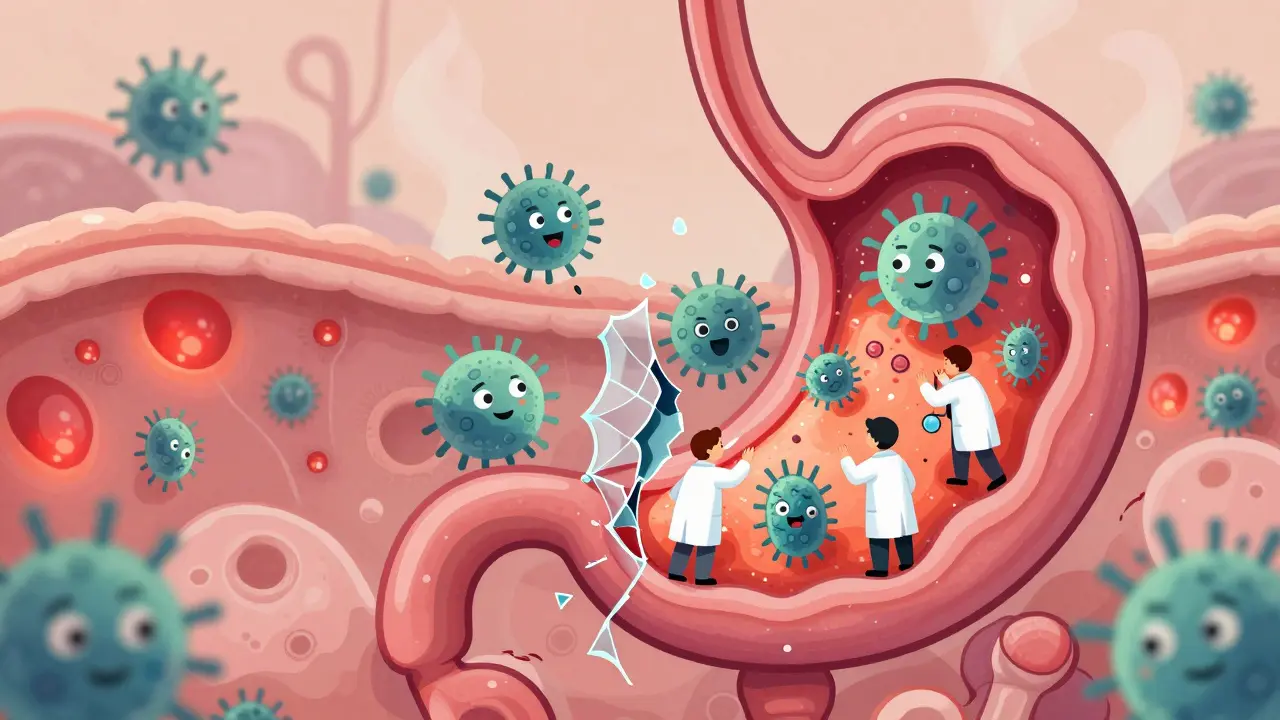
When your stomach feels like it’s on fire after eating, or you’re constantly bloated and nauseous, it’s easy to blame stress or bad food. But if these symptoms stick around, you might be dealing with gastritis-inflammation of the stomach lining. It’s more common than you think, affecting around 500 million people worldwide. And in most cases, it’s not just indigestion. It’s often caused by a tiny, sneaky bacteria called Helicobacter pylori-a silent invader that can linger for years without you knowing.
What Exactly Is Gastritis?
Your stomach lining, or mucosa, is designed to handle strong acids and digestive enzymes. It’s protected by a thick layer of mucus. But when that barrier breaks down, the acid starts eating away at the tissue itself. That’s gastritis. It’s not one single disease. It’s a spectrum: some people get sudden, sharp pain (acute gastritis), while others have a slow-burning irritation that lasts months or years (chronic gastritis). There are two main types: erosive and nonerosive. Erosive gastritis means there are actual breaks or sores in the lining-sometimes leading to bleeding. You might see black, tarry stools or even vomit blood. Nonerosive gastritis doesn’t show visible damage on endoscopy, but under the microscope, you’ll see inflammation, cell changes, and sometimes thinning of the stomach wall. That’s called atrophic gastritis, and it’s often linked to long-term H. pylori infection.What Causes Gastritis?
The biggest culprit by far is Helicobacter pylori. This spiral-shaped bacteria lives in the stomach and is responsible for 70-90% of gastric ulcers and a huge chunk of chronic gastritis cases. It’s estimated that up to 80% of people in developing countries carry it, and even in places like Australia or the U.S., about 1 in 4 adults are infected. But H. pylori isn’t the only player. Regular use of NSAIDs like ibuprofen or aspirin can wear down the stomach lining, especially if taken daily. Alcohol, especially in large amounts, irritates the mucosa directly. Severe stress-like from major surgery, burns, or trauma-can also trigger acute gastritis. Then there’s autoimmune gastritis, where your immune system mistakenly attacks your own stomach cells. That’s rare, affecting less than 1% of people, but it’s serious because it leads to vitamin B12 deficiency and pernicious anemia.How Do You Know If You Have It?
Symptoms vary wildly. Some people feel nothing at all, especially with chronic gastritis. Others have classic signs: burning or aching pain in the upper abdomen, nausea, vomiting, bloating, and feeling full too quickly after eating. You might lose your appetite or notice unexplained weight loss. Red flags that need immediate attention include vomiting blood (which can look like coffee grounds), black or sticky stools (a sign of internal bleeding), and extreme fatigue or dizziness-signs you’re losing iron from chronic bleeding. These aren’t normal indigestion. They mean your stomach lining is damaged enough to bleed.How Is It Diagnosed?
Doctors don’t guess. They test. The gold standard is an upper endoscopy. A thin, flexible tube with a camera is passed down your throat to look at your stomach lining. If they see inflammation, they take tiny tissue samples (biopsies) to check for H. pylori and rule out cancer. There are also non-invasive tests. The urea breath test is accurate and widely used. You drink a special solution, and if H. pylori is present, it breaks down the urea and releases carbon dioxide you exhale. Blood tests can detect antibodies, but they can’t tell if the infection is current or past. Stool antigen tests look for H. pylori proteins and are reliable for diagnosis and checking if treatment worked.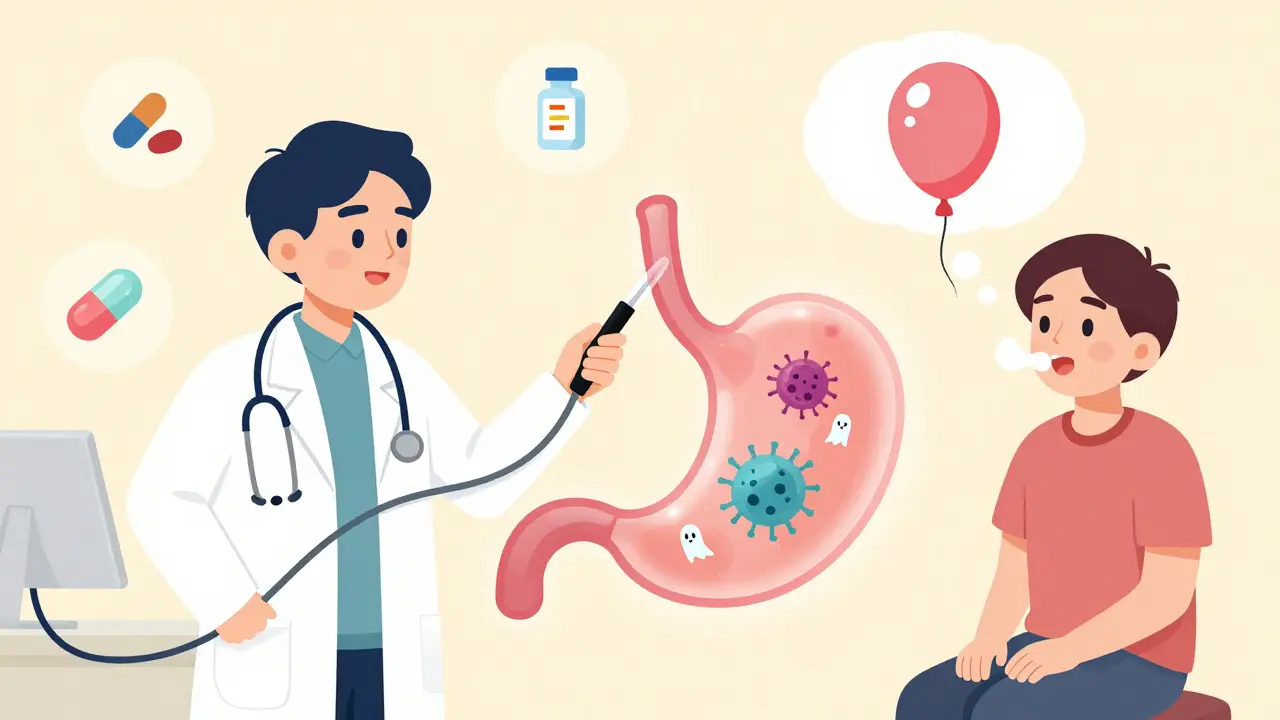
H. pylori Treatment: The Real Game-Changer
If H. pylori is the cause, treating it isn’t optional-it’s life-saving. Left untreated, it increases your risk of stomach cancer by up to 6 times. The standard treatment is called triple therapy: a proton pump inhibitor (PPI) like omeprazole or esomeprazole, plus two antibiotics, usually amoxicillin and clarithromycin. This combo works in 80-90% of cases in areas with low antibiotic resistance. But here’s the problem: clarithromycin resistance is rising. In the U.S., it’s now over 35%, down from just 10% in 2000. That means triple therapy fails more often. In places with high resistance, doctors now use bismuth quadruple therapy-a PPI, bismuth subsalicylate, metronidazole, and tetracycline. This works better, with success rates of 85-92%. A newer drug, vonoprazan (brand name Voquezna), was approved by the FDA in 2022. It’s a potassium-competitive acid blocker-stronger and longer-lasting than traditional PPIs. In clinical trials, it achieved 90.3% H. pylori eradication rates, compared to 75.6% with standard therapy. It’s already being used in Japan and is now available in the U.S. and Australia for patients who’ve failed previous treatments.What About NSAID-Induced Gastritis?
If your gastritis comes from painkillers like ibuprofen or naproxen, the first step is stopping them-if possible. If you need them for arthritis or heart protection, your doctor might switch you to celecoxib (a COX-2 inhibitor), which is gentler on the stomach. Either way, you’ll still need a PPI to let the lining heal. Don’t just stop your meds without talking to your doctor, especially if you’re on them for heart health.What About Lifestyle Changes?
Medication helps, but habits matter. Cutting back on alcohol can reduce symptoms by 60% within two weeks. Smoking slows healing-quitting improves recovery by 35%. Spicy food doesn’t cause gastritis, but it can make symptoms worse. Avoid large meals and lying down right after eating. Stress won’t cause H. pylori, but it can make your symptoms feel worse.What Happens After Treatment?
You can’t just finish your antibiotics and call it done. You need confirmation. About four weeks after finishing treatment, you’ll take a urea breath test or stool test to make sure the bacteria is gone. If it’s still there, you’ll get a second-line regimen-different antibiotics, maybe with vonoprazan. Some people struggle with side effects. Antibiotics can cause diarrhea, metallic taste, or nausea. About 62% of patients report these issues. Taking probiotics like Lactobacillus during treatment can help reduce gut upset. Don’t stop your meds unless the side effects are unbearable-talk to your doctor first.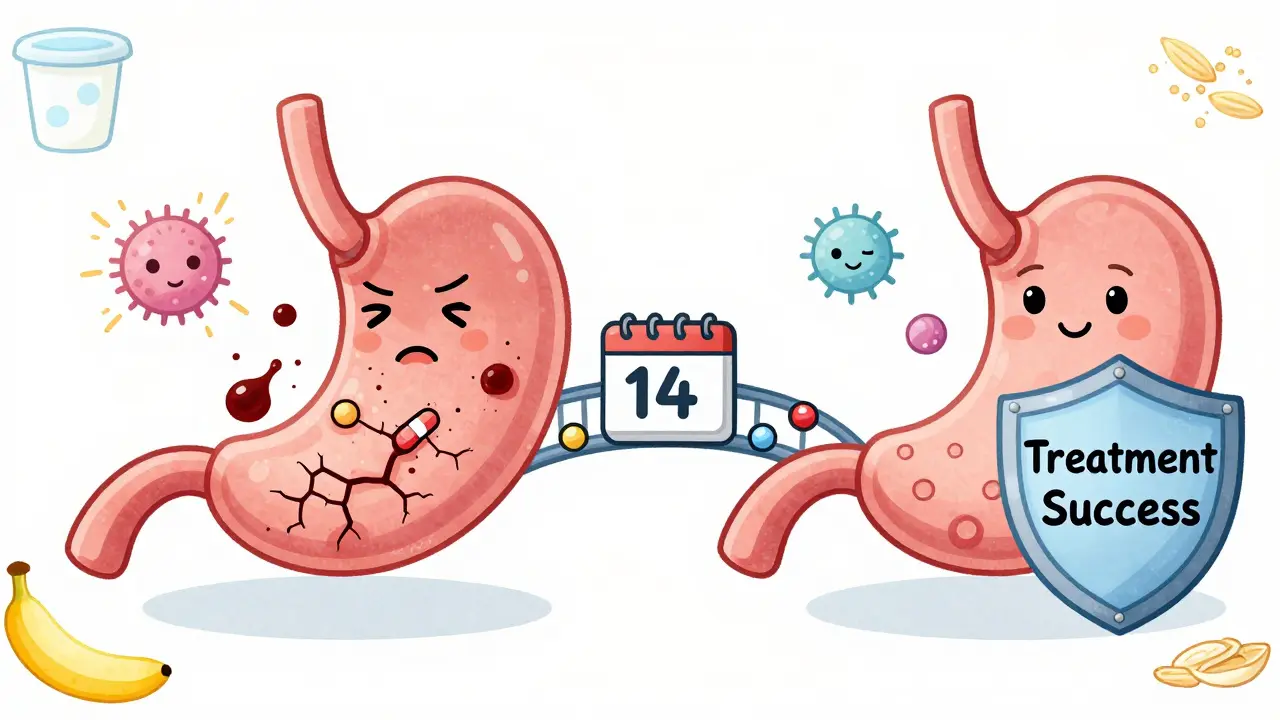
Long-Term Risks and Monitoring
Even after H. pylori is gone, some people still have symptoms. That’s because the stomach lining may have already changed-especially if you had atrophic gastritis. In these cases, your doctor might recommend periodic endoscopies to check for early signs of cancer. Autoimmune gastritis requires lifelong B12 injections or high-dose oral supplements. Without treatment, you risk nerve damage and anemia.When Should You Worry?
Don’t ignore persistent symptoms. If you’ve had upper abdominal pain for more than two weeks, or you’re losing weight without trying, get checked. If you see blood in your stool or vomit, go to the ER. Early detection of H. pylori and proper treatment cuts your risk of stomach cancer by half, according to the American Gastroenterological Association.Common Misconceptions
Not every case of gastritis needs antibiotics. Some people have mild, asymptomatic H. pylori and no ulcers or cancer risk factors. In those cases, doctors may just monitor rather than treat. But if you have symptoms, a history of ulcers, or a family history of stomach cancer-treatment is recommended. Also, PPIs aren’t harmless. Long-term use can lead to rebound acid reflux when you stop them. About 40% of people who take PPIs for over a year experience this. That doesn’t mean you shouldn’t take them-it means you should use them as directed and not self-prescribe.Can gastritis go away on its own?
Acute gastritis caused by short-term triggers like alcohol or NSAIDs can improve if you remove the cause. But chronic gastritis-especially from H. pylori-won’t resolve without treatment. Left untreated, it can lead to ulcers, bleeding, or even stomach cancer. Don’t wait for it to get better on its own.
Is H. pylori contagious?
Yes. H. pylori spreads through contaminated food, water, or close contact like sharing utensils or kissing. It’s more common in crowded or low-income settings with poor sanitation. Most infections happen in childhood. If one family member has it, others should be tested.
Can stress cause gastritis?
Stress doesn’t directly cause H. pylori infection or most forms of gastritis. But severe physical stress-from burns, trauma, or major surgery-can trigger acute erosive gastritis. Emotional stress can worsen symptoms and slow healing, but it’s not the root cause.
What’s the best diet for gastritis?
There’s no one-size-fits-all diet, but avoiding irritants helps. Skip alcohol, caffeine, spicy foods, and acidic items like citrus or tomatoes if they trigger symptoms. Eat smaller, more frequent meals. Focus on bland, easy-to-digest foods like oats, bananas, rice, lean proteins, and vegetables. Probiotic-rich foods like yogurt may help support gut health during treatment.
How long does H. pylori treatment take?
Standard treatment lasts 10 to 14 days. You’ll start feeling better within a few days, but you must finish all your meds-even if you feel fine. Stopping early increases the chance of the bacteria surviving and becoming resistant. Confirmation testing happens four weeks after treatment ends.
Can you get H. pylori again after treatment?
Reinfection is rare in developed countries like Australia or the U.S.-less than 1% per year. But it’s more common in places with poor sanitation. If symptoms return after successful treatment, it’s more likely due to another cause, like NSAID use or autoimmune gastritis, not a new H. pylori infection.

Celia McTighe
This is so helpful! 🙌 I’ve been dealing with bloating for months and just assumed it was stress. Learning about H. pylori being so common really puts things in perspective. Thanks for breaking it down so clearly!
Sydney Lee
I must say, the level of medical literacy displayed in this post is... astonishing. Most people wouldn’t know the difference between erosive and nonerosive gastritis-let alone the pharmacokinetics of vonoprazan. Truly, this is what happens when science is communicated with precision.
Though I must question the reliance on antibiotics in an era of rampant resistance. The author mentions clarithromycin resistance rising-but fails to adequately emphasize the ecological catastrophe of indiscriminate antibiotic use. This is not medicine. This is chemical warfare on your microbiome.
Bradly Draper
I had this for years and didn’t even know. Just thought I was ‘sensitive’ to food. Got tested, turned out I had H. pylori. Took the meds, felt like a new person. No more burning after coffee. Life changed.
sonam gupta
In India we just drink neem water and pray. Why do you need all these pills? Our grandmas knew how to fix stomachs without Western drugs
Ryan Touhill
You know, it’s fascinating how the medical establishment treats H. pylori as a villain-yet ignores the broader context of industrialized food, glyphosate exposure, and the collapse of gut biodiversity.
Yes, antibiotics work. But they’re a bandaid on a ruptured dam. The real question isn’t how to kill the bacteria-it’s why it’s there in the first place. The stomach isn’t a battlefield. It’s an ecosystem. And we’re the ones who poisoned it.
Ellen-Cathryn Nash
I’ve been on PPIs for 5 years. Every time I try to stop, I get acid reflux so bad I feel like my throat is being shredded. I know I’m dependent. I know it’s not ideal. But I’m not willing to risk the burning again. And no one ever tells you how hard it is to quit. This post? It’s the first time I’ve felt seen.
Debra Cagwin
To anyone reading this and feeling overwhelmed-you’re not alone. Getting diagnosed with gastritis can feel scary, but you’re taking the right steps by learning.
Start small: cut out one trigger (maybe caffeine or spicy food), drink more water, and give your stomach space to heal. And if you’re on antibiotics, pair them with a probiotic. Your gut will thank you. You’ve got this.
Samantha Hobbs
So wait-so I can’t just eat tacos and drink tequila and then pop a Tums? 😅 I mean, I knew it wasn’t healthy but I thought it was just ‘me being dramatic’
ANA MARIE VALENZUELA
This is textbook. But let’s be real-how many of these people actually followed up with a breath test? I bet 80% just assumed they were cured. And then they’re back in 6 months with worse symptoms. You can’t treat this like a Netflix binge-finish the episode and forget it. This is your stomach we’re talking about.
Kelsey Youmans
I appreciate the thoroughness of this post. As someone who works in global health, I’ve seen how access to diagnostics and treatment varies dramatically across regions.
In low-resource settings, even basic stool antigen tests are unavailable. The emphasis on vonoprazan and triple therapy is valuable-but it’s a luxury many cannot access. We must advocate for equitable distribution of diagnostics and affordable, effective regimens. Science should not be a privilege.
Hakim Bachiri
I’m not saying this is wrong-but I’m also not saying it’s right. I’ve read three different papers on H. pylori eradication this week. One says bismuth quadruple is gold. Another says vonoprazan is the future. A third says we should be using fecal transplants.
So who’s right? The FDA? The WHO? The guy in the Reddit thread with 200 upvotes? I don’t know anymore. All I know is I’ve got a stomach that feels like a warzone and a doctor who just shrugs and says ‘take this.’
Teresa Marzo Lostalé
It’s strange how we’ve turned our bodies into crime scenes. We scan, we biopsy, we culture, we kill. But we never ask why the crime happened in the first place.
H. pylori isn’t evil. It’s just… surviving. Maybe we’re the invasive species.
Nicole Beasley
Wait so if I eat yogurt every day, does that count as probiotics? 🤔 I mean, I like it and it’s tasty. But is it enough? Or do I need fancy supplements?
oluwarotimi w alaka
H. pylori? That’s a CIA bioweapon disguised as bacteria. They’ve been testing it in poor communities since the 90s. Why do you think they push PPIs so hard? To keep you dependent. To keep you buying. To keep you quiet. You think this is medicine? This is control.
Gran Badshah
Bro I got tested last year after this post. Turned out I had it. Took the meds, felt like a ghost for 2 weeks (all that metallic taste), but now? I can eat spicy food again. No more panic before meals. Best decision ever.