Why Your Pills Might Be Dead Before the Expiration Date
You check the bottle. The expiration date is still six months away. You pop the pill. But what if it’s already lost its power? That’s not just a guess-it’s science. Heat and humidity don’t just make you uncomfortable; they’re quietly destroying the medicine in your cabinet. And you probably don’t even know it.
The expiration date on your medication isn’t a magic deadline. It’s a guarantee-only if the drug was stored properly. The U.S. Food and Drug Administration says expiration dates mean the drug is still fully potent and safe under recommended conditions. But most people store pills in the bathroom, the kitchen, or the glovebox of their car. All of those places are chemical death traps.
What Happens When Heat and Moisture Attack Your Meds
Medications are chemical compounds. They’re designed to stay stable under controlled conditions: between 15°C and 25°C (59°F-77°F) with humidity under 60%. That’s not the same as your house in Brisbane in January. When temperatures climb above 30°C (86°F) and humidity hits 70% or higher, the chemistry starts to break down.
Take aspirin. When it gets wet, it turns into salicylic acid and acetic acid-the same stuff that gives vinegar its bite. That doesn’t just make it less effective. It can irritate your stomach more than the original pill ever did.
Insulin is even worse. A 2023 study in the Journal of Hospital Association of Hawaii found that insulin loses up to 20% of its potency after just 24 hours at 37°C (98.6°F). That’s body temperature. If you leave your insulin pen on the counter after a morning walk, you’re not just wasting money-you’re risking high blood sugar, diabetic ketoacidosis, or worse.
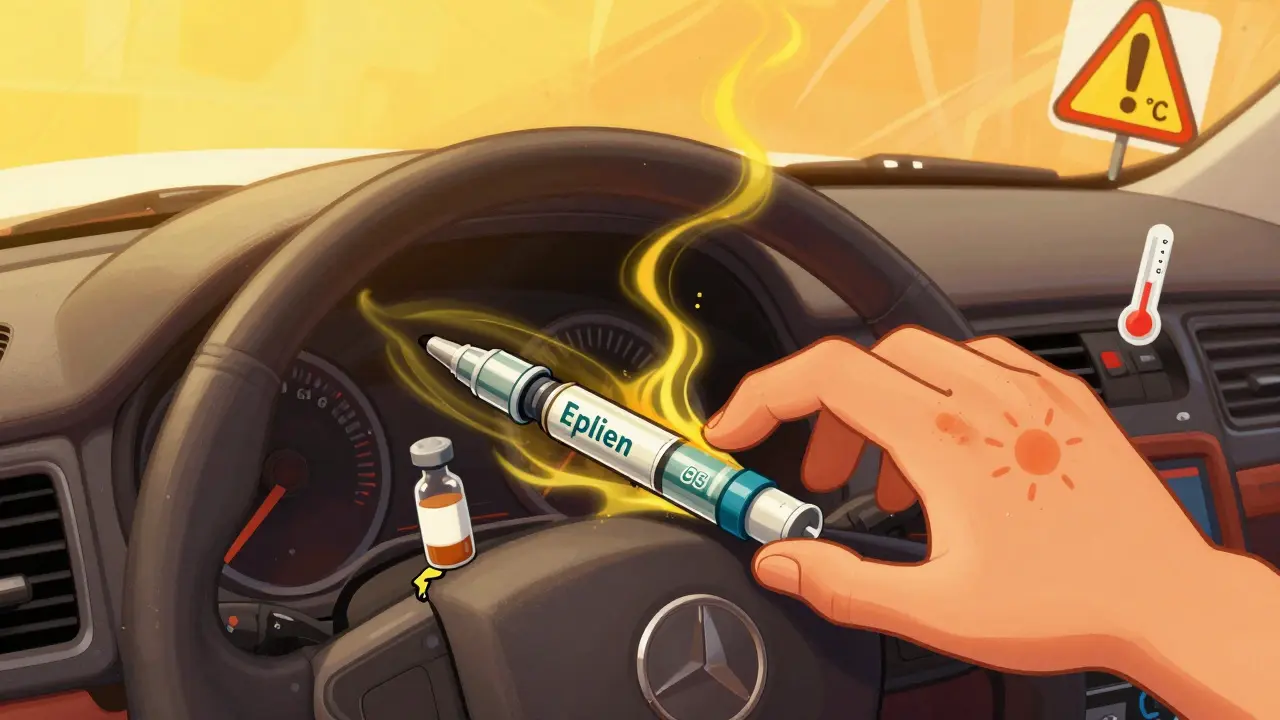
Biologics like monoclonal antibodies? They’re proteins. Heat above 8°C (46°F) makes them unfold and clump. Once that happens, they’re permanently ruined. No amount of cooling fixes it. Same goes for EpiPens. When they’re left in a hot car, the spring mechanism can fail. In anaphylaxis, a failed EpiPen isn’t just inconvenient-it’s deadly.
Not All Pills Are Created Equal
Some meds are tough. Others are fragile. Knowing the difference saves lives.
- High-risk meds: Insulin, nitroglycerin (for angina), thyroid pills, liquid antibiotics like amoxicillin suspension, biologics, EpiPens, inhalers, and glucose test strips. These degrade fast in heat or moisture.
- More stable meds: Tablets of ibuprofen, acetaminophen, statins, and most generic pills. These hold up better-up to 90% potency even at 30°C for months. But even they can fail if soaked in steam from your shower.
Hard capsules are better than soft ones. Tablets beat liquids. Pills in foil blisters last longer than those in plastic bottles. Why? Because moisture can’t get in as easily. That’s why pharmacies seal meds in bottles with desiccants-those little packets that say “Do Not Eat.” They’re not there for show. They’re keeping your pills from turning to mush.
Where You’re Probably Storing Your Meds (And Why It’s Wrong)
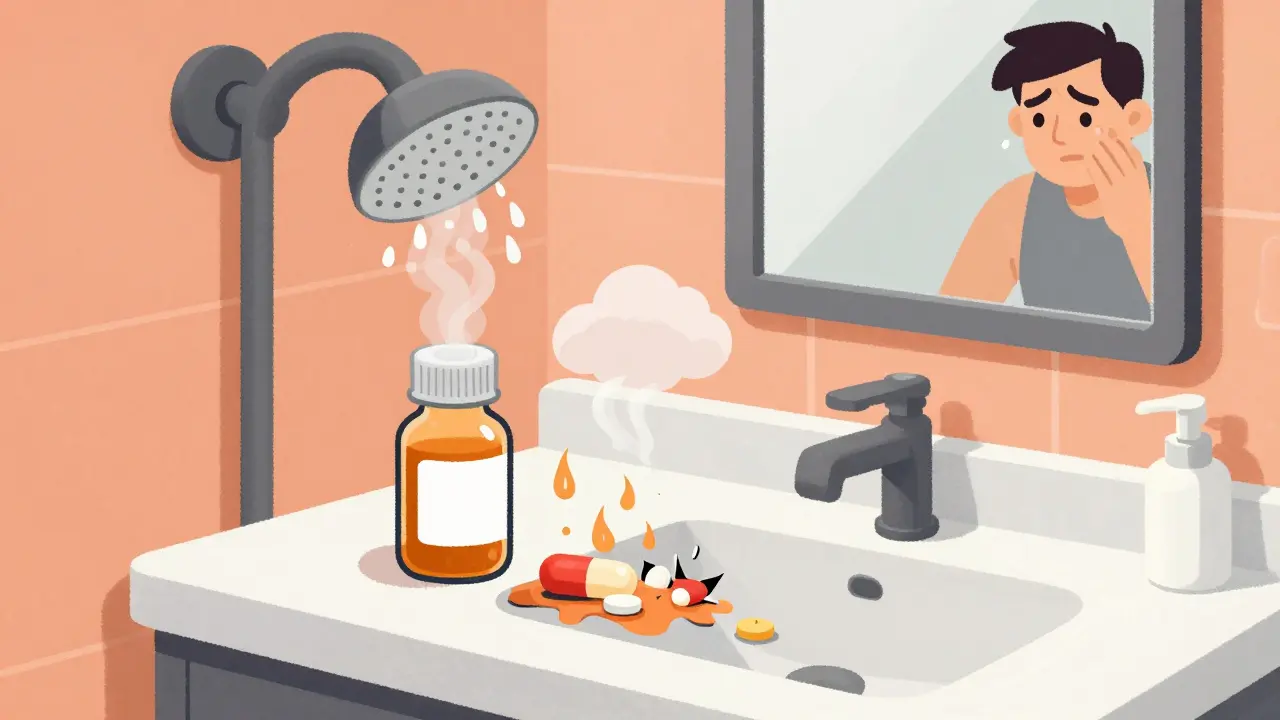
The bathroom is the worst place. Every time you shower, humidity spikes to 70-90%. Heat from the water rises. Pills sitting on the counter? They’re being steamed. That’s why you sometimes see tablets sticking together, capsules cracking, or pills changing color. That’s not aging. That’s damage.
The kitchen? Bad too. Near the stove, oven, or sink, temperatures regularly hit 32°C (90°F). Humidity from boiling water or dishwashers creeps in. A 2020 NIH study confirmed: bathrooms and kitchens are the top two places where medications lose potency.
And don’t forget the car. On a sunny day in Brisbane, the inside of a parked car can hit 60°C (140°F). That’s hotter than an oven. Pills in a purse or glovebox? They’re baking. Inhalers can explode. Liquid meds can separate. Insulin becomes useless.
What You Can Actually Do to Protect Your Meds
You don’t need a fridge for everything. But you do need to be smart.
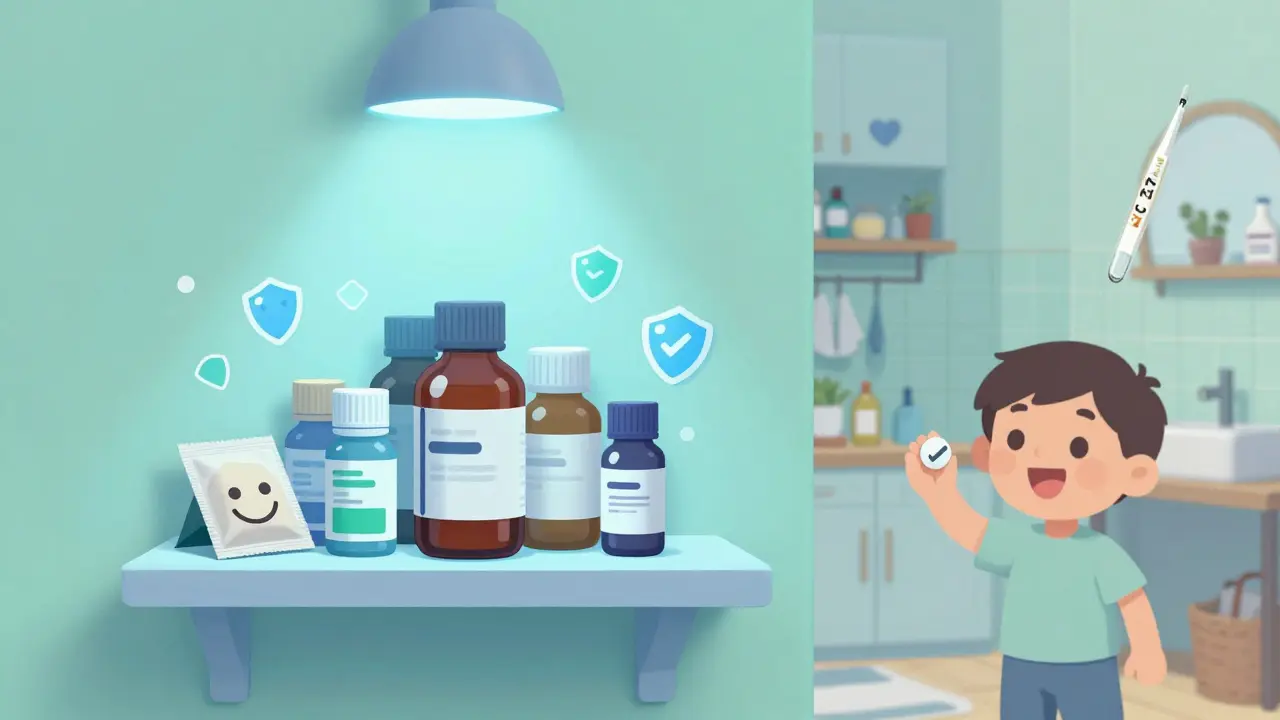
- Store in a cool, dry place. A bedroom drawer, a closet shelf, or a cabinet away from windows works. Keep it below 25°C and below 60% humidity.
- Keep it in the original bottle. Those bottles aren’t just plastic. They’re designed with child-resistant caps, opaque material to block light, and tight seals. Don’t dump pills into pill organizers unless you’re using them immediately.
- Use a cool pack for travel. If you’re heading out for the day with insulin or a biologic, buy a pharmacy-grade cooling pack. They’re cheap and last 8-12 hours.
- Never leave meds in the car. Not even for 10 minutes. If you’re going to the pharmacy, bring a cooler bag.
- Check for signs of damage. Discoloration? Odd smell? Pills that are sticky, cracked, or harder than usual? Toss them. You can’t tell if a pill is still good just by looking at the date.
Dr. Hani Jneid from Baylor College of Medicine says thyroid meds should be kept away from light and moisture, and never above 86°F. That’s not a suggestion. That’s a safety rule.
The Real Danger: Invisible Failure
Here’s the scary part: you won’t feel it when your meds go bad.
If your blood pressure pill loses 30% of its strength, you won’t suddenly feel dizzy. You’ll just notice your numbers creeping up over weeks. By then, you’ve increased your risk of stroke or heart attack.
If your antibiotic is weakened, it won’t kill all the bacteria. The survivors become resistant. That’s how superbugs form. The NIH says this is one of the biggest hidden dangers of improper storage.
And insulin? If it’s degraded, your blood sugar spikes. You might not realize it until you’re in the hospital. A 2022 study from Ohio State University showed that EpiPens exposed to heat had a 15-20% failure rate. That’s one in five people who think they’re protected-and aren’t.
What’s Changing in the Industry
Pharmaceutical companies are starting to wake up. New packaging includes temperature-sensitive labels that change color if the drug got too hot. Some insulin pens now have built-in heat sensors. Smart blister packs with Bluetooth chips are being tested-linking to your phone to warn you if your meds got too warm.
But here’s the problem: most of that tech is still in labs or hospitals. For the average person, the advice hasn’t changed since the 1990s: keep it cool, keep it dry, keep it dark.
And that’s the real challenge. As climate change brings more heat waves-Brisbane hit 43°C in December 2024-more people will be storing meds in unsafe conditions. The World Health Organization now calls medication stability in extreme heat a growing global health threat.
When in Doubt, Toss It
The FDA says it plainly: “Using expired medicines is risky and possibly harmful to your health.” But even before expiration, heat and humidity can make them dangerous.
If you’re unsure-whether it’s because the bottle got hot, the pills look odd, or you just can’t remember where you stored them-throw it out. Replacing a $10 pill is cheaper than an ER visit. Replacing a life? That’s not an option.
Your meds aren’t just chemicals. They’re your safety net. Treat them like it.

Gregory Parschauer
Let me be crystal clear: storing meds in the bathroom is not just negligent, it’s criminal. You’re not just risking your own life-you’re contributing to antimicrobial resistance on a societal level. The FDA guidelines exist for a reason, and ignoring them because ‘it’s just one pill’ is the exact kind of cognitive dissonance that’s killing us. Desiccants aren’t decorative. They’re your last line of defense. If you can’t be bothered to read the label, don’t expect the system to save you.
And don’t get me started on EpiPens in cars. That’s not ‘forgetting’-that’s playing Russian roulette with anaphylaxis. I’ve seen patients arrive in the ER with melted pens and zero epinephrine. No one’s coming to save you when your auto-injector fails. You think the hospital staff will thank you for your ‘oops’? They’ll just document it as a preventable death.
This isn’t about convenience. It’s about accountability. If you’re the type who leaves insulin on the counter while you make coffee, you don’t deserve to live with a chronic condition. Period.
mike swinchoski
People are dumb. Pills don’t care if it’s hot. They just break. You think your body knows the difference between a good pill and a bad one? Nah. It just gets sicker. I had a cousin who took old antibiotics and got a superbug. Now he’s on IVs every month. All because he kept his meds in the bathroom. Dumb. Just dumb.
Lethabo Phalafala
I grew up in a house where the medicine cabinet was above the toilet-same as everyone in my neighborhood. We didn’t know any better. My grandmother took her thyroid pills for years like that. She never said a word about feeling off, but her heart was always racing. Only when she moved to a cooler apartment did her doctor finally say, ‘Your meds might’ve been cooking for 20 years.’
It broke my heart. Not because she was careless-because no one ever told her. We need more public health campaigns that don’t sound like a lecture from a pharmacist. We need stories like this-real, raw, and relatable. If you’re reading this and you keep your insulin on the windowsill? Please, for the love of everything holy, move it. You’re not being lazy. You’re just unaware. And awareness is the first step to survival.
Lance Nickie
lol so u mean my aspirin that i left in my car last summer is now vinegar? cool. i’ll just take 2x then. problem solved.
vishnu priyanka
In India, we’ve always stored medicines in tin boxes tucked away in cupboards-away from sun and steam. My grandma used to say, ‘If the medicine sweats, it’s dead.’ We didn’t need a PhD to know that. Now I see people in the US keeping pills in their gym bags, in the glovebox, even in their beach towels. I mean, it’s like leaving your phone in a sauna and wondering why it dies.
Also, the part about blister packs? Yes. Foil beats plastic every time. Even the local chemist here wraps my pills in foil if I ask. It’s cheap, it’s old-school, and it works. Maybe we don’t need smart Bluetooth packs. Maybe we just need to remember how our grandparents did it.
Robin Williams
Think about it-your meds are tiny time capsules of chemistry. They’re holding their breath until you need them. But you? You’re treating them like snacks you left on the dashboard.
Heat doesn’t just ‘degrade’ them. It murders their soul. That insulin? It was made to save lives. Not to become a warm, useless puddle while you grab a soda at the gas station.
We’ve turned medicine into a commodity. But it’s not a product. It’s a promise. A promise between your body and science. And when you break that promise? You’re not just wasting money. You’re betraying your own survival.
So yeah. Keep it cool. Keep it dark. Keep it sacred.
Scottie Baker
Y’all are acting like this is some new revelation. I’ve been telling my mom for years not to keep her blood pressure pills next to the stove. She still does it. ‘It’s fine, I’ve done it for 30 years!’ Yeah, and your kidneys are probably holding a grudge.
And don’t even get me started on people who think ‘expired’ means ‘still good.’ That’s like saying your milk’s fine because the carton says ‘best by’ and you didn’t see mold yet.
I’m not mad. I’m just disappointed. And honestly? I’m scared for all of us.
Anny Kaettano
As a nurse who’s seen too many ER visits tied to degraded medications, I want to say this gently: you are not alone in this ignorance. Most people don’t know this stuff. But now you do. And knowledge is power-not just for you, but for everyone around you.
Start small. Move your meds to a drawer. Use a cool pack for travel. Ask your pharmacist for advice-most will give you a free humidity indicator strip. And if you’re caring for an elderly parent or someone with diabetes? Don’t assume they know. Show them. Help them.
This isn’t about fear. It’s about compassion. And yes, it’s also about science. But the science only matters if we translate it into action. So act. Today. Your life, or someone else’s, might depend on it.
Kimberly Mitchell
The FDA’s ‘recommended conditions’ are a fantasy. No one lives in a climate-controlled lab. The whole premise is elitist. You want people to store meds in a dark, dry, 22°C drawer? That’s a luxury for people who don’t live in a 1200-square-foot apartment with no AC and three kids running around.
Instead of shaming people for storing pills in the bathroom, fix the infrastructure. Fix housing. Fix access to cool storage. Stop blaming the victim for not having a climate-controlled medicine cabinet. This isn’t about personal responsibility. It’s about systemic failure dressed up as a PSA.
Angel Molano
Throw it out. Don’t think. Don’t check. Just toss it. Your life isn’t worth the $10.