Hypothyroidism-Statin Risk Calculator
How This Tool Works
Input your TSH level and statin type to see your risk of statin-induced muscle damage. Based on research showing untreated hypothyroidism increases myopathy risk by 3-4 times.
Your Myopathy Risk
When you’re on statins to lower cholesterol, muscle pain or weakness can feel like just another side effect. But if you also have hypothyroidism, that ache might not be harmless-it could be a warning sign of something far more serious. The combination of an underactive thyroid and statin therapy doesn’t just add up; it multiplies risk. People with untreated or poorly controlled hypothyroidism are 3 to 4 times more likely to develop statin-induced myopathy, and in rare cases, life-threatening rhabdomyolysis.
Why This Interaction Is More Than Just a Coincidence
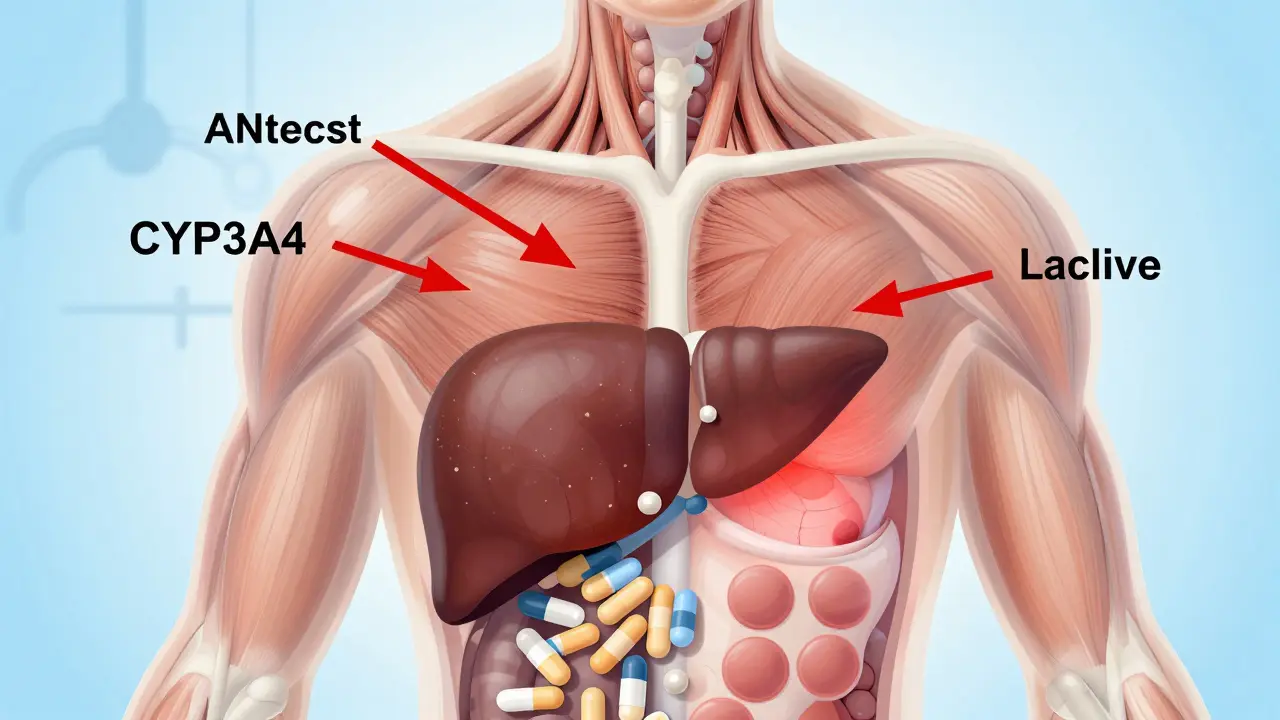
It’s not that statins cause muscle damage in everyone. Most people tolerate them fine. But when your thyroid isn’t producing enough hormone, your body’s ability to handle statins breaks down in several key ways. First, hypothyroidism slows down the liver’s ability to process drugs. Statins like simvastatin, atorvastatin, and lovastatin are broken down by an enzyme called CYP3A4. In hypothyroid patients, this enzyme works 30-50% slower, meaning the drug builds up in your blood. Higher levels = higher risk. Second, your muscles are already running on low energy. Thyroid hormones help power your mitochondria-the tiny energy factories inside muscle cells. When thyroid levels are low, those mitochondria struggle. Statins make this worse by reducing coenzyme Q10 (CoQ10), a compound your muscles need to produce energy. Studies show statins can drop CoQ10 levels by 25-50%. Combine that with a thyroid that’s already starving your muscles of fuel, and you’ve got a perfect storm for muscle breakdown.How Bad Can It Get?
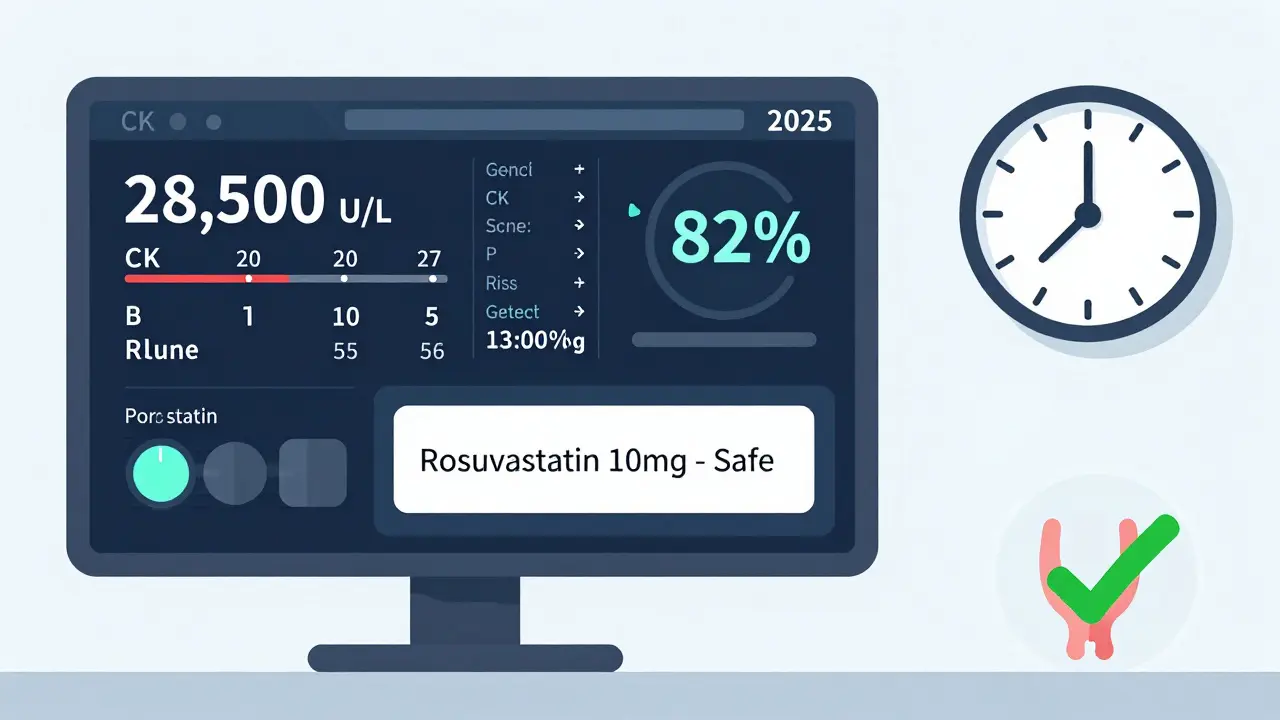
The worst-case scenario is rhabdomyolysis. This is when muscle tissue breaks down so badly that it floods your bloodstream with proteins like creatine kinase (CK). Your kidneys can’t filter it all, leading to kidney failure. A 2015 case report in the European Thyroid Journal described a patient whose CK levels soared past 15,000 U/L-over 30 times the normal limit. He needed emergency dialysis. Another case in 2023 had a CK level of 28,500 U/L. The patient survived, but only because doctors caught it in time. The risk isn’t theoretical. A 2019 study of over 12,000 people found that those with TSH levels above 10 mIU/L had more than four times the risk of statin myopathy compared to those with normal thyroid function. Even subclinical hypothyroidism-where TSH is between 4.5 and 10-doubles the risk. And it’s not just about numbers. Real people report it. On Reddit, users describe muscle pain so severe they couldn’t climb stairs. One patient, after starting atorvastatin with a TSH of 9.2, saw his CK spike to 8,400 U/L. He had to stop all meds for weeks.Not All Statins Are Created Equal
If you have hypothyroidism, the type of statin you take matters a lot. Lipophilic statins-those that dissolve easily in fat-penetrate muscle tissue more deeply. That includes simvastatin, atorvastatin, and lovastatin. These are the ones most often linked to muscle problems in thyroid patients. Hydrophilic statins, like pravastatin and rosuvastatin, don’t enter muscle cells as easily. They’re safer. A 2021 meta-analysis showed that simvastatin at 40 mg or higher had a 12.7% myopathy rate in hypothyroid patients. Pravastatin? Just 1.3%. Rosuvastatin at 10-20 mg carries only a 1.4-fold increased risk compared to a 3.2-fold risk with atorvastatin. That’s why the 2022 American College of Cardiology guidelines now say: avoid high-dose simvastatin in hypothyroid patients. If you’re on it and have an underactive thyroid, talk to your doctor about switching. Rosuvastatin or pravastatin are better choices.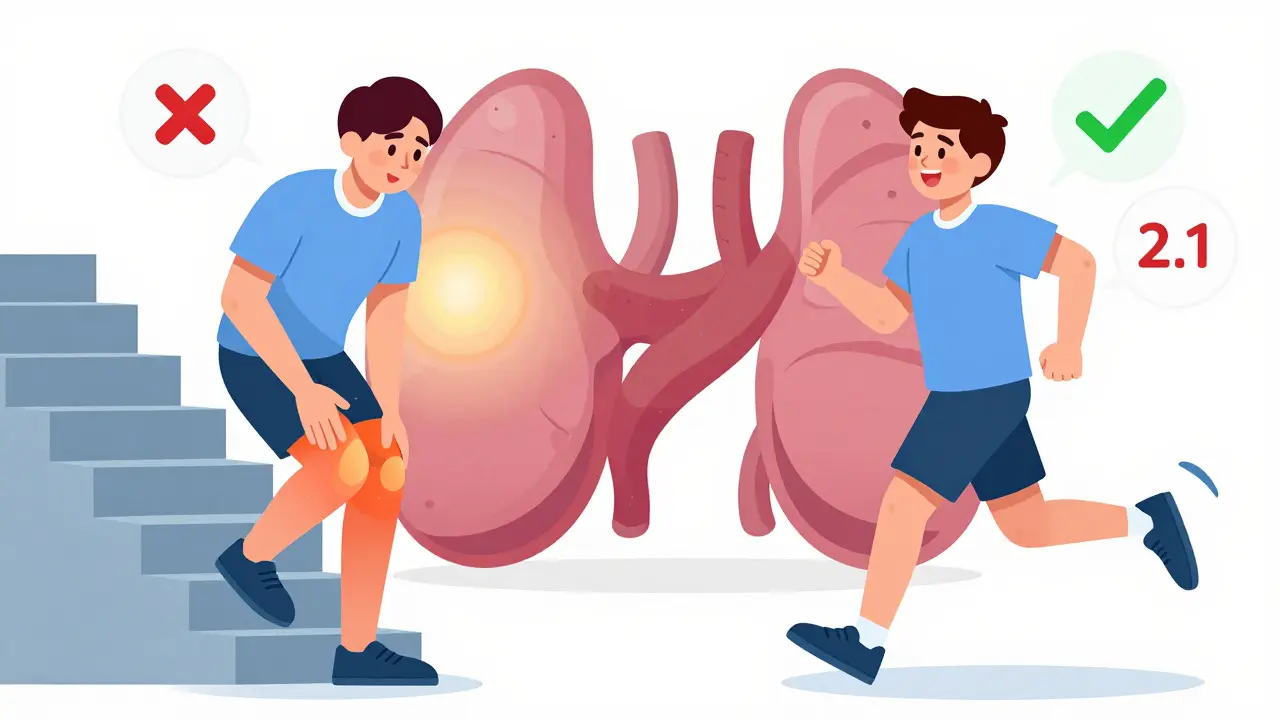
What Should You Do Before Starting a Statin?
The answer is simple: get your thyroid checked-before you take the first pill. The 2023 American Thyroid Association guidelines recommend testing TSH and free T4 before starting any statin. If your TSH is above 4.0 mIU/L, you’re at increased risk. The goal? Get your TSH between 0.5 and 3.0 mIU/L before beginning statin therapy. That’s not just a suggestion-it’s a proven way to cut myopathy risk by 78%, according to Dr. Paul W. Ladenson of Johns Hopkins. Don’t assume your thyroid is fine because you’re on levothyroxine. Many patients are under-treated. TSH levels above 4.0 are common in people who think they’re “stable.” But that’s not stable enough when you’re on a statin. A 2023 Healthline survey of over 1,200 hypothyroid statin users found that 73% who developed muscle pain had TSH levels above 4.5.Monitoring and What to Watch For
Even if your thyroid is under control, you still need to monitor for muscle symptoms. Don’t wait for severe pain. Early signs include:- Mild soreness after walking or climbing stairs
- Unexplained fatigue that doesn’t improve with rest
- Stiffness or cramping, especially in the thighs or shoulders
Why So Many People Stop Their Statins-And Why They Shouldn’t
Here’s the sad part: many hypothyroid patients stop their statins because of muscle pain. A 2022 study found that 32.4% of hypothyroid patients quit statins within a year due to side effects. In contrast, only 14.7% of people with normal thyroid function did. That’s over 6 million unnecessary statin discontinuations in the U.S. each year. But here’s the good news: when thyroid function is properly managed, 85-90% of hypothyroid patients can safely stay on statins. A 2023 Circulation study showed that once TSH was optimized, these patients had the same risk of heart attack or stroke as people without thyroid disease. The statin wasn’t the problem. The uncontrolled thyroid was.What’s Changing in 2026?
The FDA is preparing new guidance requiring thyroid testing before high-intensity statin use. The European Medicines Agency will soon require warnings about this interaction on all statin packaging. And research is moving fast. A 2023 Nature Medicine study identified a genetic risk score that combines thyroid-related genes and a specific gene variant (SLCO1B1) to predict myopathy risk with 82% accuracy. A clinical trial called THYROSIMVASTATIN (NCT05328761) is testing a personalized risk calculator that will soon help doctors pick the safest statin based on your thyroid level and DNA. Results are expected in mid-2025.Bottom Line: Control Your Thyroid, Protect Your Muscles
Statin therapy saves lives. Hypothyroidism is manageable. But together, without proper management, they can be dangerous. If you have hypothyroidism and are on-or considering-a statin:- Get your TSH and free T4 tested before starting
- Work with your doctor to get TSH between 0.5 and 3.0 mIU/L
- Avoid high-dose simvastatin (≥40 mg)
- Choose rosuvastatin or pravastatin if possible
- Report any muscle pain early-even if it’s mild
- Don’t stop your statin without talking to your doctor
Can hypothyroidism cause muscle pain even without statins?
Yes. Untreated hypothyroidism can cause muscle stiffness, cramps, and weakness on its own due to reduced energy production in muscle cells. This is called hypothyroid myopathy. Symptoms often improve with thyroid hormone replacement. But when statins are added, the damage becomes much worse and faster.
Should I stop my statin if I have hypothyroidism?
No-not unless your doctor advises it. The real issue isn’t the statin itself, but uncontrolled thyroid levels. Most people with hypothyroidism can safely take statins once their TSH is in the target range (0.5-3.0 mIU/L). Stopping statins unnecessarily raises your risk of heart attack and stroke.
Is there a blood test to check for statin-related muscle damage?
Yes. Creatine kinase (CK) is the main blood marker. High levels indicate muscle breakdown. Your doctor should check CK at baseline and again after 3 months of starting or changing a statin. If CK is over 10 times the upper limit of normal-or over 5 times with symptoms-you should stop the statin and get evaluated.
Can CoQ10 supplements prevent statin muscle pain in hypothyroid patients?
Evidence suggests yes. A 2020 randomized trial found that 200 mg of CoQ10 daily reduced muscle pain by 53.6% in hypothyroid patients taking statins. While not yet a formal recommendation in all guidelines, it’s low-risk and often used by clinicians. Talk to your doctor before starting.
Why is TSH above 4.0 a problem for statin users?
TSH above 4.0 indicates suboptimal thyroid hormone levels, even if you’re on medication. At this level, your liver processes statins more slowly, and your muscles are already energy-deprived. Studies show this increases myopathy risk by 2-4 times. The goal isn’t just to be “in range”-it’s to be in the optimal range (0.5-3.0) to protect your muscles and heart.
What if my TSH is normal but I still have muscle pain on statins?
You may still have subclinical hypothyroidism or another issue like vitamin D deficiency, genetic risk (SLCO1B1 variant), or an autoimmune condition. Ask your doctor to check free T4, vitamin D, and consider genetic testing if symptoms persist. Switching to a hydrophilic statin like rosuvastatin may also help.

Jessie Ann Lambrecht
Okay but let’s be real - if your doctor didn’t check your TSH before throwing you on a statin, they’re not doing their job. I had muscle pain so bad I could barely lift my coffee mug. Turns out my TSH was 8.7. I was told I was ‘fine’ on levothyroxine. Turns out ‘fine’ is a lie. Switched to rosuvastatin, got my TSH down to 1.9, and now I’m hiking again. Don’t let anyone gaslight you about your thyroid. You’re not imagining the pain.
Anastasia Novak
Ugh. Another ‘thyroid is the root of all evil’ post. Look, statins cause myopathy in 5-10% of people. Period. Hypothyroidism? Maybe a multiplier. But let’s not turn every ache into a medical thriller. CoQ10 supplements? Please. That’s just placebo with a fancy label. And don’t get me started on ‘personalized risk calculators’ - we’re not in Star Trek yet. The real problem? Overmedication culture. You don’t need a statin unless your LDL is 190+. End of story.
Jonathan Larson
The intersection of endocrinology and pharmacology is one of the most underappreciated domains in clinical medicine. The biochemical cascade initiated by suboptimal thyroid hormone levels - particularly the downregulation of hepatic CYP3A4 activity and mitochondrial dysfunction - creates a pharmacokinetic and pharmacodynamic vulnerability that is neither trivial nor coincidental. The data presented here are not merely observational; they are mechanistically coherent. One must ask: if we accept that thyroid status modulates drug metabolism, why is baseline TSH not universally mandated prior to statin initiation? The answer lies not in science, but in systemic inertia. We must demand better.
Alex Danner
Let me tell you what no one says: if you're on levothyroxine and your TSH is 5.2, you’re not ‘stable’ - you’re just not in crisis yet. I was that guy. Took simvastatin 40mg, woke up feeling like my legs were wrapped in concrete. CK hit 12,000. Thought I was dying. Turned out my endo was just ‘waiting to see if I needed more meds.’ I switched to pravastatin 10mg, upped my levo to 112mcg, and my CK dropped to normal in 6 weeks. Don’t wait for your doctor to catch up. Get your own labs. Fight for your body.
Elen Pihlap
my tsh was 12 and i was on atorvastatin and i couldnt even open a jar and now i cry every time i think about it
Katrina Morris
so i just got my tsh checked after reading this and it was 4.8 😭 i thought i was fine because i take synthroid but now im scared to take my statin tomorrow... should i wait till i see my dr or just skip it for now? also anyone know if walmart has coq10 cheap??
Poppy Newman
CoQ10 changed my life 💪 thyroid + statin = nightmare, but 200mg daily and suddenly I can walk up stairs again 🙌 also switched to rosuvastatin - no more ‘why does my thigh feel like it’s full of wet sand’ 🥲
Ayodeji Williams
bruh u all actin like statins be killin y’all. i got hypothyroidism and i take atorvastatin and i’m fine. y’all just wanna be sick. my uncle in nigeria take no pills and still live to 92. maybe stop stressin and eat more yam? 🤷♂️