
Getting the right dose of medicine isn’t just about following the label. For many people, the standard dose on the bottle can be too much-or too little-depending on their age, weight, and how well their kidneys are working. A 70-year-old with kidney disease, a 120-pound elderly woman, or a 300-pound man with diabetes might all need completely different amounts of the same drug. Get it wrong, and you risk serious harm: kidney damage, confusion, falls, or even death. Get it right, and the medicine works as it should-without side effects.
Why One Size Doesn’t Fit All
Medicines move through your body in predictable ways. They’re absorbed, distributed, broken down, and then cleared-mostly by your kidneys. But your body changes over time. As you age, your kidneys slow down. Muscle mass drops, fat increases, and blood flow to organs decreases. All of this affects how drugs behave. A 65-year-old might clear a drug 30% slower than a 30-year-old, even if both have the same serum creatinine level. That’s why older adults are 30% more likely to have an adverse drug reaction, and nearly half of those are due to incorrect dosing in kidney impairment.
Weight matters too. If you’re underweight, drugs may build up faster because there’s less tissue to spread them through. If you’re obese, some drugs get trapped in fat and don’t reach their target effectively. The body doesn’t treat a 250-pound person the same way it treats a 130-pound person, even if both have normal kidney function. Many guidelines now use adjusted body weight for dosing in obesity, not actual weight. This prevents overdosing while still ensuring enough drug gets to the target.
Kidney Function: The Silent Gatekeeper
Your kidneys filter about 120 to 150 quarts of blood each day. When they’re healthy, they remove waste and excess drugs. When they’re not, those drugs stick around-building up to toxic levels. About 37 million Americans have chronic kidney disease (CKD), and many more are undiagnosed. In Australia, 1 in 10 adults has some level of kidney impairment. Yet, most people don’t know their kidney function until it’s too late.
Doctors don’t just look at serum creatinine. They calculate estimated glomerular filtration rate (eGFR) using the CKD-EPI equation. This formula uses your age, sex, race, and creatinine level to estimate how well your kidneys are filtering. The results are grouped into stages:
- Stage 1: eGFR ≥90 (normal or high, but with kidney damage)
- Stage 2: eGFR 60-89 (mild reduction)
- Stage 3a: eGFR 45-59 (mild to moderate)
- Stage 3b: eGFR 30-44 (moderate to severe)
- Stage 4: eGFR 15-29 (severe)
- Stage 5: eGFR <15 (kidney failure)
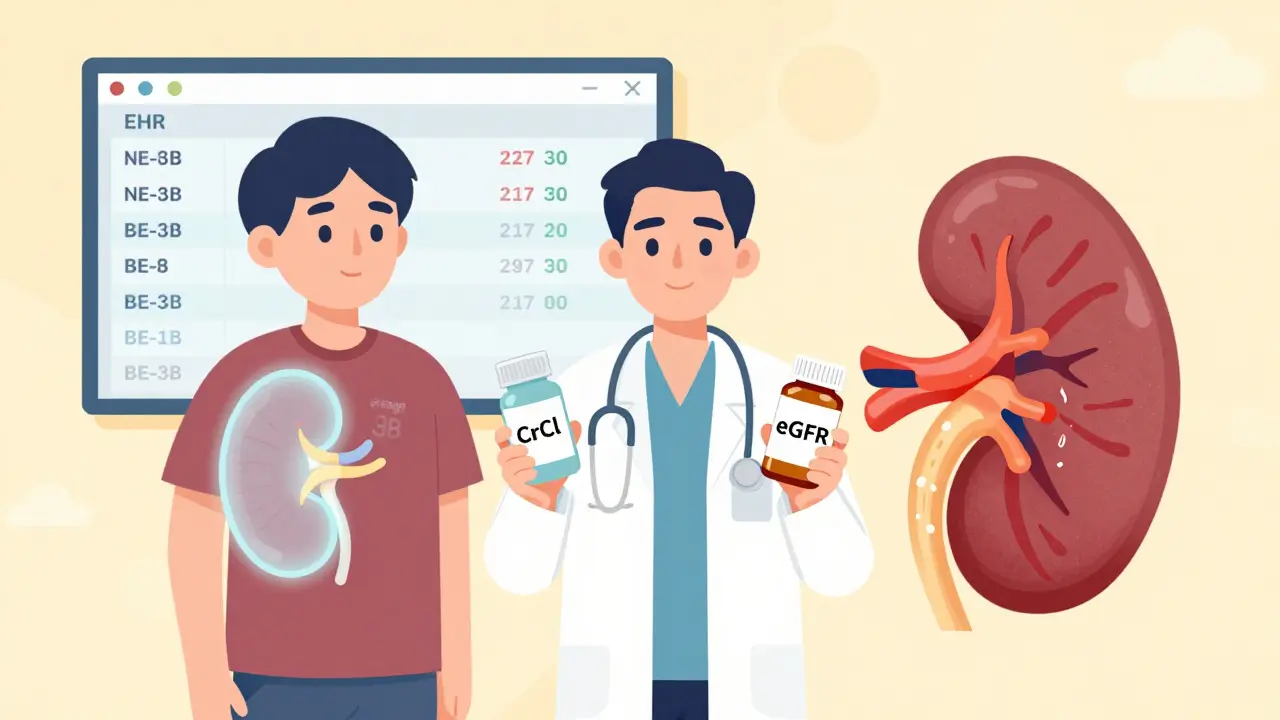
But here’s the catch: while eGFR is used to stage kidney disease, most drug dosing guidelines still rely on creatinine clearance (CrCl), calculated using the Cockcroft-Gault equation. Why? Because drug studies were done using CrCl, not eGFR. And CrCl accounts for body weight-something eGFR doesn’t. So even if your eGFR says you’re in Stage 3, your actual drug clearance might be lower if you’re underweight or higher if you’re obese. This mismatch causes confusion-and errors.
Calculating the Right Dose: Cockcroft-Gault vs. CKD-EPI
Two equations are used to estimate kidney function. One is for staging disease. The other is for dosing drugs. Mixing them up is a common mistake.
Cockcroft-Gault (CrCl):
(140 − age) × weight (kg) × 0.85 (if female) ÷ (serum creatinine × 72)
This equation includes weight and age, making it better for drug dosing-especially in obese patients. For those with BMI over 30, doctors use adjusted body weight:
Adjusted weight = Ideal body weight + 0.4 × (actual weight − ideal weight)
Ideal body weight = 50 kg + 2.3 kg for every inch over 5 feet (men), or 45.5 kg + 2.3 kg for every inch over 5 feet (women).
CKD-EPI (eGFR):
This is more accurate for general kidney health, especially in older adults and those with normal or near-normal kidney function. It doesn’t use weight. That’s why it’s used for diagnosis, not dosing. But many EHR systems now auto-calculate eGFR and display it prominently-leading clinicians to assume it’s the right number for prescribing.
A 2022 study in the Journal of Clinical Pharmacy and Therapeutics found that 41% of residents used the wrong weight type when calculating CrCl. They used actual weight in obese patients. Result? Underdosing of antibiotics, leading to treatment failure. In another case, a pharmacist caught a diabetic patient on 1000 mg of metformin twice daily-despite an eGFR of 28. The safe maximum is 500 mg daily. The patient had been on the wrong dose for six months.
What Drugs Need Adjustment?
Not every drug needs a dose change. But many common ones do:
- Antibiotics (vancomycin, cefazolin, ciprofloxacin)
- Diabetes drugs (metformin, sitagliptin, glipizide)
- Heart medications (digoxin, lisinopril, furosemide)
- Pain relievers (morphine, codeine, gabapentin)
- Seizure drugs (phenytoin, levetiracetam)
For example, metformin is contraindicated if eGFR is below 30. Between 30 and 45, the dose must be reduced. Between 45 and 60, it’s usually okay at standard doses. But many prescribers don’t check. A 2022 survey by the American Society of Health-System Pharmacists found that 68% of pharmacists saw inappropriate renal dosing at least once a week. Antibiotics were the most common error (32%), followed by heart meds (28%) and diabetes drugs (22%).
Real-World Problems and Solutions
Doctors aren’t bad. They’re overwhelmed. A full assessment takes 5 to 7 minutes per patient. That’s time they don’t always have. In emergency rooms, where rapid decisions are needed, dosing errors spike. One pharmacist on Reddit shared a near-miss: a patient was given a full dose of vancomycin for a UTI, despite having Stage 3B CKD. The drug level spiked to toxic levels. They ended up in the ICU.
But there’s hope. Hospitals that integrated automated CrCl calculators into their electronic health records saw a 53% drop in dosing errors over 18 months. Alerts that pop up when a drug is prescribed to someone with low kidney function reduce serious errors by 47%. Still, not all systems are equal. Some use eGFR. Others use CrCl. Some don’t adjust for weight at all. One pharmacist in Chicago reported seeing five different dosing recommendations for the same antibiotic, depending on which hospital formulary they checked.
The solution? Standardization. A new reference database from the American Society of Nephrology and the American Society of Health-System Pharmacists is set to launch in 2025. It will unify dosing guidelines across all major sources. Until then, clinicians must double-check. Don’t trust the EHR default. Don’t assume the label is safe. Always verify the drug’s specific renal dosing recommendation-using CrCl, adjusted weight, and stage-appropriate thresholds.
What You Can Do
If you’re taking medications regularly, especially if you’re over 65, underweight, overweight, or have high blood pressure or diabetes:
- Ask your doctor or pharmacist: “Is my dose right for my kidneys?”
- Know your eGFR number. If you don’t know it, ask for a recent lab result.
- Bring a list of all your meds to every appointment-including supplements.
- Don’t assume a new prescription is safe just because it’s from a specialist.
- If you feel dizzy, confused, or unusually tired after starting a new drug, call your pharmacist. It might be a dosing issue.
For caregivers of elderly relatives: watch for signs of drug toxicity-confusion, falls, loss of appetite, swelling in the legs. These aren’t just “getting older.” They could be signs of a drug overdose.
The Future: Personalized Dosing
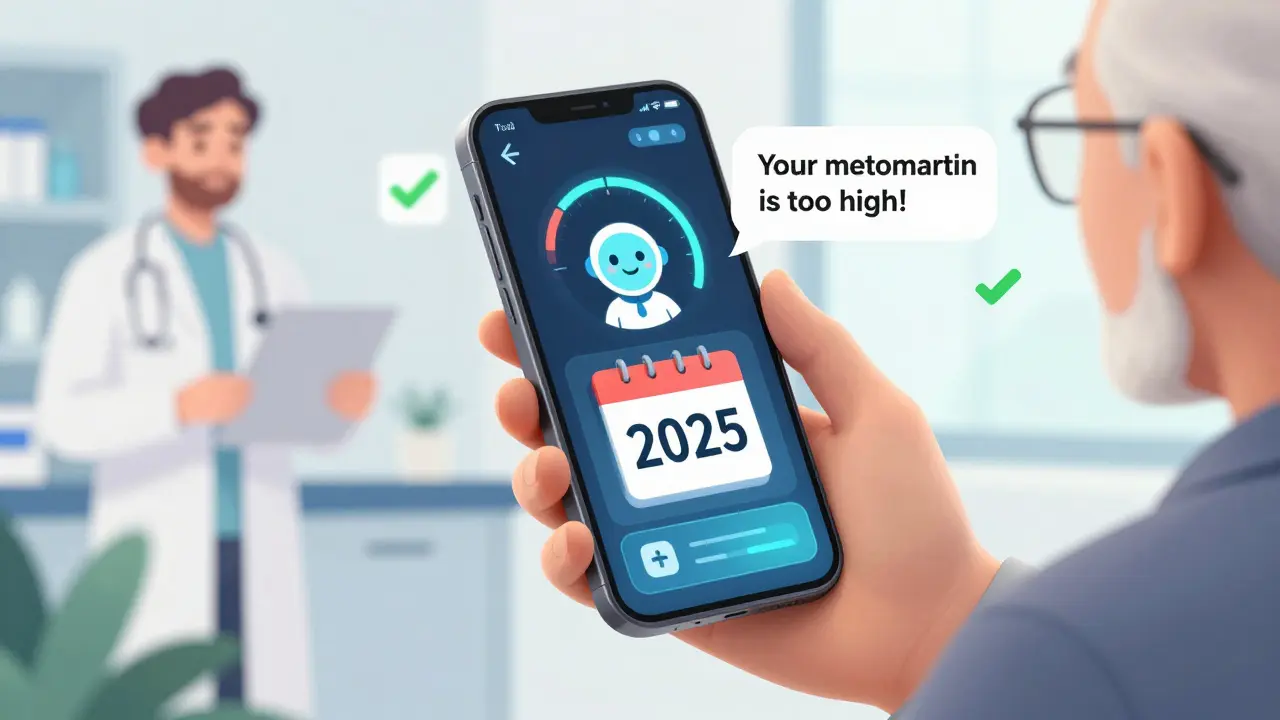
Right now, dosing is based on population averages. But the future is individual. The FDA is pushing for therapeutic drug monitoring-measuring actual drug levels in the blood-to guide dosing in real time. The NIH is funding AI tools that will combine kidney function, genetics, age, and weight to predict the perfect dose. Wearable sensors that estimate kidney filtration in real time are already in early testing. Within five years, your phone might tell you your drug level is too high-before you even feel sick.
But until then, the best tool you have is awareness. Know your numbers. Ask questions. Don’t let a standard dose become a silent danger.
How do I know if my medication dose needs to be adjusted for my kidneys?
Your doctor should check your kidney function with a blood test to calculate your eGFR or creatinine clearance (CrCl). If your eGFR is below 60, or if you’re over 65, underweight, or obese, your dose may need adjustment. Ask your pharmacist or doctor to review your meds using your latest lab results. Don’t assume your dose is safe just because it’s on the label.
Why is weight important in medication dosing?
Weight affects how much of a drug circulates in your body. In obese patients, some drugs get stored in fat and don’t reach their target, so higher doses are needed. But if you use total body weight to calculate kidney function, you might overestimate clearance and end up with too much drug in your system. That’s why adjusted body weight is used-adding only 40% of the extra weight above ideal. Underweight patients may need lower doses because there’s less tissue to dilute the drug.
What’s the difference between eGFR and CrCl?
eGFR estimates how well your kidneys filter waste and is used to stage chronic kidney disease. CrCl estimates how fast your kidneys clear drugs from your blood and is used for dosing. eGFR doesn’t include weight; CrCl does. That’s why CrCl is preferred for drug adjustments-even though eGFR is more accurate for general kidney health. Always use CrCl for dosing unless the drug label says otherwise.
Can I trust the dosing recommendations in my EHR?
Some EHR systems have good alerts, but many use eGFR instead of CrCl, or don’t adjust for weight. A 2023 review found that 38% of antibiotic dosing guidelines in different databases contradict each other. Always verify the dose against a trusted source like Lexicomp or Micromedex. If the system suggests a dose that seems too high or too low for your situation, ask your pharmacist to double-check.
What are the most common drugs that need kidney adjustments?
Common ones include metformin (diabetes), vancomycin and cefazolin (antibiotics), digoxin (heart), furosemide (water pill), gabapentin (nerve pain), and morphine (pain). Even over-the-counter drugs like ibuprofen can be risky in advanced kidney disease. Always check if your medication is cleared by the kidneys-and what the recommended dose is for your kidney function level.
What to Do Next
If you’re on any long-term medication, request a medication review with your pharmacist. Bring your latest blood work, especially your serum creatinine and eGFR. Ask: “Which of my drugs need dose changes based on my kidney function?” Most pharmacies offer this service for free. If you’re a caregiver, make this part of your monthly check-in. A simple conversation can prevent a hospital visit.
And if you’re a healthcare provider: don’t rely on defaults. Don’t skip the calculation. Use adjusted weight. Use CrCl. Double-check the drug’s specific guidelines. Your next patient could be the one who survives because you took those extra three minutes.

Jenna Allison
Just had my mom’s meds reviewed last week-turns out she was on double the metformin for her eGFR of 34. Her pharmacist caught it. She’s been less dizzy since. Seriously, if you’re over 65 or on more than 3 meds, ask for a renal dosing check. It’s free at most pharmacies.
Also, never trust the EHR default. Mine auto-filled 1000mg for metformin even though her CrCl was 29. Scary stuff.
Vatsal Patel
Oh wow. So we’ve turned medicine into a math test now? Next they’ll make you pass a calculus exam before you get a prescription.
Meanwhile, the guy who’s 300 lbs and diabetic gets a dose based on some 1970s formula while the 120-lb grandma gets crushed under ‘adjusted weight’ math. What a world. We’re not patients-we’re variables in a spreadsheet.
Helen Leite
THEY’RE HIDING THE TRUTH 😱
Did you know the FDA and Big Pharma don’t want you to know how many people are getting poisoned by ‘standard doses’? 🚨
They use eGFR because it’s cheaper to ignore weight! 💊💀
And your doctor? They’re paid to keep you on the meds. Don’t trust them. Check your CrCl. NOW.
#PharmaLies #KidneyDanger
Shanta Blank
Oh honey. Let me tell you about my uncle. Took his lisinopril like the bottle said. Ended up in the ER with his kidneys screaming like a banshee. The doctor didn’t even check his creatinine. Said ‘you’re old, just take it.’
Now he’s on dialysis. And guess what? The label never said ‘do not use if you’re 72, 110 lbs, and have been diabetic since ’08.’
So yeah. This isn’t ‘medical advice.’ It’s a death sentence wrapped in a pamphlet.
And don’t even get me started on how EHRs are coded by interns who think ‘eGFR’ is a new iPhone model.
Tiffany Wagner
i just found out my gfr is 48 and i’ve been on gabapentin for 3 years at 300mg twice a day… i think i need to talk to my pharmacist
also why does everyone say crcl but the chart says egfr
so confusing
Amelia Williams
This is so important and honestly so under-discussed. I’m a nurse and I’ve seen too many seniors get sicker because of dosing errors.
But here’s the good news-you can fix this. Ask your pharmacist to do a med review. Bring your labs. Write down your meds. Don’t be shy.
And if you’re a provider? Take the extra 3 minutes. It’s not extra work-it’s the work.
You’re saving lives, not just checking boxes.
Sharon Biggins
i just asked my dr to check my kidney dose for my blood pressure med… she said she already did
but i dont think she looked at my crcl
so i printed the cockcroft-gault formula and showed her
she apologized and changed it
thank god i asked
Michael Camilleri
People are so lazy now. You want a pill? Fine. But don’t blame the doctor when your kidneys give out because you didn’t care enough to learn how your own body works.
It’s not magic. It’s science. You don’t need a PhD to understand that a 250-pound man and a 90-pound woman need different doses.
Stop outsourcing your health to an app that says ‘eGFR 52 = fine.’
Wake up. Your body isn’t a spreadsheet.
lorraine england
Love this breakdown. Just had a patient last week-81, 105 lbs, eGFR 38, on vancomycin. The resident ordered full dose. I caught it. Changed it to adjusted weight CrCl. She’s doing great now.
Side note: I always print the dosing guidelines for my patients. They’re scared of meds. Giving them the numbers helps them feel less helpless.
Also, yes-ask your pharmacist. They’re the real heroes.