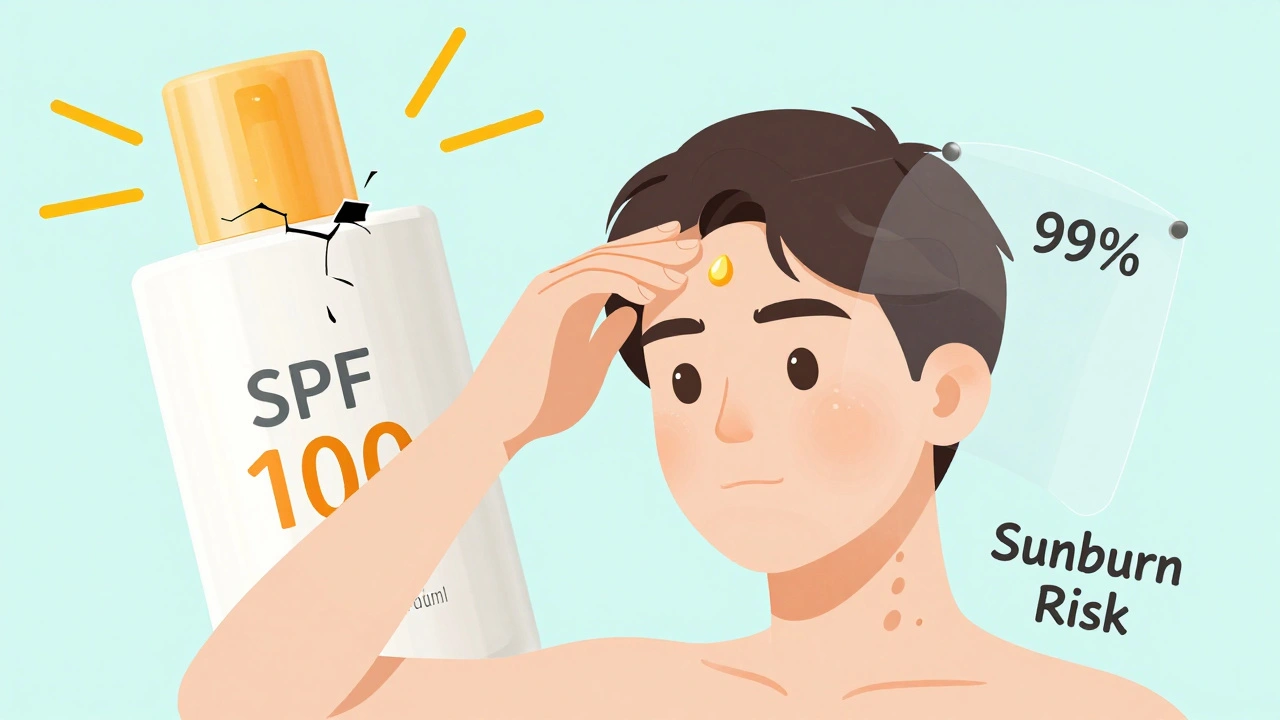
Most people think sunscreen is simple: slap it on, go outside, stay safe. But if you’ve ever bought a bottle labeled SPF 100, only to get burned by noon-or noticed a white cast that looks like you dusted your face with flour-you know it’s not that easy. OTC sunscreens are one of the most misunderstood products in personal care, and the difference between a good one and a bad one could mean the difference between healthy skin and skin cancer.
What SPF Actually Means (And Why Higher Isn’t Always Better)
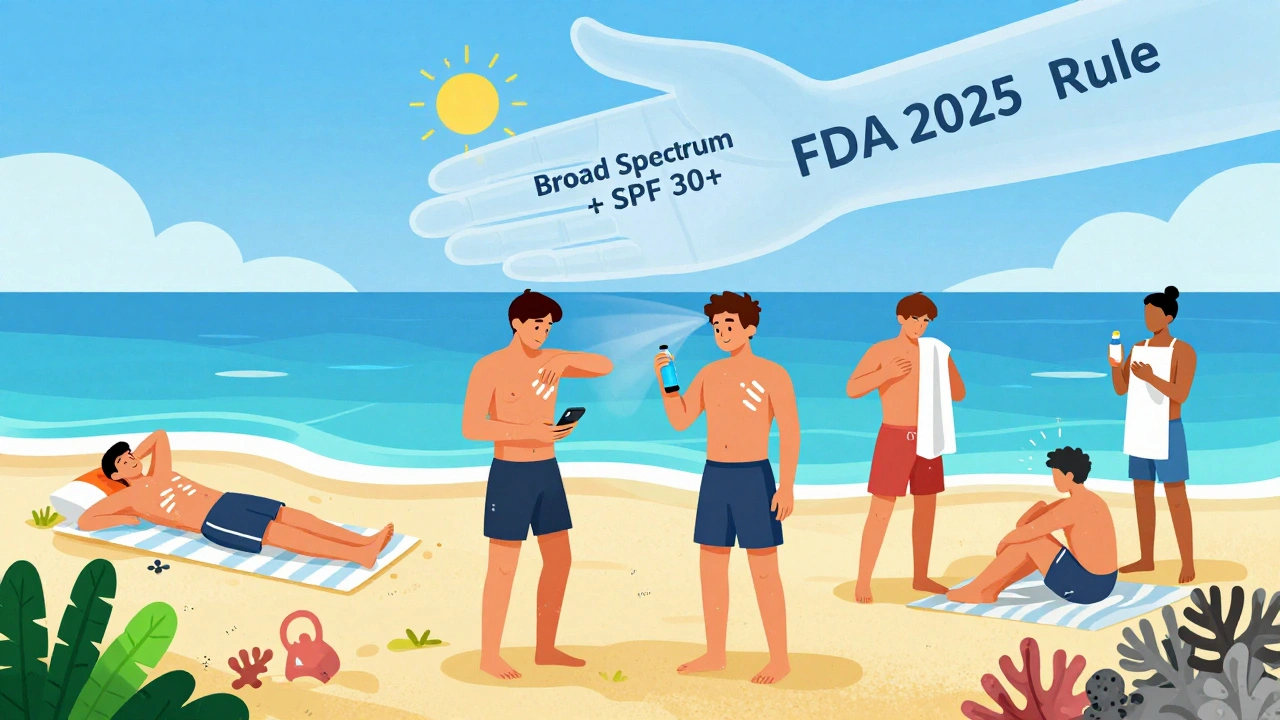
SPF stands for Sun Protection Factor, and it only measures protection against UVB rays-the ones that cause sunburn. It’s not a measure of how long you can stay in the sun. SPF 30 doesn’t mean you can stay out twice as long as SPF 15. It means it blocks 97% of UVB rays. SPF 50 blocks 98%. SPF 100 blocks 99%. That’s it. The jump from SPF 30 to SPF 50 gives you barely more protection, but the price can double.The FDA says SPF values above 50 are misleading because they suggest significantly better protection than they deliver. That’s why, as of 2025, the final rule requires all OTC sunscreens making a broad-spectrum claim to be at least SPF 30. Anything below SPF 15 can’t even claim to help prevent skin cancer.
Here’s the math: SPF 30 lets through 1 out of every 30 UVB rays. SPF 50 lets through 1 out of 50. That’s a 1% difference in exposure. But that 1% matters over decades of sun exposure. Still, if you’re applying less than the recommended amount-which most people do-SPF 100 might as well be SPF 20. The key isn’t the number on the bottle. It’s how much you use and how often you reapply.
Broad Spectrum Isn’t Just a Marketing Word
UVB burns your skin. UVA ages it. UVA rays penetrate deeper, cause wrinkles, and contribute to melanoma. That’s why “broad spectrum” matters more than SPF. The FDA requires sunscreens labeled as broad spectrum to pass a test that proves they protect against UVA rays up to 370 nanometers. If a product doesn’t meet that, it can’t say “broad spectrum”-even if it’s SPF 50.But here’s the catch: not all broad-spectrum sunscreens are equal. In Consumer Reports’ 2025 testing of 107 products, top-performing chemical sunscreens like La Roche-Posay Anthelios Melt-in Milk SPF 60 scored 92 out of 100 for UVA protection. Meanwhile, mineral sunscreens like Blue Lizard Sensitive SPF 50 scored only 55. Why? Many mineral formulas don’t have enough zinc oxide or the right particle size to block UVA effectively. Some products labeled “mineral” or “reef-safe” tested as low as SPF 4-far below what’s printed on the label.
Mineral sunscreens use zinc oxide or titanium dioxide. They sit on top of the skin and physically block UV rays. They work immediately and are less likely to irritate sensitive skin. But they often leave a white cast, especially on darker skin tones. Chemical sunscreens absorb UV rays. They’re usually more cosmetically elegant, invisible on skin, and more effective at blocking UVA. But some ingredients-like oxybenzone and octinoxate-are linked to coral reef damage, which is why Hawaii and Key West banned them in 2021.
Reapplication: The Most Ignored Rule
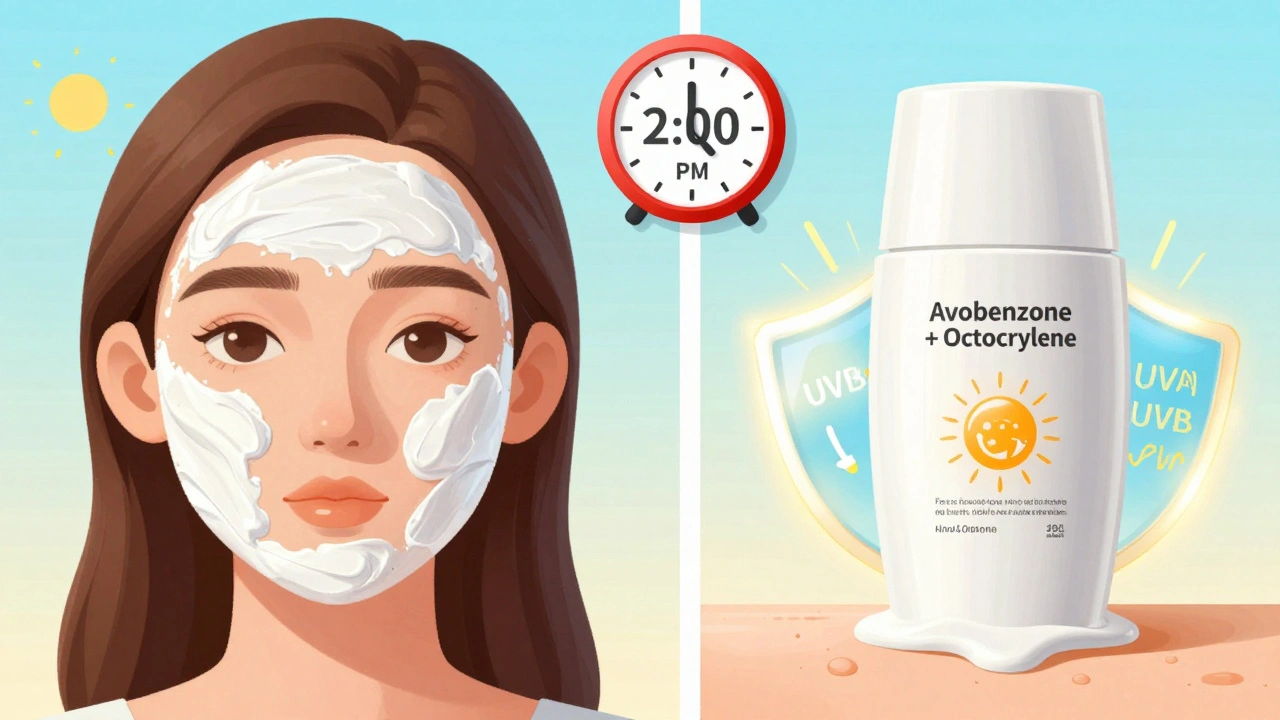
No sunscreen lasts all day. Not even “water-resistant” ones. The FDA defines water resistance as either 40 or 80 minutes of swimming or sweating. After that, protection drops fast. And if you towel off? You’re removing up to 80% of the product, even if you didn’t get wet.The American Academy of Dermatology says reapply every two hours. But a 2024 study found only 14.3% of beachgoers actually do. Most people apply once in the morning and forget about it. That’s why skin cancer rates keep rising-even as sunscreen sales grow.
Here’s what you need to do: set a timer on your phone. Every two hours, stop what you’re doing and reapply. If you’re swimming, sweating, or drying off with a towel, reapply immediately. Use enough. Most people use only 25-50% of the recommended amount. For your face, you need about 1/4 teaspoon-that’s five pea-sized dots, one for each cheek, forehead, nose, and chin. Rub it in. Don’t just spray and hope it covers.
What’s in Your Sunscreen? The Ingredients That Matter
The FDA has approved only 18 active ingredients for OTC sunscreens. Two are minerals: zinc oxide and titanium dioxide. The rest are chemical filters. The most common are:- Zinc oxide (5-25%) - Best for sensitive skin, anti-inflammatory, protects against UVA and UVB. Look for concentrations above 10% for reliable protection.
- Avobenzone (0.1-3%) - The best UVA filter among chemical sunscreens. But it breaks down in sunlight unless stabilized with octocrylene or other ingredients.
- Octinoxate (1.5-7.5%) - Great for UVB, but banned in Hawaii for coral damage.
- Octocrylene - Helps stabilize avobenzone and adds water resistance.
- Oxybenzone - Effective but controversial. Found in many drugstore sunscreens, but linked to hormone disruption and coral bleaching.
For sensitive skin or melasma, dermatologists recommend EltaMD UV Clear SPF 46. It contains 9% zinc oxide and niacinamide, which calms redness and strengthens the skin barrier. For everyday use under makeup, Supergoop! Unseen Sunscreen SPF 40 is a favorite-it disappears on all skin tones.
Watch out for “sunscreen” products that aren’t real sunscreens. Some moisturizers, foundations, and BB creams claim SPF, but they rarely provide enough protection unless you use a full teaspoon on your face. Most people use way less, making the SPF rating meaningless.
What to Buy (And What to Avoid)
Based on 2024-2025 testing and dermatologist recommendations:- Best overall: La Roche-Posay Anthelios Melt-in Milk SPF 60 - High UVA/UVB protection, lightweight, no white cast.
- Best for sensitive skin: EltaMD UV Clear SPF 46 - Zinc oxide-based, calming ingredients, no fragrance.
- Best mineral: CeraVe Hydrating Mineral Sunscreen SPF 50 - Good for dry skin, but apply generously to avoid white cast.
- Best spray: Neutrogena Ultra Sheer Dry-Touch SPF 100 - Easy to apply, but spray in a well-ventilated area and rub in.
- Avoid: Products with SPF over 50 that don’t list avobenzone or zinc oxide as primary filters. Also avoid sprays you can’t rub in, and any product without “broad spectrum” on the label.
Price doesn’t always mean quality. CVS Health SPF 50 spray costs $2.99 and performed well in tests. JLo Beauty’s SPF 30 moisturizer costs $55-same protection, way more marketing.
Real-World Problems and How to Fix Them
People report three big issues:- White cast on dark skin: Try tinted mineral sunscreens like Black Girl Sunscreen or Vanicream Daily Facial Moisturizer with SPF 30. Or switch to chemical sunscreens like Supergoop! or Neutrogena Hydro Boost.
- Stinging eyes: Avoid chemical sunscreens with oxybenzone or octinoxate near the eyes. Use a stick sunscreen (like Thinkbaby SPF 50) around the orbital area.
- Pilling under makeup: Wait 15 minutes after applying sunscreen before putting on foundation. Use a light layer and let it absorb.
Some products oxidize on skin-turning orange or gray. That’s common with iron oxide in tinted sunscreens. Try applying a thin layer and letting it sit before adding more. Or choose a non-tinted formula.
What’s Changing in 2025 and Beyond
The FDA is expected to finalize new rules in late 2025. These will:- Require all sunscreens to meet stricter UVA protection standards (matching the EU).
- Block 12 chemical ingredients, including PABA and trolamine salicylate, from being sold.
- Force companies to prove their SPF claims with real-world testing, not just lab conditions.
Mineral sunscreens are growing fast-projected to make up 35% of the market by 2027. But until their UVA protection improves, chemical sunscreens still win in performance. New tech is coming too: wearable UV sensors like Shade Smart (launching Q2 2025) will alert your phone when it’s time to reapply.
One thing won’t change: sunscreen is only effective if you use it right. No matter the brand, the SPF, or the price-you need to apply enough, reapply often, and choose broad spectrum. That’s the only formula that actually works.
Is SPF 100 really better than SPF 50?
No. SPF 50 blocks 98% of UVB rays. SPF 100 blocks 99%. That’s just a 1% difference in protection. But SPF 100 often gives a false sense of security, leading people to apply less and stay out longer. Reapplication every two hours matters more than the number on the bottle.
Do I need sunscreen on cloudy days?
Yes. Up to 80% of UV rays penetrate clouds. You can get sunburned on an overcast day. Daily sunscreen use reduces melanoma risk by 50%, according to the American Academy of Dermatology. Make it part of your morning routine, rain or shine.
Are mineral sunscreens safer than chemical ones?
For your skin, yes-especially if you’re sensitive or pregnant. Zinc oxide doesn’t absorb into the bloodstream and is less likely to cause irritation. But for UV protection, many mineral sunscreens don’t block UVA as well as chemical ones. Look for formulas with at least 10% zinc oxide and broad-spectrum labeling.
How much sunscreen should I use on my face?
Use about 1/4 teaspoon-enough to cover your entire face and neck. That’s five pea-sized dots: one for each cheek, forehead, nose, and chin. Most people use half that amount, which cuts protection in half. Don’t guess-measure it.
Can I use last year’s sunscreen?
Check the expiration date. Most sunscreens last three years unopened. Once opened, they’re good for about one year. If it smells weird, looks separated, or changed color, throw it out. Expired sunscreen doesn’t protect you.
Is spray sunscreen as effective as lotion?
Only if you use enough. Sprays are easy to miss spots and often applied too lightly. Spray generously and rub it in with your hands. Don’t rely on spray alone for your face-use a lotion or stick there. The FDA warns that spray sunscreens can be flammable and pose inhalation risks.

Deborah Jacobs
I used to think SPF 100 was the holy grail until I got sunburned at a beach picnic with a bottle that cost more than my shoes. Turns out, I was slathering on maybe a quarter of what I needed. Now I measure with a pea-dot method-five dots on my face, rub it in like I’m painting a tiny masterpiece. No white cast, no drama. And I reapply every two hours like it’s my job. My skin has never looked better.
Also, ditch the spray unless you’re willing to rub it in. I saw a guy at the park spray his whole body and walk away like he just won the lottery. Dude looked like a ghost with a sunburn. Don’t be that guy.
EltaMD UV Clear? Life changer. My melasma faded. No irritation. No glittery residue. Just clean, calm skin. Worth every penny.
And yes, clouds are liars. I got burned on a gray day in December. Never again.
Mineral sunscreens? I used to hate the white cast until I found Vanicream. Now I wear it under my foundation and no one knows. It’s like magic armor.
Stop buying sunscreen based on marketing. Look at the ingredients. Look at the broad spectrum label. Look at the expiration date. It’s not a beauty product. It’s your skin’s bodyguard.
Also, if your sunscreen smells like old fish? Toss it. I learned that the hard way. Skin doesn’t forgive.
And for the love of all things holy, don’t trust SPF in your moisturizer unless you’re using a full teaspoon. I’ve seen people dab a pea-sized blob and call it a day. That’s not sunscreen. That’s a prayer.
Thank you for this. Finally, someone explained it without jargon. I’m telling all my friends.
Stephanie Fiero
SPF 100 is a scam and so is every brand that tells you its ‘reef safe’ while using oxybenzone and calling it ‘natural’ lol. I read the FDA rules and they’re all lies. They let these companies get away with this because they pay off the regulators. I work in pharma and I’ve seen the reports. The FDA doesn’t test real-world use. They test lab conditions with perfect application. No one applies that much. So SPF 50 is really SPF 12 in real life. They know this. They don’t care.
Also, zinc oxide is the only thing that works. Titanium dioxide? Useless for UVA. And don’t get me started on sprays. You’re breathing in nanoparticles. That’s how you get lung cancer. I’m not even joking. Read the studies. They’re hiding it. The truth is, the only safe sunscreen is a hat and staying inside. But they don’t want you to know that because sunscreen sales are a $50 billion industry.
Also, if you’re using anything with avobenzone, you’re asking for trouble. It breaks down and turns into free radicals. I’ve seen the data. It’s worse than the sun. I’m not paranoid. I’m informed.
Use zinc oxide. 25%. No fragrance. No chemicals. That’s it. Everything else is a lie.
sean whitfield
SPF is a cult. You people think sunscreen is science. It’s not. It’s marketing. You pay $40 for a bottle that blocks 98% of UVB. The other 2%? That’s your soul’s test. You think you’re safe? You’re just a sheep in lotion.
And broad spectrum? Ha. Who even knows what that means? The FDA says 370 nanometers. But what’s 370? Is that the wavelength of your ex’s last text? I don’t know. I don’t care. I just want to live.
Reapply every two hours? Why? Because the sun is a capitalist machine designed to make you sweat and buy more. Set a timer? Nah. I set a vibe. If I’m having fun, I don’t reapply. If I’m bored, I reapply. That’s how I roll.
And mineral vs chemical? Who cares. I’m not a lab rat. I’m a human. I’ll use whatever’s cheapest. I bought a $3 CVS sunscreen last week. I’m still alive. So there.
Also, the FDA is owned by Big Pharma. The real enemy is the government. They want you dependent. They want you afraid. Sunscreen is just the gateway drug to vaccines.
Wear a shirt. Stay in the shade. That’s the real protection. Everything else is a scam.
Marvin Gordon
Love this breakdown. Real talk: sunscreen is the most underrated skincare step by far. I used to skip it because I thought I didn’t need it. Then I got a suspicious mole. Turned out benign, but it scared the hell out of me.
Now I use La Roche-Posay every single morning. Rain or shine. Even when I’m working from home. UV rays come through windows. I didn’t know that until last year.
And yes, the white cast is real. I have medium skin and I used to hate mineral stuff. Then I found CeraVe Hydrating Mineral SPF 50. It blends like butter. No more ghost face.
Reapplying is the hardest part. I set a reminder on my phone. Two hours. Like clockwork. I don’t care if I’m in the middle of a Zoom call. I pause. I rub it in. My skin thanks me.
And sprays? I only use them on my back. Never on my face. Too risky. And you can’t control the amount. I’d rather spend 10 extra seconds and get it right.
Also, expired sunscreen? I throw it out. No exceptions. If it’s been open longer than a year, it’s trash. My skin isn’t a guinea pig.
Thanks for the clarity. This should be required reading in high school.
William Chin
It is imperative to underscore the critical importance of adhering to the recommended dosage of sunscreen as stipulated by the American Academy of Dermatology. The application of less than the requisite quantity, namely one-quarter teaspoon for the facial region, constitutes a significant deviation from evidence-based protocols and renders the efficacy of the product functionally null. Furthermore, the assertion that SPF values above 50 are misleading is not merely a regulatory stance, but a scientifically validated conclusion derived from empirical photobiological modeling. It is also noteworthy that the degradation of chemical filters such as avobenzone under prolonged solar exposure necessitates the inclusion of photostabilizing agents, a criterion that is frequently omitted in budget formulations. The failure to reapply after perspiration or dermal drying, which removes up to eighty percent of the topical barrier, is tantamount to negligence. One must also be vigilant regarding the presence of titanium dioxide in mineral formulations, as suboptimal particle dispersion significantly compromises UVA attenuation. The FDA’s forthcoming regulatory revisions, while overdue, represent a necessary corrective measure in the face of widespread consumer misinformation. The market must be held accountable for the dissemination of products that fail to meet minimum efficacy thresholds. This is not a matter of preference-it is a matter of public health.
Lucy Kavanagh
So the FDA says SPF 50 is enough? Funny. In the UK, we’ve been using proper sunscreens for decades. You Americans think you’re smart because you have SPF 100. But here, we know the truth. The sun doesn’t care about your numbers. It only cares if you’re covered. And don’t even get me started on those spray sunscreens. You think you’re being clever? You’re poisoning the ocean and breathing in chemicals. We banned oxybenzone in 2018. You still use it. Why? Because you don’t care about the planet. You care about convenience.
And mineral sunscreens? We’ve had them for years. Zinc oxide, 20%, no fragrance. Simple. Effective. But you Americans need glitter and fragrance and ‘unseen’ formulas. You’re obsessed with looking good, not being safe.
I saw a woman at the beach in Florida with SPF 100 and no hat. She got burned. She cried. She blamed the sun. No. She blamed herself. But she won’t admit it. She’ll buy another bottle. And another. And another.
Stop the nonsense. Wear a hat. Wear a shirt. Use real sunscreen. And stop buying American junk.
Chris Brown
I find it deeply troubling that society has normalized the idea that sunscreen is a luxury or a cosmetic choice. This is not a matter of vanity. It is a matter of survival. The rise in melanoma cases among young adults is not coincidental-it is the direct result of decades of cultural negligence. People treat sunscreen like they treat exercise: something they’ll do ‘when they feel like it.’
And yet, when someone gets cancer, they blame genetics. They blame bad luck. They never blame the fact that they applied a dime-sized amount of SPF 30 and called it a day.
There is a moral failure here. A failure of responsibility. We are told to ‘be safe,’ but we are not held accountable. We are given products with misleading labels, and we accept them. We are told to reapply every two hours, and we laugh. We think we’re too busy. Too cool. Too invincible.
This post is not informative. It is a plea. And I am saddened that it must be so.
Michael Dioso
SPF 100 is a joke. You know what’s worse? People who buy it and then don’t reapply. They think they’re bulletproof. They’re not. They’re just idiots with a $40 bottle.
And mineral sunscreens? Yeah, they’re ‘safer’-until you realize most of them are barely above SPF 10. I tested one ‘mineral’ sunscreen that said SPF 50. Lab test said SPF 4.4. FOUR. FOUR.
And don’t even get me started on ‘reef-safe’ labels. That’s just a marketing lie. The FDA doesn’t even regulate that term. Companies slap it on because it sounds good. Same with ‘non-nano.’ It doesn’t mean anything unless you know the particle size.
Avobenzone? It breaks down. So what? So does your will to live after you get melanoma at 35.
Here’s the truth: if you’re not using at least 10% zinc oxide and reapplying every 90 minutes, you’re wasting your time. Everything else is theater.
And yes, I’ve read the FDA rules. And the studies. And the lawsuits. You’re not safe. You’re just lucky so far.
Krishan Patel
As a medical researcher with a focus on photodermatology, I must emphasize that the efficacy of sunscreen is not determined by its price, brand, or marketing claims, but by its active ingredient concentration and formulation stability. Zinc oxide, when present at concentrations exceeding 10%, provides the most reliable and photostable UVA/UVB protection available in over-the-counter formulations. Avobenzone, while effective, requires stabilization through octocrylene or other photostabilizers to prevent photodegradation-a detail frequently omitted in low-cost products.
Furthermore, the claim that SPF 50 offers negligible advantage over SPF 30 is misleading in the context of cumulative lifetime exposure. A 1% difference in UVB transmission translates to approximately 30% less DNA damage over a 40-year period, according to longitudinal epidemiological studies from the Journal of the American Academy of Dermatology.
Reapplication every two hours is not a suggestion-it is a physiological necessity, as sweat, sebum, and mechanical friction reduce topical concentration by 50–80% within that window. The American Academy of Dermatology’s recommendation is based on controlled clinical trials, not marketing.
Lastly, the notion that ‘spray sunscreens are convenient’ is dangerously false. The FDA has issued multiple warnings regarding inadequate application and inhalation risks. Topical application with manual rubbing remains the gold standard. Anything else is negligence masked as convenience.
Do not be misled by trends. Science is not democratic. Use zinc oxide. Apply generously. Reapply frequently. Your skin will thank you in 2045.