Steroid Acne Treatment Calculator
Find Your Best Treatment
Answer a few questions about your condition to get personalized treatment recommendations.
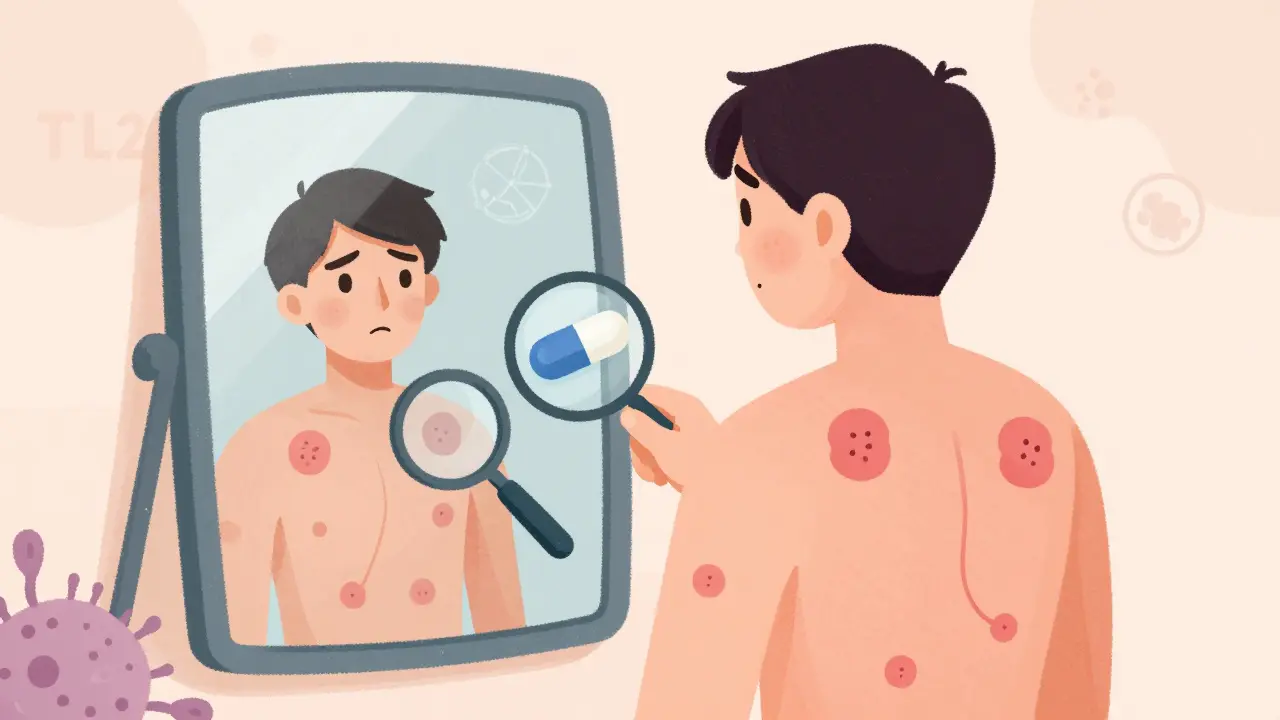
When you start taking steroids-whether for asthma, an autoimmune disease, or after a transplant-your body isn’t the only thing that changes. Your skin can turn against you. For many, it starts with a few red bumps on the chest or back. Then they spread. They don’t respond to your usual acne products. They don’t go away after a week or two. And they’re not the kind of breakouts you got as a teenager. This is steroid-induced acne.
What Makes Steroid Acne Different?
Steroid-induced acne doesn’t look like regular acne. It’s not just oily skin and clogged pores. It’s a direct reaction to corticosteroids like prednisone or anabolic steroids used in bodybuilding. The lesions are often uniform-small, red, follicular bumps that appear suddenly, usually 4 to 6 weeks after starting the medication. Unlike typical acne, which favors the face, steroid acne hits the chest, shoulders, and upper back hardest. The face can be affected too, but it’s not the main battleground.There’s another form you might not know about: Malassezia folliculitis. This isn’t acne at all-it’s a fungal overgrowth triggered by steroids. It shows up as itchy, pinpoint pustules, all the same size, no blackheads or whiteheads. It’s common on the chest and back, and it’s often mistaken for bacterial acne. That’s why treating it with benzoyl peroxide or antibiotics can fail. You’re fighting the wrong enemy.
Research from 1973 by Mills, Leyden, and Kligman first linked this pattern to steroid use. Since then, we’ve learned more. Steroids change how your skin’s immune system reacts. They boost Toll-like receptor 2 (TLR2), which makes your skin more sensitive to the bacteria naturally living on you-Propionibacterium acnes. That triggers inflammation, even if you’ve never had acne before.
Who Gets It and Why?
It’s not random. About 10% to 20% of people on high-dose corticosteroids-think 20mg of prednisone or more per day-develop it. Adolescents and young adults are more likely, but anyone can be affected. The higher the dose and the longer you’re on it, the greater the risk. For bodybuilders using anabolic steroids, the numbers are even higher. Some reports suggest nearly half of long-term users develop severe acne.Here’s the catch: you might not realize it’s the steroids. You might blame your diet, your workout gear, or stress. But if you started a new steroid treatment and then saw a sudden outbreak of uniform bumps on your chest, it’s likely steroid acne. The delay is key. It doesn’t show up the next day. It takes weeks. That’s why people often ignore it until it’s bad.
Topical Treatments That Actually Work
The good news? You don’t have to quit steroids to fix this. Many patients need to keep taking them for life. The solution isn’t stopping-it’s targeting the problem correctly.Tretinoin 0.05% is the gold standard. Back in 1973, a study of 12 patients showed 85-90% improvement in just two to three months, even while continuing prednisone. Today, dermatologists still recommend it. It unclogs pores, reduces inflammation, and prevents new lesions. Start slow-every other night-to avoid burning or peeling. Use a pea-sized amount for your whole chest and back.
For Malassezia folliculitis, you need antifungals. Ketoconazole shampoo (2%) works wonders. Wash your chest and back with it, leave it on for 5 to 10 minutes, then rinse. Do this 2-3 times a week. Selenium sulfide shampoo (2.5%) is another option. Both are available over the counter.
Benzoyl peroxide (5%) is useful for bacterial acne, but not for fungal. Use it as a wash, not a leave-on cream. It kills acne-causing bacteria and reduces oil. But don’t overdo it. It can dry out your skin, especially if you’re already on steroids, which thin the skin barrier.
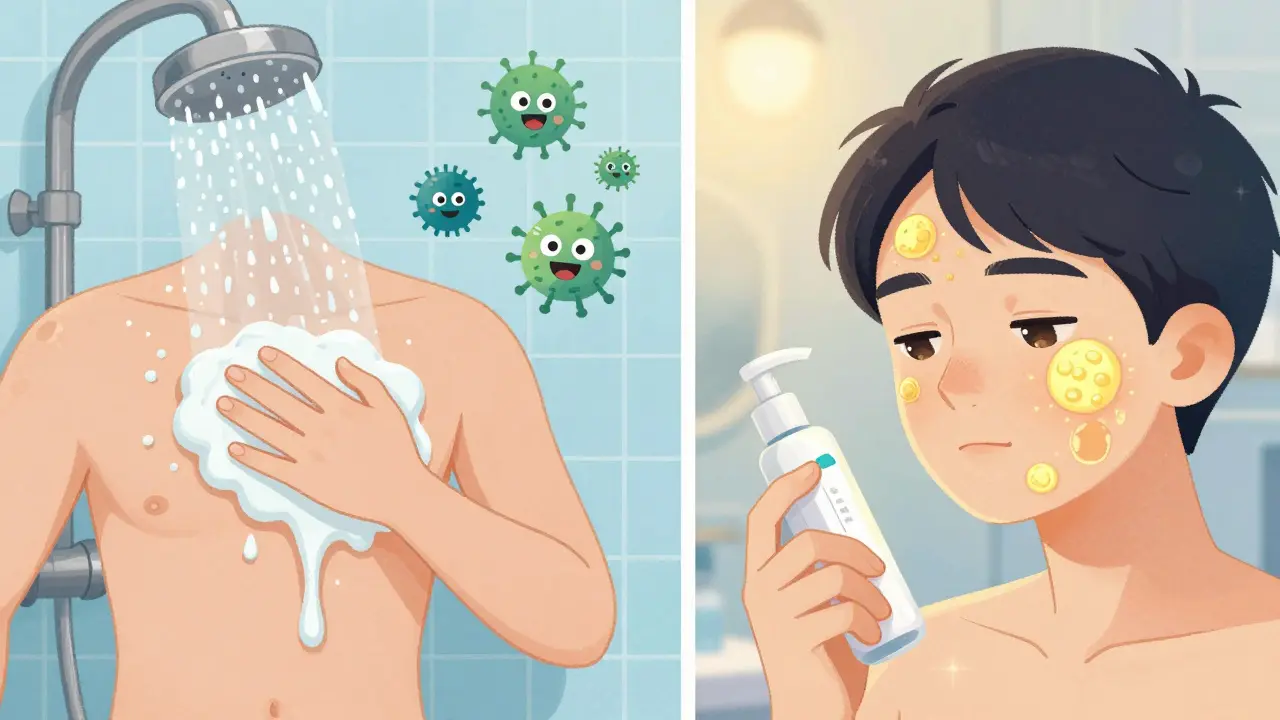
Avoid scrubs, loofahs, and harsh cleansers. Steroid skin is fragile. Rubbing it raw makes things worse. Stick to gentle, fragrance-free cleansers. Moisturize daily with non-comedogenic products. Look for ingredients like ceramides or hyaluronic acid-they repair the barrier steroids break down.
Oral Options When Topicals Aren’t Enough
If your acne is widespread, painful, or not budging after 8 weeks of topical treatment, you’ll need stronger tools.Oral antibiotics like doxycycline (100mg twice daily) help reduce inflammation and kill bacteria. But they’re not a long-term fix. The CDC warns that overuse leads to resistant strains. Use them for 3-4 months max.
For women, oral contraceptives with ethinyl estradiol and a progestin (like drospirenone) can help. They lower androgen levels, which steroids can spike. Spironolactone (25-50mg daily) is another anti-androgen option. It’s not FDA-approved for acne, but dermatologists use it often-with great results.
For severe cases, isotretinoin (Accutane) is powerful. It shrinks oil glands, kills bacteria, and resets skin cell turnover. But here’s the warning: if you’re using anabolic steroids, isotretinoin can trigger a dangerous condition called acne fulminans. It causes deep, painful, ulcerated lesions, sometimes with fever and joint pain. There are documented cases of hospitalizations after patients took isotretinoin during or right after a steroid cycle. This is rare, but real. Never start isotretinoin without a dermatologist’s supervision if you’re using anabolic steroids.
Lifestyle Adjustments That Help
Medications help, but your daily habits make or break recovery.Shower after workouts. Sweat traps bacteria and yeast against your skin. If you’re on steroids, your skin is already more prone to infection. Rinse off within 30 minutes of training.
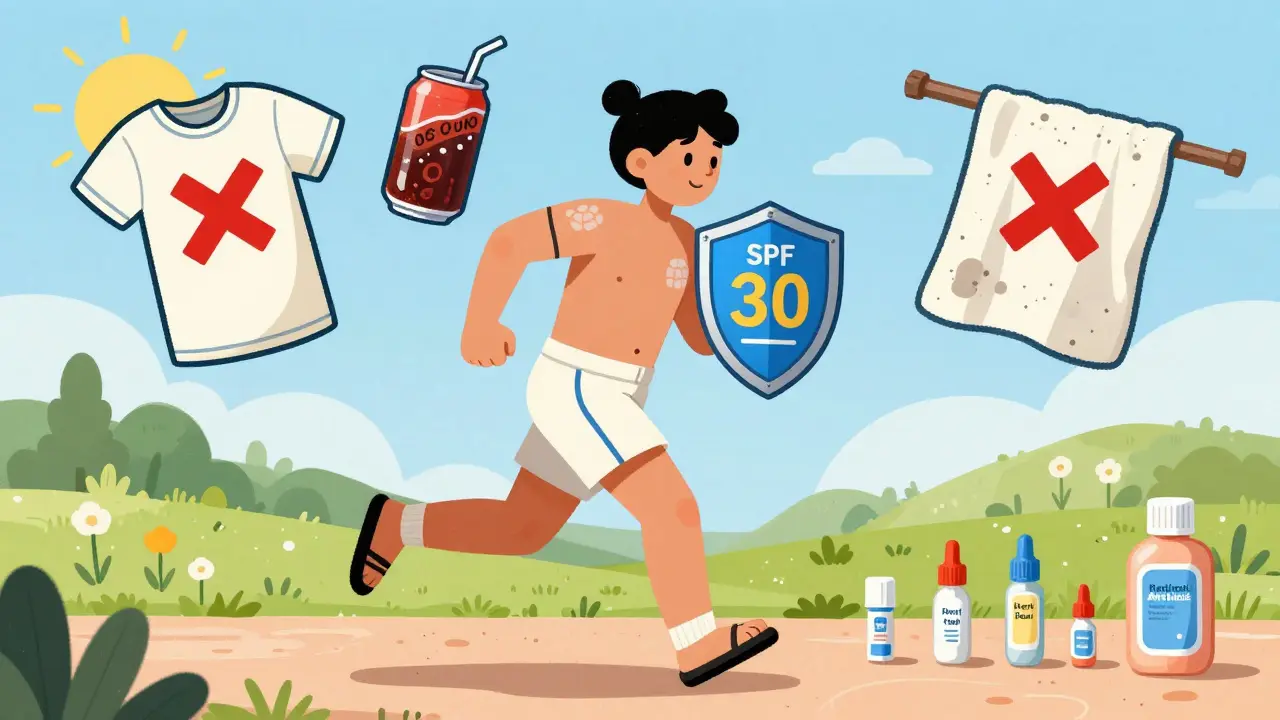
Wear loose, breathable clothing. Tight shirts, synthetic fabrics, and sweaty gear create a warm, moist environment where yeast and bacteria thrive. Cotton is your friend.
Watch your diet. While no food causes steroid acne directly, high-glycemic foods (sugars, white bread, soda) can spike insulin, which increases oil production. Cut back. Focus on whole foods, lean proteins, and vegetables.
Sun protection is non-negotiable. Steroids make your skin thinner and more sensitive. Topical treatments like tretinoin and benzoyl peroxide make it worse. Use a broad-spectrum SPF 30+ daily. Even on cloudy days. Reapply if you’re outside for long.
Don’t pick or pop. This isn’t just about scarring. It spreads bacteria and triggers more inflammation. Let the treatments do their job.
How Long Until It Clears?
If you stop the steroids, most cases resolve in 4 to 8 weeks. But if you can’t stop-like transplant patients or those with chronic inflammation-you’ll need ongoing management. Tretinoin and antifungals can keep it under control indefinitely. The key is consistency. Most people see improvement in 6-8 weeks, but full clearing takes up to 12.One patient on Reddit, who’d been on prednisone for 6 months after a kidney transplant, said: “Topical clindamycin worked for two weeks. Then nothing. Tretinoin 0.05% cleared 80% of my chest in 8 weeks. I still take prednisone. But my skin is back.”
Another, who started prednisone for asthma, wrote: “I had hundreds of bumps. My dermatologist said, ‘Don’t panic. This is common. Here’s the cream.’ It worked. I didn’t need to quit the steroid.”
What’s New in Treatment?
Science is moving fast. Researchers are now looking at TLR2 inhibitors-topical drugs that block the exact pathway steroids use to trigger inflammation. Early trials show a 65% reduction in lesions after 12 weeks. It’s not available yet, but it’s coming.Another frontier is the skin microbiome. Steroids disrupt the balance of good and bad microbes on your skin. Companies are testing products with ammonia-oxidizing bacteria to restore balance naturally. Think of it like probiotics for your skin.
Doctors are also starting to test for genetic variants in TLR2. Some people are genetically more likely to get severe steroid acne. In the future, a simple cheek swab might tell you if you’re at high risk before you even start steroids.
When to See a Dermatologist
You don’t need to wait until it’s out of control. If you notice:- Uniform red bumps on your chest or back after starting steroids
- Itchy pustules that don’t respond to acne washes
- Breakouts that worsen despite using your old routine
- Lesions that are painful, deep, or ulcerating
See a dermatologist within 2-3 weeks. Early treatment prevents scarring and reduces frustration. Many patients wait months, thinking it’s just “bad acne.” By then, it’s harder to treat.
And if you’re using anabolic steroids illegally-please, talk to a doctor. The risks go beyond acne. Liver damage, heart problems, and hormonal collapse are real. There are safer ways to build muscle.
Final Thoughts
Steroid-induced acne isn’t your fault. It’s a side effect of powerful medicine. You’re not broken. You’re not failing at skincare. You’re dealing with a biological reaction that’s well-documented, understood, and treatable.You don’t have to choose between your health and your skin. With the right approach-tretinoin, antifungals, gentle care, and patience-you can manage both. Keep taking your steroids if you need them. But don’t let your skin suffer in silence. The tools to fix this have been around for 50 years. You just need to use the right ones.

Mike Rengifo
Been on prednisone for lupus for 3 years. This post nailed it. Tretinoin saved my chest. No more angry red bumps. Just wish I’d known sooner.
Matt Davies
Man, this is the kind of info that should be printed on every steroid prescription bottle. I’ve seen so many guys in the gym sweating over their ‘bad skin’ while popping antibiotics like candy. Meanwhile, their fungal folliculitis is just chilling like a tiny yeast cult. 🤦♂️
Meenakshi Jaiswal
If you’re using ketoconazole shampoo, try diluting it with water 1:1. Less drying, same results. And always follow up with a ceramide moisturizer - steroids strip your skin like a sandblaster. You’re not just treating acne, you’re rebuilding a fortress.
Isabel Rábago
It’s not just about the meds - it’s about accountability. People treat their bodies like disposable machines. You pop steroids like candy, then blame your skin for ‘reacting.’ Wake up. Your skin isn’t broken - you just stopped listening to it. This isn’t skincare, it’s spiritual neglect.
Ashley Bliss
They don’t want you to know this. They don’t want you to know that the pharmaceutical industry profits from you being stuck in this loop - antibiotics, then creams, then isotretinoin, then scars. But the truth? The real solution is stopping the steroid. They’ll never tell you that because you’re a cash cow. The skin is just the first warning. Next comes your liver. Then your heart. Then your soul.
Dev Sawner
According to the 1973 Mills-Leyden-Kligman study, the TLR2 upregulation mechanism is statistically significant (p < 0.01). However, the sample size was n=12, which introduces significant selection bias. Furthermore, the study did not control for concurrent microbiome shifts induced by dietary variables - a critical confounder. One must exercise extreme caution in generalizing these findings.
Jedidiah Massey
TLR2 inhibitors? Pfft. That’s just pharma’s next cash cow. We’ve been down this road before - remember the ‘miracle’ probiotic creams? All hype. The real breakthrough? Stop taking the damn steroids. No magic serum will fix a system you’re poisoning from within. 🧪
Emily P
Does anyone know if this applies to inhaled steroids too? I’ve been on fluticasone for years and noticed tiny bumps around my jawline… but I assumed it was just friction from the mask.
Anna Sedervay
One must acknowledge the epistemological dissonance inherent in the contemporary dermatological paradigm. The conflation of fungal etiology with bacterial pathology represents a fundamental misalignment with the ontological structure of cutaneous immunology. One is left to wonder whether the clinical community is merely perpetuating a hermeneutic circle of diagnostic error, reinforced by pharmaceutical marketing and the institutional inertia of medical education.
Moses Odumbe
Just tried the ketoconazole shampoo trick - 2x a week, left on 10 mins. BRO. My chest looks like a baby’s butt now. 😍 Also, no more itching. I’m basically a new man. #SkinWin
Lynsey Tyson
Thank you for writing this. I felt so alone when I got this. Like I was the only one whose skin betrayed them after taking medicine to stay alive. It’s okay to need both - the meds and the tretinoin. You don’t have to choose.
Sarah McQuillan
Interesting how everyone’s so quick to blame steroids. In America, we’re obsessed with blaming chemicals. In India, they just use neem oil and call it a day. Maybe we’re overcomplicating this because we’re too addicted to pills and potions. Simple solutions are always the most dangerous ones to admit.
Vicki Belcher
My dermatologist said the same thing about tretinoin - and I cried because I thought I’d never get my skin back. 8 weeks later, I’m wearing tank tops again. 🥹 Thank you for this. You saved me from giving up.