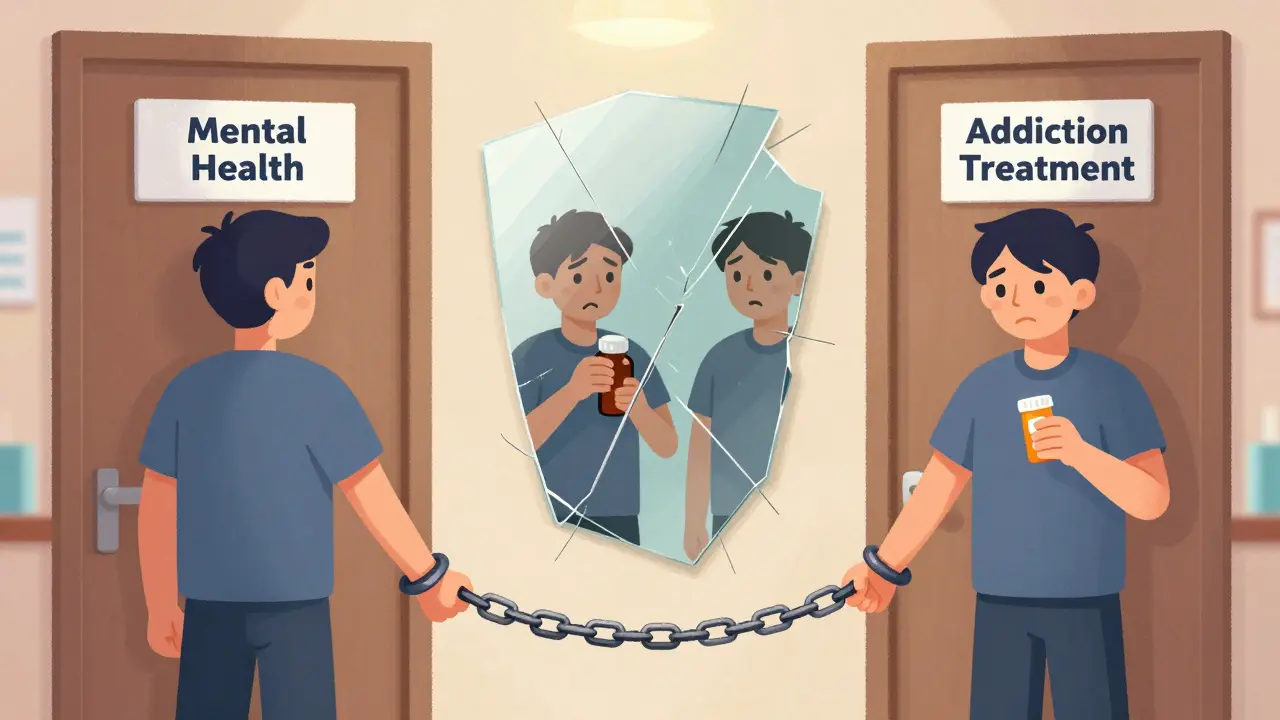
Imagine you’re struggling with depression, and to cope, you start drinking every night. The alcohol helps you sleep, but soon your mood gets worse, your relationships fray, and you lose your job. You go to a mental health clinic, and they give you therapy and medication. Then you’re told to go to a separate addiction program. But the addiction program doesn’t talk about your depression. And the mental health team doesn’t know you’re drinking. You’re stuck bouncing between two systems that don’t talk to each other. This isn’t rare-it’s the norm for millions of people. That’s where integrated dual diagnosis care changes everything.
Why Separate Treatment Doesn’t Work
For years, mental health and substance use disorders were treated as two separate problems. If you had schizophrenia and drank heavily, you’d see one provider for your psychosis and another for your alcohol use. The thinking was simple: fix one thing at a time. But in practice, it failed. Treating depression without addressing the drinking? The drinking keeps feeding the depression. Treating the drinking without touching the anxiety or bipolar disorder? The person often relapses because the root pain is still there. Research shows this approach is costly, confusing, and ineffective. People get lost between systems. One provider says, "Stop using," while another says, "Your brain needs medication to feel stable." The messages clash. Patients feel blamed, misunderstood, or even punished for struggling. According to the Substance Abuse and Mental Health Services Administration (SAMHSA), only about 6% of people with co-occurring disorders get help for both conditions at the same time. That means over 15 million adults in the U.S. are falling through the cracks.What Is Integrated Dual Diagnosis Care?
Integrated Dual Diagnosis Treatment, or IDDT, is a proven model that treats mental illness and substance use as one connected condition-not two. It’s not just having both services in the same building. It’s having the same team, the same treatment plan, and the same goals for both issues. The team includes psychiatrists, counselors, case managers, and peer support specialists-all trained in both mental health and addiction. This approach started in New Hampshire and Dartmouth in the 1990s and has since become the gold standard. It’s backed by decades of research and endorsed by SAMHSA, the Cleveland Clinic, and major health systems across the U.S. and Australia. The core idea is simple: if your brain is unwell and you’re using substances to cope, you need help that understands how they feed each other.The Nine Key Parts of IDDT
IDDT isn’t a vague idea-it’s a structured, evidence-based system with nine core components:- Motivational interviewing: A conversation style that helps people explore their own reasons for change, without pressure or judgment.
- Substance abuse counseling: Focused on reducing harm, not just pushing for abstinence. If someone isn’t ready to quit, the goal is to use less safely.
- Group treatment: Peer support in a setting where everyone understands both mental health struggles and addiction.
- Family psychoeducation: Teaching loved ones how to support without enabling, and how to recognize warning signs.
- Participation in self-help groups: Encouraging involvement in groups like Dual Recovery Anonymous, where both conditions are acknowledged.
- Pharmacological treatment: Medications for depression, bipolar disorder, schizophrenia, or withdrawal-all carefully managed together.
- Health promotion: Addressing physical health issues like poor nutrition, lack of sleep, or diabetes that often go ignored in dual diagnosis care.
- Secondary interventions: For people who aren’t responding to standard treatment-adjusting the plan, trying new therapies, or increasing support.
- Relapse prevention: Planning for setbacks, not just avoiding them. Because relapse is part of recovery, not a failure.
This isn’t a checklist-it’s a living system. Each person’s plan is built around their life, not a textbook.
Harm Reduction: A Game-Changer
One of the biggest shifts in IDDT is letting go of the idea that abstinence is the only path to recovery. For someone with severe schizophrenia who uses cannabis to quiet hallucinations, forcing immediate sobriety can make their psychosis worse. IDDT doesn’t ignore substance use-it meets people where they are. Harm reduction means asking: "What’s the least dangerous way you can use right now?" It means teaching safer injection practices, checking for overdose risk, or helping someone switch from alcohol to a less harmful substance while working on underlying trauma. This approach builds trust. People stay in treatment longer. They start to believe recovery is possible-even if it’s slow. A 2018 study tracked 154 people with severe mental illness and substance use disorders over a year. After IDDT, the number of days they used alcohol or drugs dropped significantly. That’s not just a statistic-it’s someone getting back to work, reconnecting with their kids, or sleeping through the night without a bottle.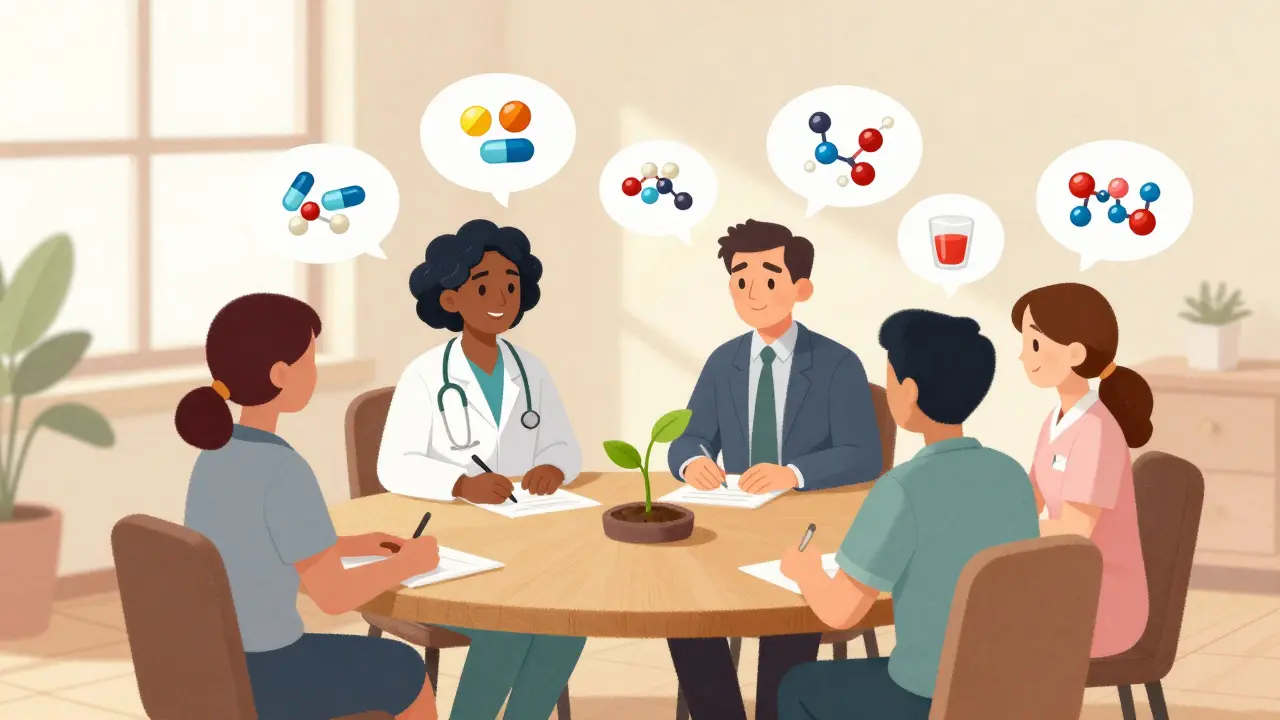
What Makes IDDT Different from Other Programs?
Traditional programs often separate services by diagnosis. Mental health centers don’t take people who are actively using. Addiction centers won’t treat psychosis. This creates a cruel catch-22: you have to be stable to get help, but you can’t get stable without help. IDDT breaks that cycle. The same clinician helps you manage your voices and your cravings. The same nurse checks your blood pressure and your medication adherence. The same case worker helps you find housing and applies for disability benefits-all while knowing you’re trying to cut back on opioids. This coordination saves money too. A 2023 study from the Washington State Institute for Public Policy found IDDT reduced alcohol and drug use symptoms by measurable amounts. But here’s the catch: the cost to run these programs is still high. Training staff, hiring specialists, and building integrated teams takes funding most clinics don’t have.Barriers to Getting IDDT
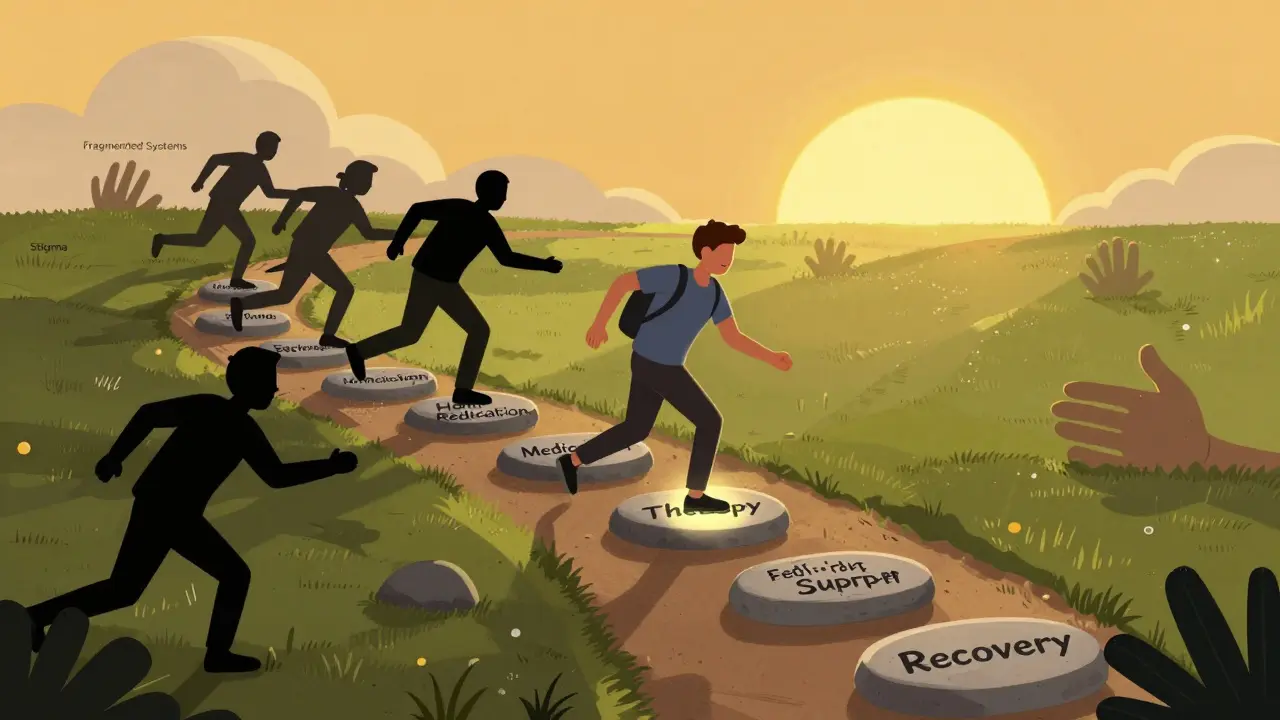
Even though IDDT works, it’s still hard to find. Why?- Training gaps: Most clinicians are trained in one area-mental health or addiction. Few get certified in both. A 2018 trial found that even after three days of IDDT training, many clinicians didn’t improve their skills in motivational interviewing.
- Funding: Insurance rarely pays for integrated care. Medicaid and Medicare are slowly catching up, but reimbursement systems still reward separate services.
- Stigma: Some providers still believe people with addiction aren’t "ready" for mental health treatment-or vice versa.
- Fragmented systems: Mental health clinics, addiction centers, hospitals, and social services often operate in silos. Getting them to share records, schedules, and goals is a bureaucratic nightmare.
In Brisbane, for example, there are only a handful of clinics offering true IDDT. Most people still get referred to separate services. But change is coming. With rising overdose rates and mental health crises, more public health leaders are pushing for integrated models.
Who Benefits Most From IDDT?
IDDT works best for people with:- Severe mental illnesses like schizophrenia, bipolar disorder, or major depression
- Long-term substance use, especially alcohol, opioids, or stimulants
- A history of hospitalizations, homelessness, or legal trouble
- Failed attempts at separate treatments
But it’s not just for "the most severe." Anyone who’s tried to manage anxiety and drinking on their own, or depression and marijuana use, can benefit. The key isn’t how bad your symptoms are-it’s whether they’re connected.
One woman in her 40s, living in the suburbs, used antidepressants and drank wine every night to numb panic attacks. She saw her therapist weekly but never mentioned the drinking. When she finally joined an IDDT program, she learned the wine was making her panic worse. With the same provider helping her adjust her meds and cut back on alcohol, her anxiety dropped by 60% in six months.
What to Look For in an IDDT Program
If you’re searching for integrated care, ask these questions:- Do you have the same provider for both mental health and substance use?
- Is your treatment plan written to address both conditions together?
- Do staff members have training in both addiction and mental illness?
- Do they use motivational interviewing instead of pushing abstinence?
- Are family members included in education sessions?
- Do they offer harm reduction strategies, not just "quit or else"?
If the answer to most of these is no, you’re likely in a parallel system-not integrated care.
The Future of Dual Diagnosis Care
The need is growing. In 2023, an estimated 20.4 million U.S. adults had a dual diagnosis. That’s one in every 16 adults. Globally, numbers are climbing too, especially after the pandemic. Health systems are starting to wake up. Value-based care models now reward outcomes, not just visits. That means clinics are being paid to keep people stable-not just to see them once a week. IDDT fits perfectly. In Australia, pilot programs in Queensland and Victoria are testing integrated teams in public mental health services. Early results show fewer hospital readmissions and more people staying in housing. The biggest hurdle isn’t the science. We know IDDT works. The hurdle is funding, training, and breaking down old habits in healthcare.What You Can Do
If you or someone you care about is struggling with both mental health and substance use:- Don’t accept separate care as normal. Ask for integrated treatment.
- Look for clinics that say "dual diagnosis," "co-occurring disorders," or "IDDT" on their website.
- Call local mental health services and ask: "Do you have a team that treats both addiction and mental illness together?"
- If you’re a clinician: get trained in IDDT. It’s the most effective model we have.
- If you’re a policymaker: fund workforce training and remove payment barriers.
Recovery doesn’t happen in silos. It happens when care is whole.
What is the difference between dual diagnosis and co-occurring disorders?
They mean the same thing. "Dual diagnosis" is the older term, often used in clinical settings. "Co-occurring disorders" is the preferred modern term because it’s more accurate-it describes two conditions happening at the same time, not one being secondary to the other. Both refer to someone living with a mental health condition like depression or schizophrenia and a substance use disorder like alcoholism or opioid dependence.
Can you recover from both conditions at the same time?
Yes-and integrated treatment makes it far more likely. Many people believe you must be sober first before treating mental illness. That’s outdated. In IDDT, both are treated together. People reduce substance use, stabilize their mood, and rebuild their lives in parallel. Recovery isn’t linear, but with the right support, it’s possible.
Does IDDT require complete abstinence?
No. IDDT uses harm reduction. If someone isn’t ready to quit, the goal is to reduce harm-using less, avoiding dangerous combinations, staying safe. Abstinence is a goal for many, but not a requirement to start treatment. This approach builds trust and keeps people engaged. Studies show people who stay in treatment longer eventually reduce or stop use on their own terms.
Why don’t more clinics offer IDDT?
Three main reasons: lack of funding, lack of trained staff, and fragmented systems. Most clinics are paid per service, not per outcome. Training clinicians in both mental health and addiction takes time and money. And many systems still operate in silos-mental health here, addiction there. Changing that requires policy shifts, not just good intentions.
How do I find an IDDT program near me?
Start by calling your local public mental health service or community health center. Ask if they have a dual diagnosis team or integrated care program. You can also contact SAMHSA’s National Helpline (1-800-662-HELP) or search for "IDDT" or "co-occurring disorders" with your city name. In Australia, contact your state’s mental health line-Queensland and Victoria have pilot programs you can inquire about.

Kathryn Weymouth
Finally, someone laid this out clearly. I’ve watched my sister bounce between therapists who told her to quit drinking and addiction counselors who ignored her bipolar episodes. She hit rock bottom because no one connected the dots. IDDT isn’t just better-it’s the only thing that actually works when you’re drowning in both.
Julie Chavassieux
So… you’re saying we should stop treating people like broken machines with separate parts? Wow. That’s radical.
Candy Cotton
While I appreciate the sentiment expressed herein, it is imperative to note that the United States of America, as the global leader in psychiatric innovation, has already implemented the majority of these protocols through federally funded initiatives under the 21st Century Cures Act. The notion that this is somehow novel or underfunded is a misrepresentation of American healthcare progress.
Sam Black
Down here in Oz, we’ve been tinkering with this for years-especially in Brisbane and Melbourne. The real win? When the peer support worker who’s been through it themselves sits beside you, sipping bad coffee, and says, ‘I know how it feels to hear voices and reach for the bottle.’ That’s not therapy. That’s human connection. And it’s cheaper than hospital beds.
Cara Hritz
wait so you mean like if u have anxiety and smoke weed u shouldnt just be told to quit but like… help u with the anxiety too? wow that sounds so obvious why hasnt everyone been doing this??
Jamison Kissh
There’s a deeper philosophical shift here beyond clinical practice. We’ve built a medical system that treats the body as a collection of isolated systems-heart here, mind there, addiction over there. But the human being isn’t a machine with modular components. We’re a network of feedback loops. To treat one part without acknowledging its effect on the whole is not medicine-it’s reductionism dressed in white coats.
Art Van Gelder
Man, I’ve seen this play out in my own family. My cousin-smart guy, ex-military, PTSD, started using heroin to shut off the nightmares. Got kicked out of the VA’s mental health program because he was ‘active use.’ Then got tossed from the addiction clinic because he ‘had psychiatric issues.’ Two years lost. Then he found an IDDT team. Now he’s got a apartment, a dog, and he’s teaching woodworking to other guys in recovery. It’s not magic. It’s just… seeing the whole person. That’s all.
Tony Du bled
Real talk: if your counselor doesn’t know what kratom is or why someone might use it to ease withdrawal, they’re not ready for IDDT. This isn’t about being woke. It’s about being useful.
Jim Brown
It is my considered opinion that the paradigm shift represented by Integrated Dual Diagnosis Treatment constitutes not merely a clinical advancement, but a moral imperative. To withhold holistic care from individuals suffering from co-occurring disorders is to perpetuate a form of institutionalized neglect. The ethical foundation of medicine demands nothing less than the integration of care, for the dignity of the patient is indivisible.
Tarun Sharma
Good framework. Needs funding. Simple.
Aliyu Sani
in my city, we got a guy who used to run a rehab center-he calls it ‘the double whammy’-mental health + addiction. He said most clinics ain’t built for this. They wanna fix one thing fast so they can move to the next client. But you can’t rush the soul. IDDT? That’s the real deal. We need more of this, not less.