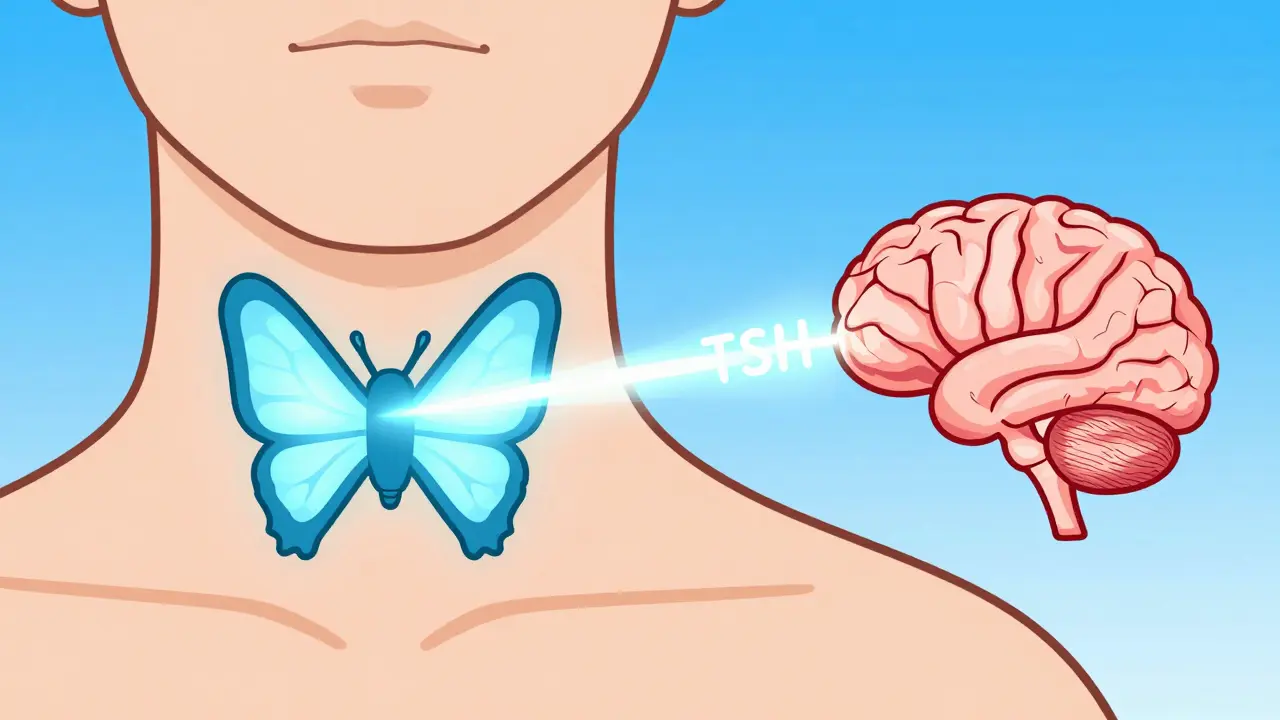
Ever felt completely exhausted, unable to shake a chill, or suddenly anxious for no clear reason? Your thyroid-a tiny, butterfly-shaped gland in your neck-might be the culprit. When doctors talk about "checking your thyroid," they aren't just guessing; they are looking at a precise chemical conversation happening between your brain and your gland. This conversation is primarily captured by two markers: TSH and T4 is the gold standard for figuring out if your metabolism is running too fast or too slow. If these numbers are off, it can feel like your internal thermostat is broken.
| Marker | What it is | Normal Range (General) | Key Role |
|---|---|---|---|
| TSH | Thyroid-Stimulating Hormone | 0.5 - 5.0 mIU/L | The "Command Signal" from the pituitary gland |
| Free T4 (FT4) | Unbound Thyroxine | 0.7 - 1.9 ng/dL | The active hormone available to cells |
| Total T4 | All Thyroxine (bound & free) | 5.0 - 12.0 μg/dL | Overall production (influenced by proteins) |
How the TSH and T4 Feedback Loop Works
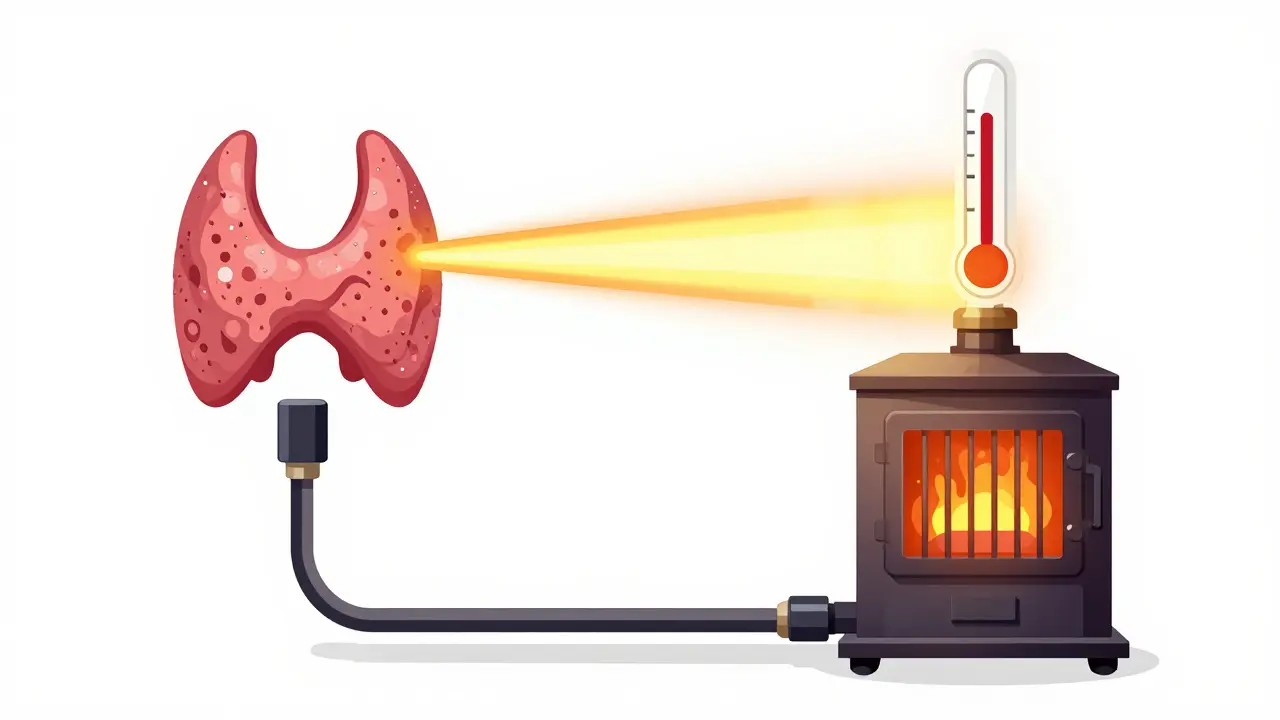
Think of your Pituitary Gland as a thermostat and your thyroid as the furnace. When the pituitary senses that thyroid hormone levels are too low, it releases TSH (Thyroid-Stimulating Hormone). This hormone acts like a loud shout, telling the thyroid to wake up and produce more T4 (Thyroxine). Once there is enough T4 in the blood, the pituitary senses the change and dials back the TSH production.
This is why TSH is often the first test doctors order. It's incredibly sensitive. In most cases, TSH can tell a doctor if something is wrong before the T4 levels even move outside the "normal" range. In fact, TSH testing alone handles about 85% of initial evaluations because it reflects the body's own demand for more hormone.
Decoding Your Test Results
Getting your lab report back can feel like reading a foreign language. The key is to look at TSH and FT4 together. If you only look at one, you might miss the full picture. For instance, a "normal" TSH doesn't always mean everything is fine, especially if you're feeling severe symptoms.
When TSH is high (above 4.5 mIU/L) and FT4 is low (below 0.8 ng/dL), it's a clear sign of primary hypothyroidism. Your brain is screaming for more hormone, but the thyroid isn't delivering. If your TSH is slightly elevated (between 4.5 and 10 mIU/L) but your FT4 is still in the normal range, you have subclinical hypothyroidism. This is a grey area where some people feel fine, while others feel exhausted and foggy.
On the flip side, if TSH is nearly non-existent (below 0.1 mIU/L) and FT4 is high (above 1.8 ng/dL), you're likely dealing with hyperthyroidism. Here, the furnace is stuck "on," pushing your heart rate and metabolism into overdrive. There is also a rare condition called central hypothyroidism, where both TSH and FT4 are low. This suggests the problem isn't the thyroid itself, but the pituitary gland that failed to send the signal in the first place.
The Pitfalls of "Normal" Ranges
One of the biggest frustrations for patients is being told their labs are "normal" despite feeling terrible. The truth is that reference ranges are based on population averages, not individual needs. What is "normal" for an 80-year-old is different from what is normal for a 25-year-old.
For example, research from Johns Hopkins suggests that using standard ranges for elderly patients can lead to overdiagnosing hypothyroidism by up to 20%. To fix this, experts now suggest age-stratified ranges-allowing for a slightly higher TSH in people over 70 or 80. Similarly, pregnancy changes everything. A woman in her first trimester needs a much tighter TSH range (0.1 to 2.5 mIU/L) to ensure the baby's brain develops correctly.
Another tricky part is the difference between Total T4 and Free T4. Total T4 includes hormones bound to proteins. Since things like estrogen therapy or pregnancy increase these proteins, your Total T4 might look high even if your active, "free" hormone levels are perfectly normal. This is why most endocrinologists prefer Free T4 (FT4)-it's the only part of the hormone that your cells can actually use.
Dosing and Managing Levothyroxine
Once a diagnosis of hypothyroidism is confirmed, the standard treatment is Levothyroxine, a synthetic version of T4. The goal is to replace what your body is missing so your metabolism can return to baseline.
Dosing isn't one-size-fits-all. For most adults with primary hypothyroidism, a typical starting dose is around 1.6 mcg per kilogram of body weight per day. However, this varies wildly based on age and health. An elderly patient might start at a much lower dose-perhaps 1.0 mcg/kg-to avoid putting too much stress on the heart. Meanwhile, infants require much higher concentrations, often 10-15 mcg/kg, to support rapid growth.
The process of finding the right dose is a game of patience. After starting or changing a dose, doctors usually wait about 6 weeks before re-testing TSH. Why so long? Because T4 has a long half-life; it takes time to reach a steady state in your bloodstream. If you change your dose every few days based on how you feel, you'll likely end up in a cycle of over-shooting and under-shooting your target.

Advanced Insights and Emerging Trends
While the TSH/FT4 duo is the gold standard, some people continue to feel "off" even when their labs look perfect. This has led to more interest in FT3 (Free Triiodothyronine) testing. T4 is essentially a storage hormone that the body converts into T3, which is the active form that actually does the work in your cells. Some people have a genetic or health-related struggle converting T4 to T3.
Recent evidence suggests that adding an FT3 test can provide valuable answers for about 15-20% of patients who remain symptomatic on levothyroxine. While most endocrinologists still rely on TSH for dosing, the medical community is moving toward a more personalized approach. We are even seeing the start of AI-assisted interpretation, where machine learning looks at TSH, FT4, BMI, and age together to reduce misdiagnosis rates.
Can I take my TSH test while taking thyroid medication?
Yes, you can, but the timing of your dose matters. Most doctors recommend taking your blood draw before your morning dose of levothyroxine to get the most accurate reading of your baseline levels. Always follow your specific doctor's instructions regarding fasting or medication timing.
Why is my TSH high but my T4 normal?
This is known as subclinical hypothyroidism. It means your pituitary gland is working extra hard (producing more TSH) to keep your T4 levels within the normal range. Whether this requires treatment depends on your symptoms, your age, and whether you have thyroid antibodies.
How often should I have my thyroid levels checked?
When you first start medication or change your dose, testing typically happens every 6 to 8 weeks. Once your levels are stable and you feel good, most patients move to once-a-year checkups. If you become pregnant or have a major health change, you'll need more frequent monitoring.
Does stress affect TSH and T4 levels?
Severe physical stress, such as a major illness or ICU admission, can cause "non-thyroidal illness syndrome." In these cases, TSH and T4 levels may drop or shift, not because of a thyroid disease, but because the body is trying to conserve energy. This is why ICU patients often need FT4 tests regardless of their TSH.
Is Free T4 more accurate than Total T4?
Generally, yes. Total T4 measures both bound and unbound hormones. Since binding proteins can change due to pregnancy, liver disease, or certain medications, Total T4 can give a misleading picture. Free T4 only measures the active hormone, providing a more accurate reflection of your actual thyroid status.
Next Steps for Your Thyroid Health
If you're staring at a lab report and feeling confused, start by mapping out your symptoms. Are you dealing with brain fog, weight gain, or a racing heart? Bring these specific notes to your doctor. If your TSH is in the "normal" range but you still feel unwell, ask about testing your Free T4 or checking for thyroid antibodies to see if an autoimmune issue like Hashimoto's is the cause.
For those already on medication, keep a simple log of when you take your pill and any new symptoms that pop up. Because different labs use different reference ranges, try to stick with the same laboratory for all your follow-up tests. This makes it much easier to spot real trends rather than just variations between different testing machines.

Nikki Grote
The distinction between the hypothalamic-pituitary-thyroid (HPT) axis and peripheral conversion is so crucial here. Many patients suffer from suboptimal T4-to-T3 conversion due to polymorphisms in the DIO2 gene, meaning that while TSH might be euthyroid, they're functionally hypothyroid at the cellular level. It's a classic example of why we need to look at the whole biochemical cascade rather than just a single marker to optimize metabolic homeostasis.
Nell O'Leary
Totally agree on the HPT axis point! :-) Relying solely on TSH can be a real gamble when the patient has clear systemic symptoms. Looking at the reverse T3 (rT3) levels would also be a great way to see if the body is in a state of "euthyroid sick syndrome" or just struggling with conversion. Great layout! (^_^)
Maggie Graziano
ranges are fake
big pharma just wants us on pills forever
dont trust the labs
ira fitriani
OMG I feel this so much!! 😭 Being told your labs are "normal" while you feel like a zombie is literally the worst experience ever! 🧟♀️ Keep fighting for your health and don't let anyone dismiss your symptoms!! ✨💪 You are your own best advocate! 🌈💖
Michael Lewis
Exactly! If you feel like garbage, you feel like garbage. Period. Stop letting doctors tell you that a number on a page overrides your actual physical experience. Get a second opinion, demand the Free T3 test, and don't stop until you find a provider who actually listens to you. You have to be the driver of your own medical care!
Autumn Bridwell
Wait, are you actually taking Levothyroxine right now? I've had a cousin who took that and she gained like twenty pounds even though the doctor said it was working! It is absolutely terrifying how these drugs mess with your brain and your weight and no one tells you the truth about the side effects! My heart is literally racing just thinking about the risks of messing with your endocrine system!
Rock Stone
Just keep it chill and take it one step at a time. It's all a journey and everyone's body reacts differently to the meds. No need to stress too much about the outliers, just find a balance that works for you and your doc. We're all just trying to figure it out as we go, man.
Bonnie Piersall
This guide is a real lifesaver for those of us wading through the medical wilderness. Finding the right dosage of levothyroxine can feel like trying to find a needle in a haystack while wearing a blindfold, but having the 6-week window explained here is a total game-changer. It's just a slow burn process where you've got to play the long game. I've seen so many people go completely haywire trying to adjust their meds every three days, which is basically like trying to steer a cruise ship with a paddle. You've got to let the chemistry settle in your system before you even think about tweaking the dial. It's all about that steady state, baby. Once you hit that sweet spot, the brain fog lifts like a morning mist and you finally feel like a human being again. Just keep a meticulous log of everything. Note the time, the brand, and how you feel after a month. It makes the conversation with your endo so much more productive when you have hard data instead of just vibes. Be patient with your body because it's doing the best it can with the tools it has. Hang in there, stay consistent, and trust the process of the slow adjustment. You'll get there eventually!