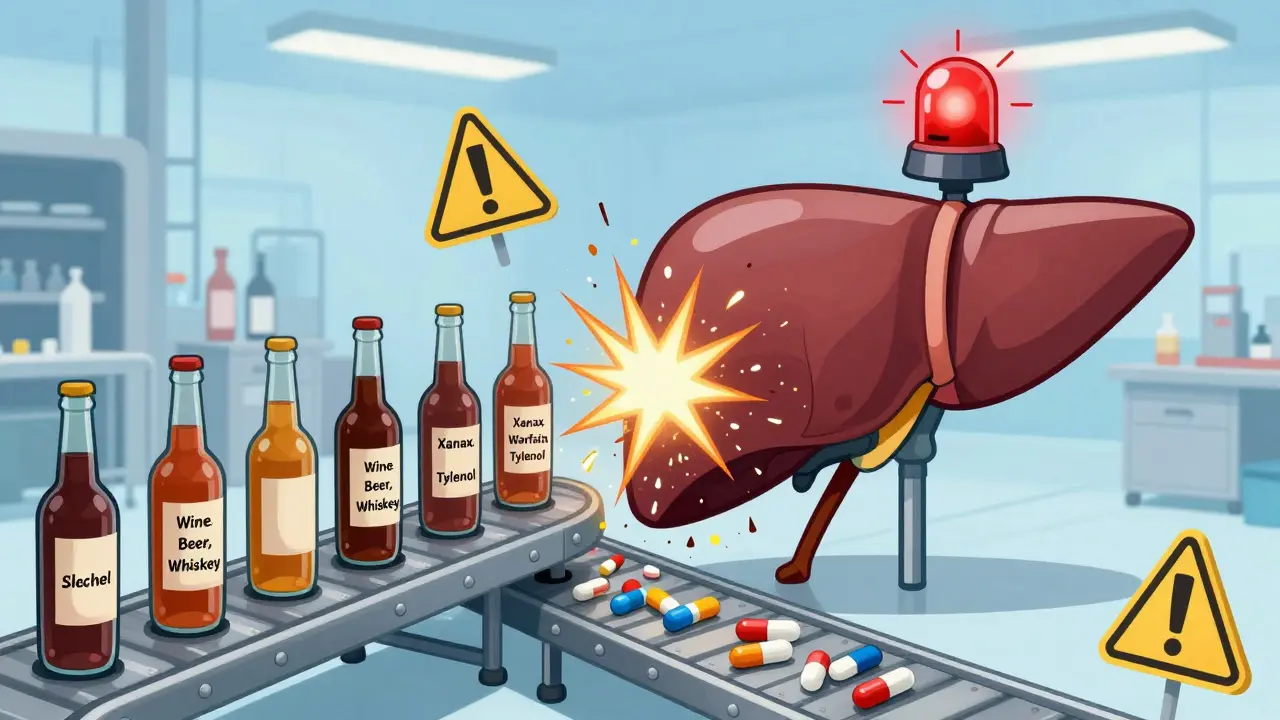
Every year, thousands of people end up in emergency rooms not because they took too much of a drug, but because they mixed something simple - a glass of wine, a beer, or a shot of whiskey - with a prescription they were told was safe. It’s not a myth. It’s not rare. And it’s not something that only happens to older people or heavy drinkers. The truth is, alcohol and prescription drugs can create deadly combinations even when you follow your doctor’s orders exactly.
How Alcohol Changes What Your Medication Does
Your body treats alcohol like a drug - because it is one. When you drink, your liver gets busy breaking it down. But so does your liver when you take medications like painkillers, anxiety pills, or blood pressure drugs. When both are in your system, they fight for the same tools to get processed. That’s where things go wrong.
There are two main ways alcohol messes with medications. One is through pharmacokinetics - how your body absorbs, moves, and breaks down the drug. The other is pharmacodynamics - how the drug works in your brain and body. Alcohol can speed up, slow down, or completely change how your medication behaves.
For example, if you drink regularly, your liver starts producing more of an enzyme called CYP2E1. That enzyme breaks down alcohol - and also some medications. The result? Drugs like propranolol (used for heart conditions) get cleared out too fast. You might think the pill isn’t working, so you take more. But it’s not the pill. It’s the beer.
On the flip side, if you have one drink right after taking a medication, alcohol can block that same enzyme. That means the drug stays in your blood longer than it should. Warfarin, a blood thinner, can spike in your system by up to 35% after just one drink. That’s enough to cause internal bleeding without warning.
The Deadliest Mixes: Benzodiazepines and Opioids
Some combinations aren’t just risky - they’re deadly. Benzodiazepines like Xanax, Valium, and Ativan are prescribed for anxiety, insomnia, or seizures. They slow down your brain. So does alcohol. Together? They don’t just add up - they multiply.
Research from the National Institute on Alcohol Abuse and Alcoholism shows that mixing alcohol with benzodiazepines increases sedation by 400%. That means you’re not just drowsy. You’re at risk of passing out, stopping breathing, or choking on your own saliva. In older adults, this mix is a leading cause of falls, fractures, and hospitalizations.
Opioids are even worse. Oxycodone, hydrocodone, fentanyl - these are powerful painkillers. They already suppress breathing. Add alcohol, and that suppression jumps sixfold. The CDC reports that in 2022, alcohol and opioid combinations were involved in 2,318 overdose deaths. That’s not accidental. It’s predictable. And it’s preventable.
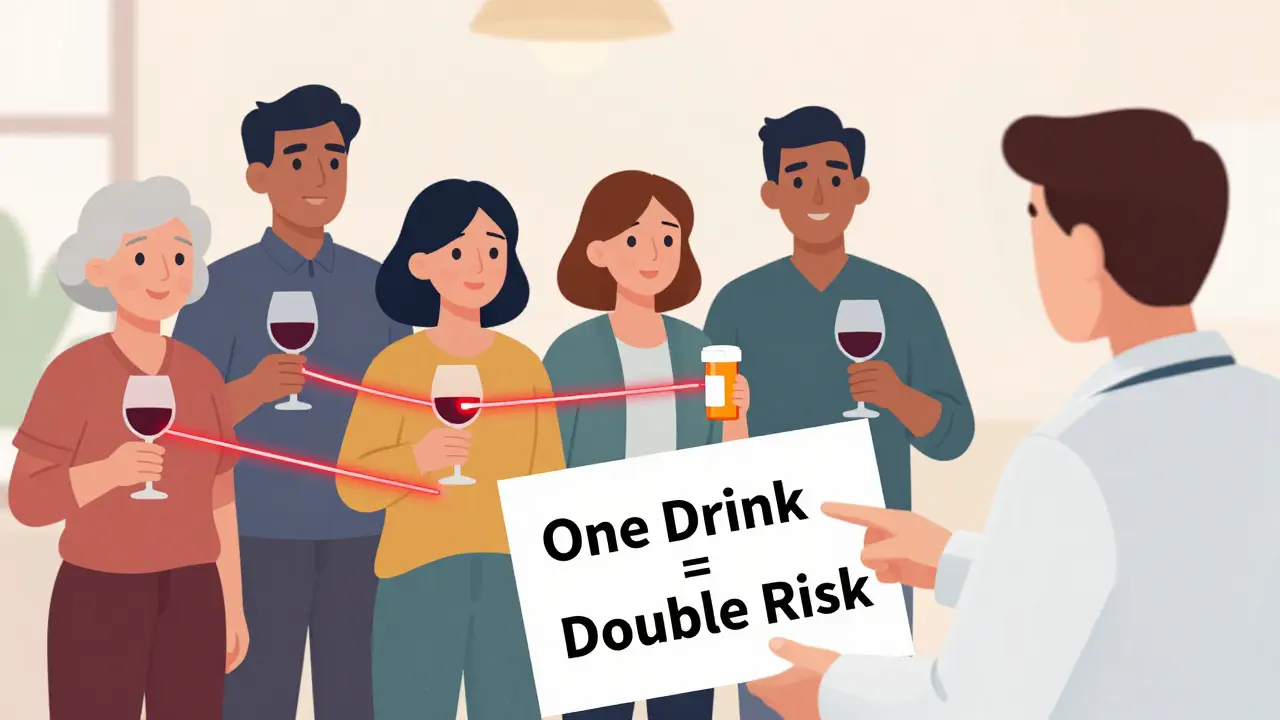
Here’s the scary part: you don’t need to be drunk. A blood alcohol level of just 0.02% - that’s one standard drink - doubles the risk of fatal overdose when combined with therapeutic opioid doses. Many people don’t realize this. They think, “I had one beer. It’s fine.” But one beer can be enough.
Other Dangerous Pairings You Might Not Know About
It’s not just anxiety and pain meds. Many everyday prescriptions carry hidden risks when mixed with alcohol.
- NSAIDs (like ibuprofen or naproxen): Alcohol increases stomach irritation. Heavy drinkers who take these painkillers have a 300% higher chance of bleeding ulcers. One study of 200,000 patients found this risk skyrockets with just three drinks a day.
- Acetaminophen (Tylenol): This is one of the most common OTC pain relievers. But when combined with alcohol, it creates a toxic chemical in the liver. In 1 out of every 200 regular drinkers who take Tylenol, this leads to acute liver failure. It doesn’t take much - a few drinks over a few days while taking the maximum daily dose of acetaminophen.
- Beta-blockers (like metoprolol): These are used for high blood pressure and heart conditions. Alcohol can make them less effective - meaning your blood pressure stays high. At the same time, it can cause your blood pressure to drop too low, leaving you dizzy or fainting. The risk spikes if you drink three or more drinks a day.
- SSRIs (like sertraline or fluoxetine): These antidepressants don’t cause liver damage like other drugs, but they make you sleepy. Alcohol makes you sleepier. The result? 35% of people over 65 who drink even one drink a day while on SSRIs report extreme drowsiness. That’s a recipe for falls, accidents, and injuries.
- Isoniazid (used for tuberculosis): This antibiotic is rare, but it’s dangerous with alcohol. About 15% of users develop liver damage when drinking while taking it. Many patients don’t even know they’re on this drug - it’s not commonly prescribed anymore, but it’s still used.
Who’s at the Highest Risk?
Not everyone reacts the same way. Some people are far more vulnerable.
Age 65 and older: Your liver doesn’t process alcohol or drugs as quickly. Your brain is more sensitive to depressants. And you’re more likely to be on multiple medications. Studies show adults over 65 experience 3.2 times more severe interactions than younger people. That’s why the American Geriatrics Society lists 15 alcohol-interacting drugs as “potentially inappropriate” for seniors.
Women: Women have less water in their bodies than men. That means alcohol gets more concentrated in the bloodstream. Even if you weigh the same as a man, one drink affects you more. Research shows women face 20% higher interaction severity with most medications.
People with liver disease: If your liver is already damaged from hepatitis, fatty liver, or past heavy drinking, even small amounts of alcohol can turn a safe drug into a poison. For acetaminophen, the risk of liver failure jumps fivefold in these patients.
People on multiple prescriptions: The more meds you take, the higher the chance one of them interacts with alcohol. Nearly half of U.S. adults over 65 take at least five medications. Many don’t realize alcohol is a factor in any of them.
Why Do So Many People Get It Wrong?
Here’s the problem: most people aren’t warned.
A 2023 WebMD survey of over 5,800 adults found that 57% believe “one drink is safe with most medications.” Thirty-two percent think only hard liquor is dangerous - not beer or wine. That’s dangerously wrong.
Doctors often don’t mention it. A review of 12,450 patient reviews on Healthgrades showed 68% of people prescribed benzodiazepines were never told to avoid alcohol. One patient wrote: “My doctor never mentioned I shouldn’t drink on Xanax.”
Even labels are inconsistent. Only 38% of benzodiazepine prescriptions include a clear alcohol warning on the bottle, according to a 2022 FDA audit. Pharmacists are often the last line of defense - and not every pharmacy has the time or training to catch every risk.
But some do. One patient left a Google review saying: “My Walgreens pharmacist refused to fill my lorazepam prescription when I admitted to regular drinking. Probably saved my life.” That’s the kind of intervention that matters.
What You Should Do
Here’s how to protect yourself:
- Check the label. Look for the words “Do not drink alcohol” or “Avoid alcohol.” If it’s not there, don’t assume it’s safe.
- Ask your pharmacist. They’re trained to spot interactions. Use the 4-question screening tool: “Do you drink alcohol? How often? How much? Are you taking any other medications?”
- Use a free app. The NIAAA’s “Alcohol Medication Check” app lets you scan your prescription and instantly see if alcohol is risky with it. It covers over 2,300 medications.
- Be honest. Tell your doctor and pharmacist how much you drink - even if it’s “just one glass of wine.” They need real numbers to give you real advice.
- When in doubt, skip it. If you’re unsure, don’t drink. The risk isn’t worth it.
The Bigger Picture
This isn’t just about individual choices. It’s a system problem. Only 32% of private U.S. practices use automated systems that flag alcohol-drug interactions when a prescription is written. In VA hospitals, that number is 89%. That’s a huge gap.
Regulations are changing. The 2022 Alcohol-Drug Interaction Labeling Act now requires clear warnings on high-risk prescriptions. By 2025, 42 states will require doctors to complete training on these interactions to keep their license. And AI tools are starting to help - systems like Epic’s now predict individual risk with 89% accuracy by analyzing age, weight, liver function, and drinking patterns.
But technology can’t replace a conversation. No app can replace a pharmacist asking, “Do you drink?” No algorithm can replace a patient saying, “I have a glass of wine every night.”
The bottom line? Alcohol doesn’t just add to your meds - it changes them. And sometimes, that change kills.
Can I have one drink with my prescription medication?
It depends on the medication. For some drugs like antibiotics (amoxicillin), one drink is usually fine. But for others - especially opioids, benzodiazepines, sleep aids, or blood thinners - even one drink can be dangerous. There’s no universal safe amount. Always check with your pharmacist or doctor.
I’ve been drinking and taking my meds for years. Should I be worried?
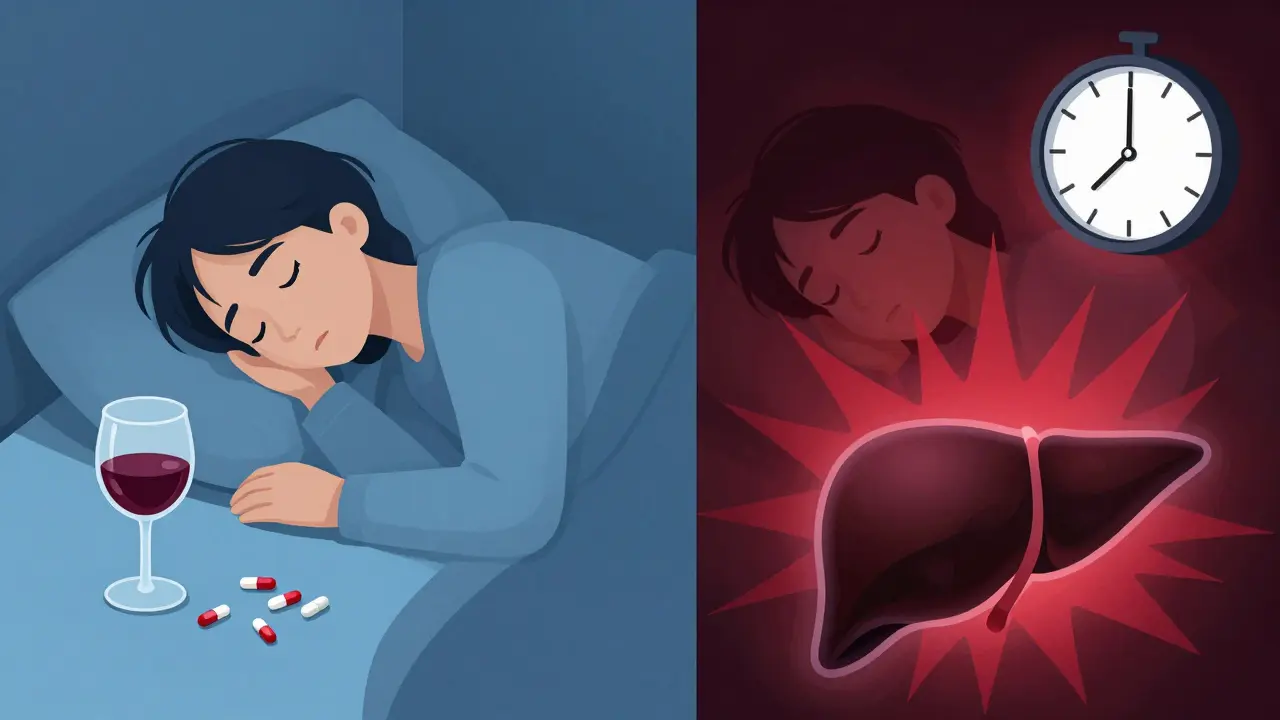
Yes. Many interactions don’t show symptoms right away. Liver damage from acetaminophen and alcohol can build up silently over months. Sedation from alcohol and anxiety meds can make you more prone to falls, especially as you age. Even if you feel fine, the risks are still there. It’s never too late to ask your doctor or pharmacist to review your medications.
What if my doctor didn’t warn me about alcohol?
You’re not alone. Studies show over two-thirds of patients aren’t warned. But that doesn’t mean it’s safe. Pharmacists are trained to catch these risks, even when doctors don’t. Bring your medication list to your pharmacist - they can review it for free. Don’t wait for someone else to tell you.
Are herbal supplements and over-the-counter drugs safe with alcohol?
No. Many OTC meds like cold remedies, sleep aids, or antihistamines contain alcohol or interact with it. Herbal supplements like kava, valerian, or St. John’s Wort can cause dangerous sedation when mixed with alcohol. Always treat them like prescription drugs - assume they interact unless proven otherwise.
I’m trying to cut back on alcohol. Where can I get help?
The NIAAA’s “Rethinking Drinking” website offers free tools, including a personalized risk calculator and tips for reducing alcohol use. Many pharmacies and community health centers also offer free counseling. You don’t need to quit cold turkey - even cutting back lowers your risk. Talk to your pharmacist or doctor. They’ve seen this before.

Benjamin Fox
Bro this is why America’s falling apart 🤡 One beer? One. Beer. And you’re gonna die? My grandpa drank whiskey with his blood pressure meds for 40 years and still golfed every Sunday. Stop fearmongering. 🍻💀
Hariom Sharma
Love this post! 🙌 So many people in India think 'alcohol = only bad if you get drunk' but it's the small daily sips that quietly wreck your liver. My uncle took metoprolol + 1 glass wine daily for years - ended up in ICU. Please share this with your family! 🌏❤️
Nina Catherine
I had no idea acetaminophen + alcohol could cause liver failure 😱 I take Tylenol for headaches and have a glass of wine most nights… I just stopped. Like, right now. Thanks for the wake up call!! 🙏 I’m gonna tell my mom too - she’s on 5 meds and drinks red wine like water 🍷
Taylor Mead
This is actually really well put. I work in a pharmacy and see this every single day. People are shocked when we say 'don't drink with this.' They say 'but I've been doing it for years!' - yeah, and you're lucky. Not everyone is. Just because you haven't crashed yet doesn't mean the engine isn't rusting.
Amrit N
i read this and thought abt my dad... he takes warfarin and has 1 beer every night. he says 'its just one'... i think i need to talk to him. thanks for sharing
Courtney Hain
This is just another government-controlled narrative to scare people into compliance. The FDA doesn’t want you drinking because they’re owned by Big Pharma. Why do you think they didn’t warn you about this before? Because they profit off your hospital visits. The real danger? Trusting doctors who’ve never even read the pharmacokinetic studies. I’ve been tracking this since 2018 - it’s all a scam. Your liver is fine. Your fear is not.
Maddi Barnes
Oh honey. You didn’t just write an article. You wrote a horror novel. And the villain? The pharmacist who didn’t say anything. The doctor who nodded and said 'you’re fine.' The system that says 'one drink' is safe until it’s not. I had a cousin die from mixing Xanax and two glasses of wine. She was 32. She thought she was being responsible. We all thought she was being responsible. We were wrong. 😔🍷
aine power
Anecdotal. Overblown. Poorly sourced.
Ellen Spiers
The empirical data presented herein is methodologically sound, particularly regarding the CYP2E1 induction dynamics and the pharmacodynamic synergism with GABAergic agents. However, the generalization of risk across all demographic strata lacks stratification by CYP polymorphism prevalence, which varies significantly between populations. Furthermore, the assertion that 'one drink' is universally dangerous is statistically unsupported without adjustment for body mass index, hepatic clearance rates, and chronicity of exposure. A more nuanced risk-benefit analysis is required.
Marie Crick
You’re killing people with your ignorance. If you drink with meds, you deserve what you get. No one forced you to be stupid.
Jonathan Rutter
I’ve been on 7 medications for 12 years. I drink two glasses of wine every night. I’ve never had a problem. I’ve seen people die from opioids and alcohol? Yeah, but they were also on 12 other pills, didn’t sleep, took pills from strangers online, and were on fentanyl patches. You’re blaming the wine for people who are just asking for it. My liver is stronger than your fear. I’m 58. I still run marathons. You want to live in fear? Fine. I’ll live in freedom.
Jana Eiffel
The ethical imperative here transcends mere pharmacological interaction. It reveals a deeper epistemological rupture in modern healthcare - the commodification of patient autonomy under the guise of paternalistic caution. When we reduce complex physiological systems to binary 'safe/unsafe' labels, we erase the lived experience of embodied rationality. The patient who drinks one glass nightly is not irrational - they are negotiating risk within a system that fails to provide adequate, individualized risk communication. The solution is not prohibition, but epistemic humility - the recognition that the body, like the soul, resists categorical control.