Ever picked up a prescription and been shocked by the price-only to find out the exact same pill costs half as much under a different label? That’s not a trick. It’s an authorized generic. These drugs are identical to the brand-name version you know, down to the color, shape, and inactive ingredients. But they’re sold at a discount. So why don’t more people know about them? And more importantly, why do they cost less?
They’re the Same Drug, Just a Different Label
Authorized generics aren’t knockoffs. They’re not cheaper because they’re lower quality. They’re made in the same factory, with the same equipment, by the same company that makes the brand-name drug. The FDA requires them to meet the exact same standards: same active ingredient, same dosage, same safety profile. If your doctor prescribed you Lipitor, and you pick up an authorized generic version, you’re getting the exact same medicine. The only difference? The box says something else.This isn’t a loophole. It’s built into U.S. drug law. When a brand-name drug’s patent expires, another company can apply to make a generic version. But the original manufacturer can also launch their own generic-under a different name, often through a partner. That’s an authorized generic. It operates under the original brand’s FDA approval (called an NDA), so it doesn’t need to go through the full generic approval process. That saves time and money. But it doesn’t save on quality.
Why the Price Drop Isn’t a Mystery
The reason authorized generics cost less comes down to one thing: no marketing. Brand-name drugs spend billions on TV ads, doctor visits, patient programs, and sales reps. That cost gets baked into the price you pay at the pharmacy. Authorized generics? They don’t need any of that. They’re sold quietly, often directly to pharmacies or through mail-order services. No billboards. No free samples. No fancy packaging. Just the drug.Think of it like buying a car. The same model, built in the same plant, might be sold under two names: one with a luxury badge and a 30% higher price tag. The authorized generic is the no-frills version. Same engine, same safety features, same warranty. Just no logo on the hood.
The 180-Day Window That Changes Everything
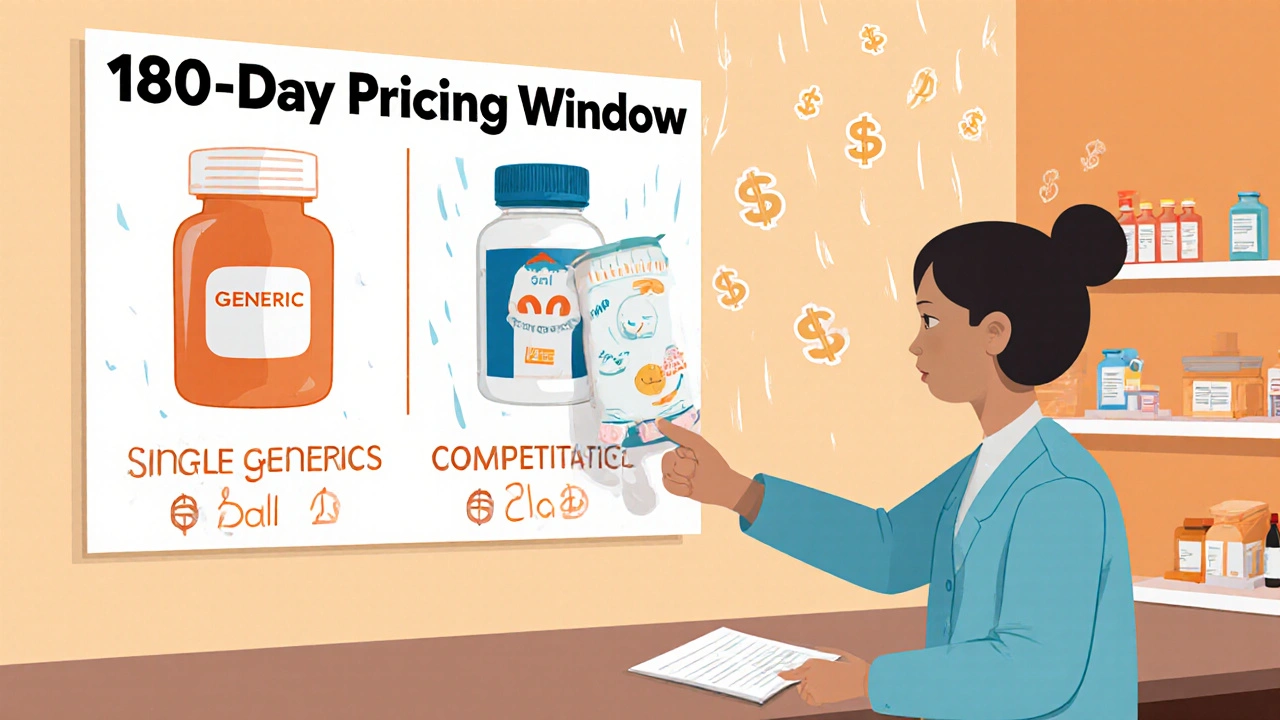
Here’s where it gets interesting. When a brand-name drug goes generic, the first company to file for approval gets 180 days of exclusive rights to sell their version. That’s a big deal. Without competition, they can charge close to the brand price-and many do. But if the original manufacturer launches an authorized generic during that 180-day window, everything changes.Now there are two versions of the same drug on the shelf: the first generic and the authorized generic. Both are cheaper than the brand. But now they’re competing with each other. That forces prices down fast. Studies show that when an authorized generic enters during this window, retail prices drop 4% to 8% compared to when only one generic is available. For pharmacies buying in bulk, the discount can be as high as 18%.
This isn’t theoretical. In 2016, Mylan launched an authorized generic of the EpiPen at $300-half the price of the branded version. That move didn’t just help patients. It forced other manufacturers to lower their prices too. The same thing happened with Gilead’s hepatitis C drugs. By launching authorized generics before patents even expired, they kept market share while keeping prices from spiraling.
Who Controls the Price You Pay?
Here’s the catch: even if an authorized generic is cheaper, you might not see the savings. That’s because Pharmacy Benefit Managers (PBMs) control what drugs go on which tier of your insurance plan. PBMs are middlemen between insurers, pharmacies, and drugmakers. They decide which version of a drug gets the lowest copay.If the PBM puts the brand-name drug on the lowest tier-and the authorized generic on a higher one-you’ll pay more for the cheaper drug. It sounds backwards, but it happens. A 2022 analysis of 1.2 million Medicare Part D patients found that when authorized generics were placed on the same tier as traditional generics, adherence improved by over 8%. But if they were buried on a higher tier, patients didn’t switch. They just paid more.
That’s why it’s important to ask your pharmacist: “Is there an authorized generic for this? And is it on the same tier as the brand?” If not, you can often request a formulary exception. Many plans will approve it if you explain you’re trying to save money.
Authorized Generics vs. Traditional Generics: What’s the Difference?
It’s easy to confuse authorized generics with regular generics. Here’s the breakdown:- Authorized generic: Made by the brand-name company (or under its license), same factory, same NDA. No separate FDA review needed.
- Traditional generic: Made by a different company, uses a separate FDA application (ANDA), may use different inactive ingredients, and often enters after the 180-day exclusivity period.
Traditional generics are still safe and effective. But they’re not always cheaper than authorized generics. In fact, when an authorized generic is available, it’s often the lowest-priced option-even lower than the first generic to enter the market.
Why Don’t More People Know About Them?
The system isn’t designed to make authorized generics obvious. Pharmacies don’t always flag them. Insurance forms don’t highlight them. Ads don’t mention them. Even doctors sometimes don’t know the difference. Most patients assume “generic” means “cheaper,” but they don’t realize there are different kinds of generics.That’s why awareness is low. Only about 12% of the U.S. generic drug market is made up of authorized generics. But they’re growing. Since 2010, 67% of brand-name drugmakers have used them for at least one product. And with the Inflation Reduction Act capping out-of-pocket drug costs for Medicare beneficiaries at $2,000 a year, the push to cut costs is stronger than ever.
What You Can Do to Save
You don’t need to be a pharmacy expert to get the best price. Here’s how to make sure you’re not overpaying:- Ask your pharmacist: “Is there an authorized generic for this prescription?”
- Check your insurance formulary. Look for the drug under both the brand name and the generic name.
- If the authorized generic isn’t on the lowest tier, ask your doctor to request a formulary exception.
- Use price comparison tools like GoodRx or SingleCare. They often list authorized generics separately.
- Don’t assume “generic” means “lowest price.” Sometimes the authorized version is cheaper-even if it’s not labeled as such.
And if you’re on Medicare, remember: every dollar you save on your prescription now counts toward your $2,000 annual cap. Choosing the right version of your drug can help you hit that cap faster-and save even more in the long run.
Is This a Fair System?
Some critics argue that authorized generics are a way for big pharma to delay real competition. By launching their own generic, they can undercut the first independent generic maker and keep control of the market. The FTC has looked into this. Their findings show that while AGs can be used strategically, they still drive down prices overall. In fact, the presence of an authorized generic during the 180-day window leads to lower prices than if no AG was there at all.It’s not perfect. But right now, for millions of people, authorized generics are the fastest, most reliable way to get a brand-name drug at a fraction of the cost. And if you know how to ask for them, you can use them to your advantage.
Are authorized generics as safe as brand-name drugs?
Yes. Authorized generics are identical to brand-name drugs in active ingredients, strength, dosage form, and quality. They’re made in the same facility, under the same FDA oversight, using the same manufacturing process. The only difference is the label.
Why is my authorized generic not cheaper on my insurance?
Your Pharmacy Benefit Manager (PBM) controls which version of the drug is placed on which tier of your plan. Sometimes, the brand-name drug is placed on the lowest tier-even if the authorized generic costs less. Ask your pharmacist to check the formulary or request a formulary exception.
How do I find out if my drug has an authorized generic?
Ask your pharmacist or check the FDA’s quarterly list of authorized generics, which is publicly available. You can also use tools like GoodRx or Drugs.com, which often list authorized generics separately from traditional generics.
Do authorized generics come in the same packaging as the brand?
No. Authorized generics are usually packaged in plain bottles or blister packs without the brand logo or marketing. The pill inside is identical, but the box looks different-often simpler and cheaper-looking.
Can I switch from a brand to an authorized generic without asking my doctor?
In most cases, yes. Authorized generics are considered therapeutically equivalent to the brand. Your pharmacist can substitute them unless your prescription says “dispense as written” or “no substitutions.” Always confirm with your pharmacist before switching.

stephen idiado
Authorized generics? More like authorized price gouging with a side of placebo branding. Same pill, same factory, same FDA stamp - but now the pharma giant gets to play both the monopolist and the discount dealer. Classic oligopoly theater.
Subhash Singh
It is indeed a matter of considerable interest that the authorized generic, while therapeutically indistinguishable from its branded counterpart, circumvents the abbreviated new drug application (ANDA) pathway by leveraging the original new drug application (NDA). This regulatory nuance, while legally sound, raises pertinent questions regarding market dynamics and equitable access.
Matthew Higgins
Bro, I just found out my $400 insulin is the exact same as the $80 generic on GoodRx. I’ve been paying for a logo this whole time. Like, I didn’t even know the pill looked the same. My pharmacist didn’t say a word. This system is rigged, but at least now I know how to beat it.
Peter Axelberg
It’s wild how much of this is just about packaging and perception. I’ve had my hands on both versions - brand-name Lipitor in that fancy blue bottle with the little heart on it, and the authorized generic in a plain white bottle with a sticker that says ‘Atorvastatin 20mg’. Same size, same taste, same side effects. The only difference? The brand version came with a pamphlet about ‘living your best life with cholesterol’ and a coupon for a free gym bag. The generic? Just the pills. And I saved $200 a month. No marketing = no markup. It’s not rocket science.
jamie sigler
Why do I even bother reading this? I’m on Medicare. I don’t care what tier it’s on. I just take what the pharmacy gives me and pray it doesn’t make me vomit.
Bernie Terrien
Pharma’s got a new magic trick: they make the generic, then call it ‘authorized’ so they can still own the market. It’s not competition - it’s a Trojan horse with a pill inside. The FTC calls it ‘strategic,’ I call it a loophole with a corporate handshake.
Jennifer Wang
It is imperative that patients and providers alike understand the distinction between authorized generics and traditional generics. Authorized generics are bioequivalent and manufactured under the same NDA as the brand, whereas traditional generics require an ANDA and may differ in inactive ingredients. The former often represents the most cost-effective option, yet formulary placement by PBMs frequently obscures this advantage. Patients should be encouraged to inquire directly with their pharmacists regarding availability and tier status.
Geoff Heredia
They’re not just selling pills - they’re selling control. The 180-day window? That’s not a loophole. It’s a cartel handshake. The brand launches its own generic to crush the real competition before it even gets started. And the FDA? They’re just the bouncer letting the VIPs in. This isn’t healthcare. It’s a corporate chess game with our prescriptions as pawns.
Tina Dinh
OMG I JUST SAVED $150 THIS MONTH ON MY BLOOD PRESSURE MEDS BY SWITCHING TO THE AUTHORIZED GENERIC!! 🙌 I didn’t even know they existed! My pharmacist was like ‘yeah, we’ve had it for months’ - why didn’t anyone tell me?! 🤯 This is life-changing. Tell your friends!!
Andrew Keh
This is a helpful overview. Many people assume all generics are the same, but the difference between authorized and traditional generics matters. The key point is that authorized generics are often cheaper and just as reliable. Asking your pharmacist and checking your insurance formulary are simple steps that can lead to real savings. It’s not complicated - just overlooked.
Sullivan Lauer
Listen - I used to be the guy who just took whatever the pharmacy handed me. Then I got hit with a $600 co-pay for a drug that had a $40 authorized generic version sitting right next to it. I asked. I pushed. I got the switch approved. Now I’m saving $700 a year. That’s a weekend trip. That’s groceries for a month. That’s peace of mind. You don’t need to be a genius to save money on meds - you just need to ask the question: ‘Is there a cheaper version of this?’ And then don’t take ‘no’ for an answer. Your wallet will thank you. And so will your future self.