
When a doctor prescribes a medication like warfarin, digoxin, or phenytoin, the difference between a life-saving dose and a dangerous one can be tiny. These are NTI drugs-narrow therapeutic index drugs-where even a small change in blood levels can lead to serious harm or treatment failure. That’s why the FDA doesn’t treat them like regular generic drugs. The rules for proving they work the same as the brand-name version are much tighter, and understanding those rules matters for patients, pharmacists, and prescribers alike.
What Makes a Drug an NTI Drug?
An NTI drug isn’t just any powerful medicine. It’s one where the gap between a safe dose and a toxic one is razor-thin. The FDA defines it using hard numbers: if the ratio of the minimum toxic dose to the minimum effective dose is 3 or less, it’s classified as an NTI drug. This isn’t guesswork. In 2022, the FDA analyzed 13 drugs and found that 10 of them had a therapeutic index of 3 or lower. The other three were close, between 3 and 5, but still treated with caution.
These drugs often require regular blood tests to make sure levels stay in the safe zone. Think of warfarin, where a blood test called INR is done weekly or monthly. Or phenytoin, used for seizures-too little and seizures return; too much and you risk brain damage. Even small changes in how the drug is absorbed can make a difference. That’s why the FDA doesn’t just rely on the usual bioequivalence rules.
Standard Bioequivalence vs. NTI Bioequivalence
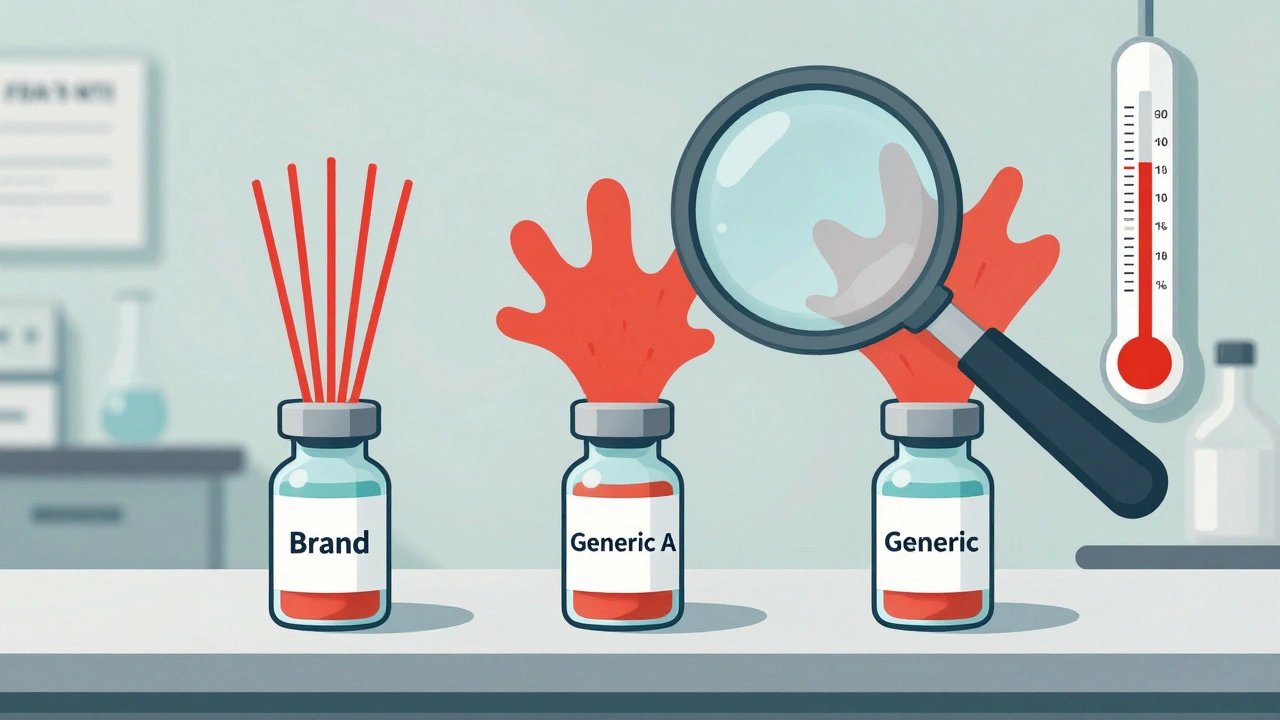
For most generic drugs, the FDA says they’re equivalent if their blood levels fall within 80% to 125% of the brand-name drug. That’s a 45% range. For NTI drugs, that’s not enough. The FDA tightened the rules to 90% to 111.11%. That’s a 21% range-more than half as wide.
But it’s not just about the average. The FDA uses a method called Reference-Scaled Average Bioequivalence (RSABE). This means the acceptable range can shift slightly based on how much the brand-name drug’s levels vary from person to person. If the brand drug has low variability, the limits stay tight at 90-111%. If it’s more variable, the FDA still requires the drug to pass the standard 80-125% test too. This dual approach ensures no generic drug slips through with hidden instability.
There’s also a strict limit on how much the generic drug’s variability can differ from the brand. The upper 90% confidence interval of the ratio of within-subject variability between test and reference must be 2.5 or less. This prevents generics that are inconsistent from being approved, even if their average levels look okay.
Quality Control Is Even Stricter
It’s not just about how the drug behaves in the body. The FDA also demands tighter control over how the drug is made. For non-NTI generics, the active ingredient must be within 90-110% of the labeled amount. For NTI drugs, that range shrinks to 95-105%. That’s a 10% window instead of 20%. This means manufacturers have to be more precise in blending and packaging. A batch that would be fine for a statin might be rejected for digoxin.
These standards aren’t optional. They’re baked into product-specific guidance documents. The FDA doesn’t publish one big list of NTI drugs. Instead, each drug gets its own guidance. If you’re making a generic version of tacrolimus, you follow the tacrolimus guidance. Same for carbamazepine, valproic acid, or everolimus. This keeps the rules precise and adaptable to each drug’s unique profile.
Which Drugs Are Affected?
Some of the most common NTI drugs include:
- Carbamazepine (for seizures)
- Phenytoin (also for seizures)
- Warfarin (blood thinner)
- Digoxin (heart medication)
- Valproic acid (mood stabilizer)
- Tacrolimus and cyclosporine (immunosuppressants after transplant)
- Lithium carbonate (for bipolar disorder)
These drugs cover critical areas: epilepsy, heart disease, mental health, and organ transplants. In each case, a small change in concentration can mean the difference between control and crisis. For transplant patients, a dip in tacrolimus levels can trigger organ rejection. For someone on lithium, a small rise can cause tremors, confusion, or kidney damage.
It’s worth noting that not every drug in these classes is automatically an NTI drug. The FDA evaluates each active ingredient individually. For example, some newer antiepileptics aren’t classified as NTI, even though they treat seizures, because their safety margins are wider.
Why This Matters for Patients
Many patients assume all generics are the same. But with NTI drugs, that assumption can be risky. The FDA says approved generic NTI drugs are therapeutically equivalent to the brand. And real-world data supports that-most patients switch without issue. But there’s a catch.
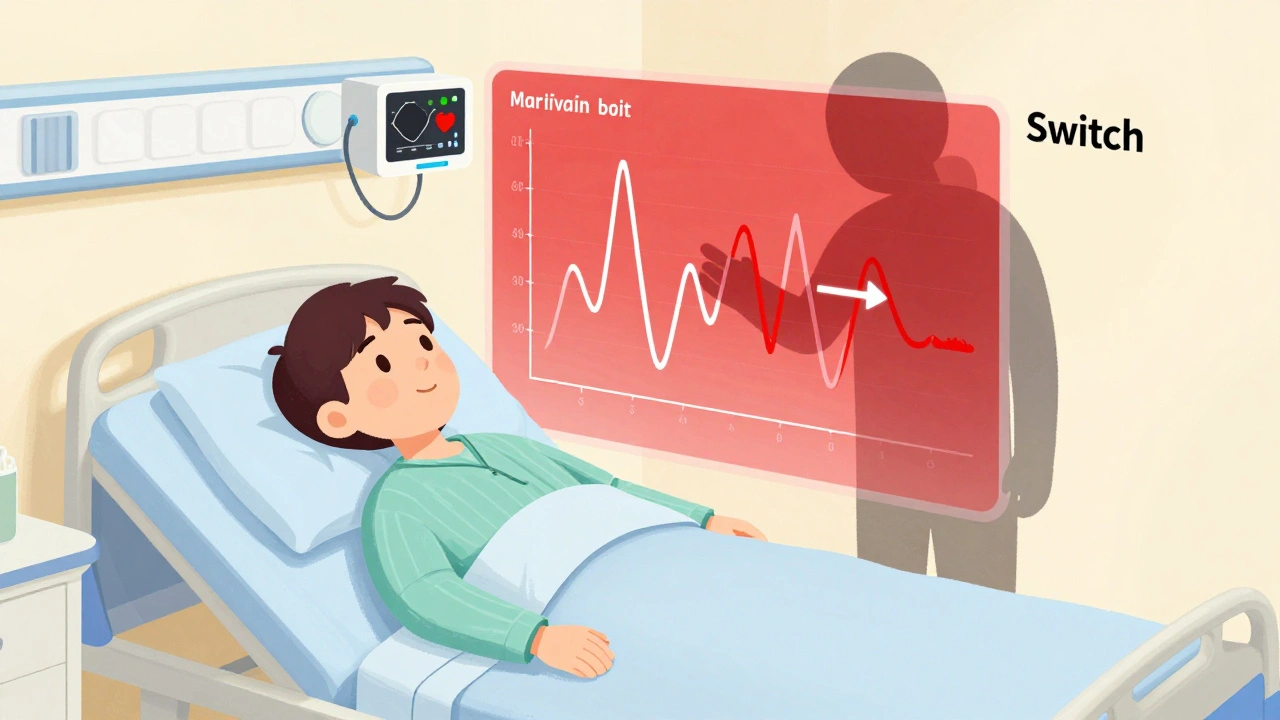
Studies have shown that two different generics of the same NTI drug, both approved under FDA rules, may not be bioequivalent to each other. One generic might be equivalent to the brand, and another might be too, but the two generics aren’t necessarily equivalent to each other. This creates a chain of uncertainty. If you switch from brand to Generic A, then later switch to Generic B, you might be getting a different level of drug than you started with-even if both are FDA-approved.
This is why some states still require patient consent before substituting an NTI generic. Some pharmacists won’t switch them at all without the prescriber’s OK. The FDA acknowledges this concern. They say the data supports safety, but they also admit that conflicting reports-especially around antiepileptic drugs-have made both doctors and patients nervous.
How Studies Are Done Differently
You can’t just run a standard bioequivalence study for an NTI drug. The FDA requires replicate designs. That means each participant takes the brand, the generic, and the brand again-multiple times. This gives enough data to calculate within-subject variability accurately. A regular study might have 24 people. An NTI study often needs 30-40, sometimes more.
The analysis is more complex too. It’s not just comparing average levels. It’s looking at how consistent the drug is across doses, how much it varies from person to person, and whether the generic’s variability matches the brand’s. This takes more time, more money, and more expertise. That’s why fewer companies make NTI generics-and why they often cost more than regular generics.
Global Differences
The FDA’s approach is unique. Health Canada and the European Medicines Agency (EMA) usually just tighten the bioequivalence range to 90-111% and call it done. The FDA goes further by factoring in variability. That’s more scientifically precise but also more complicated to implement.
This lack of global alignment causes headaches for manufacturers. A generic approved in the U.S. might not meet EMA standards, or vice versa. The FDA has said harmonization is a priority, but progress is slow. For now, companies making NTI generics must tailor their studies to each market’s rules.
What’s Next?
The FDA continues to refine its methods. In 2022, they moved from subjective definitions to a clear, math-based cutoff: therapeutic index ≤ 3. This makes classification more objective. They’re also collecting more real-world data on outcomes after generic switches, especially for drugs like warfarin and tacrolimus.
One thing won’t change: the FDA’s stance that approved generic NTI drugs are safe and effective. But the path to approval is harder, and the stakes are higher. For patients, the key is communication. If you’re on an NTI drug, ask your pharmacist or doctor if your prescription is brand or generic. If you’re switched, monitor for changes in symptoms or side effects. And don’t assume all generics are interchangeable-even if they’re both FDA-approved.
For prescribers, it’s about knowing which drugs fall into this category and being cautious with substitutions. For pharmacists, it’s about understanding the rules and knowing when to pause and check with the prescriber. For everyone, it’s a reminder: with NTI drugs, small differences matter-and the FDA’s rules are there to make sure those differences don’t cost lives.
What does NTI stand for in drugs?
NTI stands for Narrow Therapeutic Index. It means the drug has a very small margin between a safe, effective dose and a toxic or ineffective one. Even small changes in blood levels can lead to serious side effects or treatment failure. Examples include warfarin, digoxin, and phenytoin.
Are generic NTI drugs safe?
Yes, FDA-approved generic NTI drugs are considered safe and therapeutically equivalent to their brand-name versions. The FDA requires stricter testing and tighter quality controls for these drugs. Real-world data shows most patients switch without issues. However, some studies show that two different generics of the same NTI drug may not be equivalent to each other, so frequent switching between brands and generics should be done with caution.
What’s the difference between regular and NTI bioequivalence limits?
For regular drugs, bioequivalence is accepted if the generic’s blood levels are between 80% and 125% of the brand. For NTI drugs, the range is much narrower: 90% to 111.11%. This tighter window reduces the risk of under- or over-dosing. The FDA also requires the drug’s variability to be similar to the brand’s, which adds another layer of safety.
Why does the FDA use replicate studies for NTI drugs?
Replicate studies involve giving the same person multiple doses of both the brand and generic drug. This allows scientists to measure how much the drug levels vary within each person over time. For NTI drugs, this variability matters because even small fluctuations can be dangerous. Standard studies with just one dose per drug can’t capture this level of detail.
Can I switch between different generic versions of an NTI drug?
Technically, yes-if each generic is FDA-approved. But because two different generics of the same NTI drug may not be bioequivalent to each other, switching between them can lead to changes in drug levels. Patients on drugs like warfarin or tacrolimus should avoid unnecessary switches. Always talk to your doctor before changing between generic versions, even if they’re both approved.
Does the FDA publish a list of NTI drugs?
No, the FDA does not maintain a single public list of NTI drugs. Instead, each drug has its own product-specific guidance document that outlines the bioequivalence requirements. You can find these documents on the FDA’s website by searching for the drug name and "product-specific guidance." The classification is based on pharmacometric analysis, not a blanket list.

Ben Greening
The FDA's NTI bioequivalence standards are a masterclass in risk mitigation. Tightening the range from 80–125% to 90–111.11% isn’t arbitrary-it’s pharmacokinetic precision. The RSABE model accounts for intra-subject variability, which is critical when a 5% deviation could mean rejection or toxicity. This isn’t bureaucracy; it’s clinical safeguarding.
Jack Appleby
Let’s be honest-most clinicians don’t understand RSABE, yet they’re the ones prescribing these drugs. The FDA’s approach is elegant, but the disconnect between regulatory science and bedside practice is staggering. You can have perfect bioequivalence data, but if the pharmacist switches the generic without telling the patient, and the patient doesn’t know to monitor INR or lithium levels, you’ve just created a silent hazard. Knowledge isn’t power unless it’s communicated.
Neelam Kumari
Oh please. This is just Big Pharma’s way of keeping generics expensive. They call it 'safety'-but it’s really about protecting their market share. The FDA’s 'tighter standards'? A cleverly disguised trade barrier. Look at the EMA-they manage just fine with 90–111% and no replicate studies. Why should American patients pay more for the same medicine? It’s not science. It’s profit.
Michelle Edwards
Thank you for breaking this down so clearly. I’m a nurse in a rural clinic, and I’ve seen patients panic when their generic warfarin changed-even though it was FDA-approved. It’s not the drug. It’s the fear. Maybe we need better patient education, not just stricter regulations. A simple handout on why switching generics matters could save lives.
Sarah Clifford
So basically, if I’m on lithium and my pharmacy swaps my generic for another generic, I could end up in the hospital? That’s wild. Why don’t they just stick with the brand? It’s not like we’re talking about ibuprofen here.
Regan Mears
I’ve worked with transplant patients on tacrolimus for over a decade. The moment you switch generics-even if it’s ‘approved’-you’re playing Russian roulette with their graft. I’ve seen creatinine spike within days. The FDA’s rules are necessary, but they’re not enough. We need mandatory prescriber consent for NTI substitutions. Period.
Doris Lee
Hey, if you’re on one of these drugs, just ask your doc to write 'do not substitute' on the prescription. Easy fix. No drama. No panic. You’re still getting the same medicine, just not shuffled between generics. And hey-you’re worth the extra step.
Frank Nouwens
It is worth noting that the European Medicines Agency’s approach, while less granular, has demonstrated comparable clinical outcomes in longitudinal studies. The FDA’s methodology, though statistically robust, introduces logistical complexity that may not always translate into measurable patient benefit. Harmonization remains a prudent objective.
Nikki Smellie
Did you know the FDA’s NTI guidelines were influenced by a 2018 whistleblower report about a generic manufacturer falsifying dissolution data? They’re not being cautious-they’re covering up systemic fraud. And now they’re making us all pay for it with higher prices and restricted access. 🤫💉
Kaitlynn nail
It’s just drugs. People are scared of science because it sounds complicated. If it’s FDA-approved, it’s fine. Stop overthinking it. 🤷♀️
Queenie Chan
What fascinates me is how the FDA’s replicate design forces manufacturers to confront the very nature of variability-not just in absorption, but in manufacturing consistency. It’s like asking a chef to cook the same dish 12 times and measuring every spice grain. That’s not regulation-that’s artistry in pharmacology. And yet, we treat it like a checkbox. We’re so used to efficiency that we’ve forgotten precision is a form of care.
Stephanie Maillet
There’s an existential layer here we rarely discuss: medicine is not a product-it’s a relationship between molecule, body, and trust. When we allow generics to be interchangeable without verifying equivalence between generics themselves, we’re eroding that trust. The FDA’s rules are a bulwark against nihilism in pharmacology. They say: even small differences matter. And perhaps, in a world of algorithms and automation, that’s the most human thing they’ve done in years.
Raj Rsvpraj
India produces 80% of the world’s generic drugs-yet the FDA treats us like second-rate manufacturers. Why? Because they don’t trust our labs? We’ve saved millions of lives globally with affordable generics. Now you want us to spend $20 million on replicate studies just to sell to Americans? This isn’t science-it’s economic colonialism. We can meet your standards, but you must stop treating us like criminals.
Rebecca Dong
Wait-so if two generics are both FDA-approved but NOT equivalent to each other… then the whole system is a lie? Who’s testing the testers? And why aren’t they telling us? I bet they’re hiding data because they don’t want people to panic. This is how people die quietly. I’m not taking my lithium anymore. 🚨