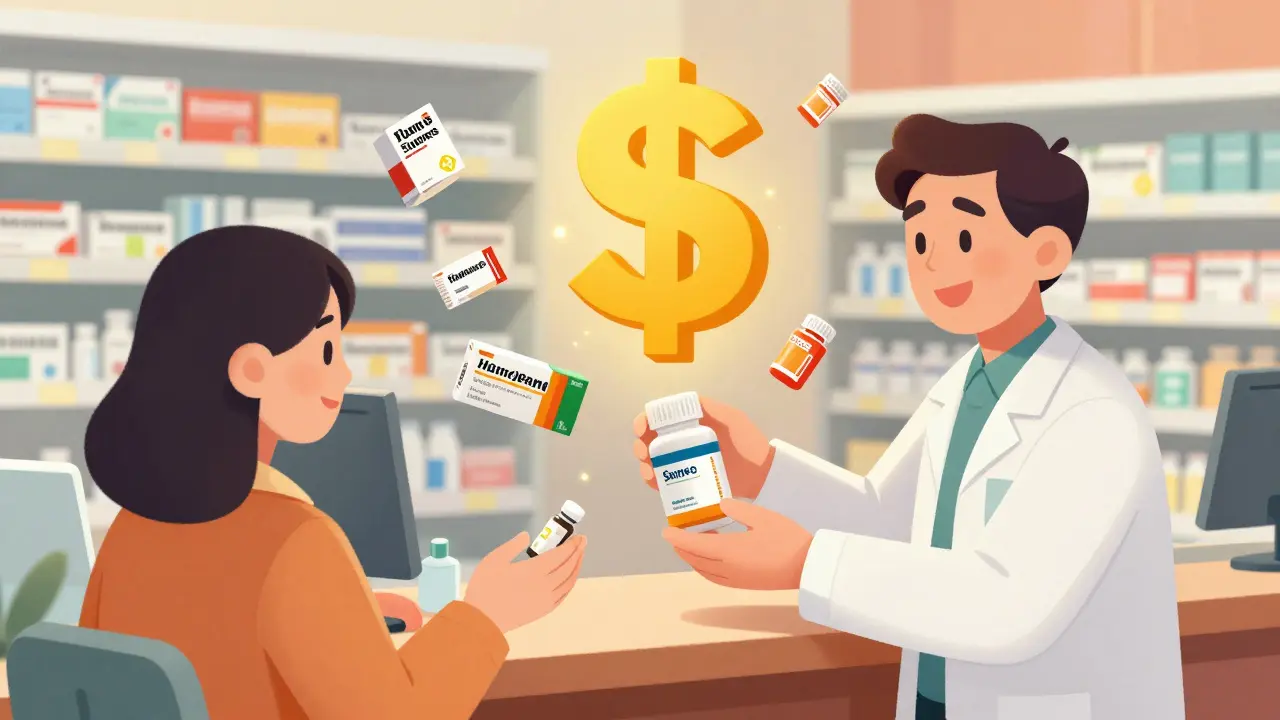
When you walk into a pharmacy to pick up your prescription, you probably assume the cost of the medicine is mostly about how much it cost to make. But here’s the truth: generics - the cheap, off-brand versions of drugs - are the real profit engine for most pharmacies. And that’s not because they’re expensive. It’s because they’re so cheap that pharmacies can mark them up wildly and still make more money than they do on expensive brand-name drugs.
Why Generics Are the Hidden Profit Machine
Over 90% of prescriptions filled in the U.S. are for generic drugs. Yet, they account for only about 25% of total drug spending. Why? Because brand-name drugs cost hundreds or even thousands of dollars per pill, while a 30-day supply of a generic might cost $4. But here’s the twist: pharmacies make more profit per generic prescription than per brand one.
On average, pharmacies earn a 42.7% gross margin on generics. That means for every $100 in sales from a generic drug, they pocket about $43 before paying rent, staff, or utilities. Compare that to brand-name drugs, where margins hover around 3.5%. Even though brand drugs make up most of the money spent, they barely contribute to pharmacy profits. In fact, a 2024 analysis found that generics made up just 29% of pharmacy sales but generated 96% of their total profit.
This isn’t a glitch - it’s by design. The system was built this way. When the Hatch-Waxman Act passed in 1984, it created a legal pathway for generics to enter the market. The goal was to cut costs. But it accidentally created a profit model where pharmacies rely on volume and markup to survive.
The Math Behind the Margin
Let’s break it down with real numbers. Say a generic drug costs $1.50 to produce. The wholesaler sells it to the pharmacy for $4. The pharmacy then bills your insurance $15. That’s a $11 gross profit. But if the same drug were brand-name, the production cost might be $8, the wholesaler sells it for $20, and the pharmacy bills $120. The pharmacy’s gross profit? Only $100 - but their margin? Just 8.3%.
Now, here’s where it gets messy. That $15 billed to your insurance? It doesn’t all go to the pharmacy. Pharmacy Benefit Managers (PBMs) - the middlemen between insurers and pharmacies - negotiate reimbursement rates. They often use a system called “spread pricing,” where they charge the insurer more than they pay the pharmacy and keep the difference. So even if the pharmacy is supposed to get $15, they might only receive $8. That leaves them with a $6.50 profit on a $1.50 drug. Sounds good? Until you factor in rent, payroll, utilities, and compliance costs.
After all expenses, the net profit on a generic prescription is often less than 2%. That’s why many pharmacies operate on razor-thin margins. They need to sell hundreds of generics just to cover overhead. And if one generic gets pulled from the market or a competitor drops its price, everything shifts.
Who Really Controls the Money?
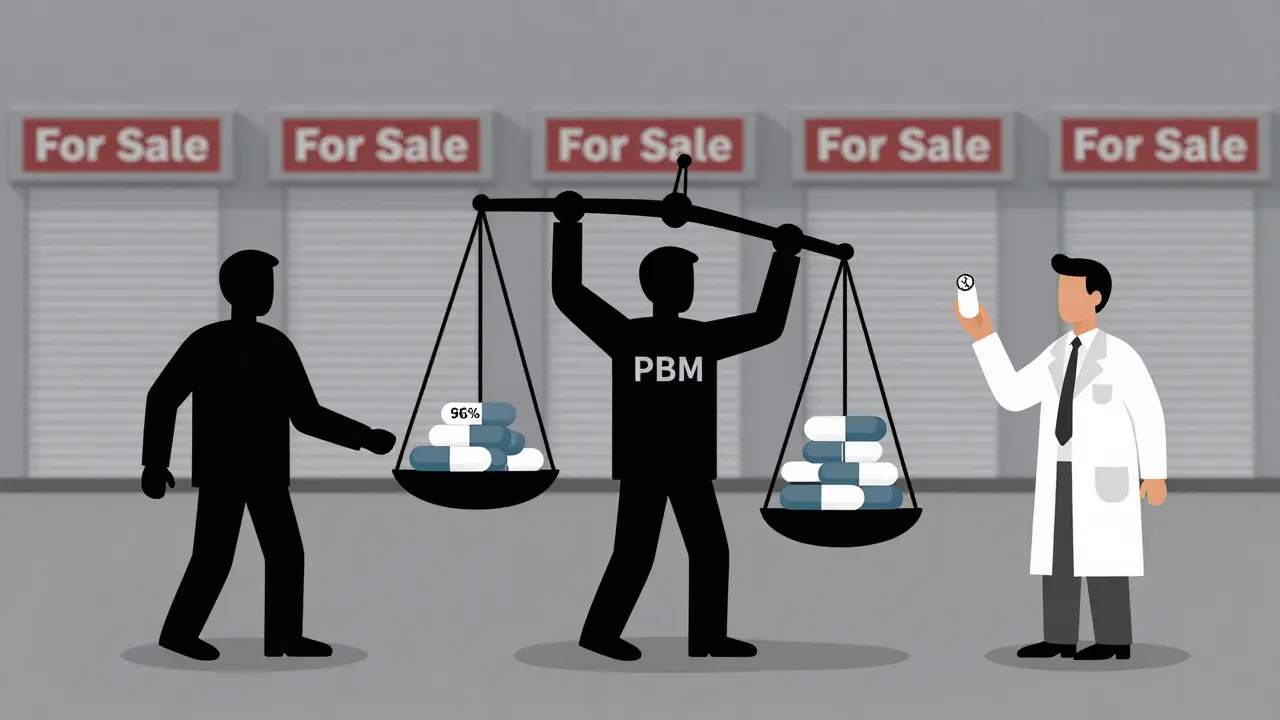
It’s not the pharmacy. It’s not even the manufacturer. It’s the PBMs. Three companies - CVS Caremark, Express Scripts, and OptumRx - control about 80% of prescription transactions in the U.S. They set reimbursement rates, negotiate with manufacturers, and decide how much pharmacies get paid. And they’re not shy about using their power.
Independent pharmacies are hit hardest. They don’t have the leverage to negotiate better rates. So they get stuck with low reimbursements, clawbacks (where PBMs demand money back after payment), and opaque pricing formulas. A pharmacy owner in Ohio told Pharmacy Times in 2023: “My net profit on generics has dropped from 8-10% five years ago to barely 2% now, while my overhead has increased 35%.”
Meanwhile, mail-order pharmacies - often owned by the same PBMs - make up to 1,000 times more margin on certain generics than local stores. Why? Because they don’t have to pay for walk-in traffic, in-person counseling, or local staffing. They ship pills in bulk. And they don’t need to compete on price because most patients don’t know what they’re paying.
The Collapse of Competition
Generics were supposed to thrive on competition. More manufacturers = lower prices. But that’s not happening anymore. Between 2014 and 2016, nearly 100 generic manufacturers were bought up in deals worth $80 billion. Today, the top five companies control 45% of the generic market.
What happens when only one company makes a generic? Price spikes. In 2024, a white paper from SureCost found that in some cases, single-source generics cost more than the original brand. One example: a generic version of a heart drug jumped from $10 to $180 overnight - because there was no competition left.
The FDA approved over 2,400 new generics between 2018 and 2020, saving an estimated $161 billion. But if manufacturers stop competing because they’re all owned by the same few corporations, those savings vanish. And pharmacies? They’re left holding the bag - with high-volume, low-margin prescriptions and no way to make up the difference.
How Pharmacies Are Fighting Back
Some pharmacies are adapting. The National Community Pharmacists Association (NCPA) has trained over 8,500 staff members to challenge PBM reimbursement decisions through their “Rebuttal Academy.” Independent pharmacies are forming coalitions to demand transparency. States like California, Texas, and Illinois passed laws in 2022-2023 requiring PBMs to disclose how they calculate reimbursement.
Others are ditching the PBM system entirely. Mark Cuban’s Cost Plus Drug Company charges $20 for a generic plus a $3 dispensing fee - no insurance, no spreads, no secrets. Amazon Pharmacy now offers $5 generics with clear cost breakdowns. These models bypass the old system and prove that pharmacies can survive without relying on hidden markups.
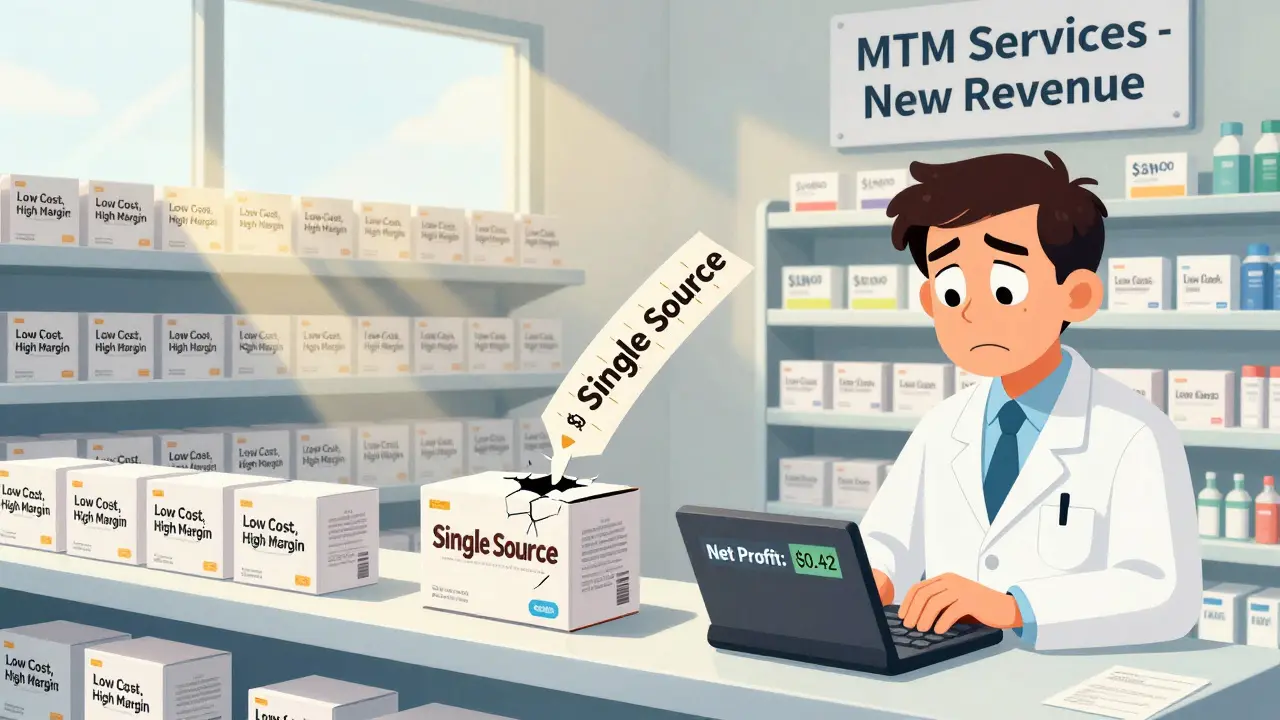
Some are shifting into services. Medication therapy management (MTM), chronic disease coaching, and immunizations are now major revenue streams. Pharmacies that offer these services report net margins of 4-6%, compared to the 1-2% from generics alone. It’s not easy - it takes time, training, and staffing - but it’s working.
The Future Is Unsteady
The U.S. spends $600 billion a year on prescription drugs. Generics are the backbone of that system. But the economics are breaking. Between 2018 and 2023, over 3,000 independent pharmacies closed. The NCPA predicts another 20-25% will vanish by 2027 if reimbursement doesn’t change.
On the flip side, Medicare’s new drug price negotiation rules (starting in 2026) could reduce overall spending pressure. If brand-name drug prices drop, more patients might switch to generics - but only if those generics are still affordable and available.
The truth is simple: pharmacies don’t make money because they sell expensive drugs. They make money because they sell lots of cheap ones - and the system lets them mark them up. But as competition fades, PBMs tighten their grip, and overhead rises, that model is collapsing. The question isn’t whether generics affect profits. It’s whether pharmacies will survive when the profit engine runs out of fuel.

Helen Brown
This whole system is rigged. PBMs are just siphoning money while pharmacies get crushed. It's not even a business anymore, it's a shell game with your prescriptions.
John Smith
They call it a pharmacy but it's a glorified vending machine for pills with a side of emotional labor. I've seen pharmacists cry over reimbursement rates. Meanwhile, some CEO in Connecticut is sipping champagne on a yacht funded by my insulin.
marjorie arsenault
I work at a small independent pharmacy. We don't make much on generics anymore, but we've started offering free medication reviews and blood pressure checks. People show up for that. It's not about the markup anymore-it's about trust. And that's worth more than any PBM contract.
Shivam Pawa
The economics are clear. Volume + low cost + opaque reimbursement = sustainable model only if competition exists. When consolidation happens, margins collapse. The system was never designed for monopolistic control. It was designed for market efficiency. Now it's a rent-extraction engine.
Donna Zurick
I used to get my meds at the corner pharmacy. Now I use Amazon because it's $5 and I don't have to explain my insurance again. I don't care how it works as long as it works. The system broke. People just adapted.
tatiana verdesoto
I lost my job when my local pharmacy closed. The owner said he couldn't afford to keep the lights on after the PBM clawback. I used to talk to him every week. He remembered my dog's name. That kind of care doesn't come from a warehouse.
Tobias Mösl
This isn't capitalism. This is feudalism with pill bottles. PBMs are the new lords. Pharmacies are serfs. Patients? We're just serf-children being fed cheap bread while the lords hoard the gold. And Congress? They're too busy taking donations from CVS Caremark to care.
Ethan Zeeb
The math is undeniable. 42.7% gross margin on generics sounds great until you realize you're getting $8 for a $15 bill and your rent is $8k/month. This isn't a profit model-it's a survival tactic. And it's failing. The FDA approves generics, but the market doesn't reward competition. It rewards consolidation.
Renee Jackson
As a pharmacist with over two decades in community health, I can confirm: the system is not broken-it was designed this way. The Hatch-Waxman Act was well-intentioned, but it created a structural dependency on volume and reimbursement arbitrage. We must shift toward value-based care. Medication therapy management isn't a nice-to-have-it's the future. Training, staffing, and reimbursement reforms must align. We cannot sustain a model where service is devalued and volume is king.
Mariah Carle
I think we're all just living in a simulation where the only thing that matters is the number on the invoice. Who even made these rules? Are we being watched? I feel like I'm in a dystopian movie and someone forgot to hit pause.
Justin Rodriguez
The real tragedy isn't the margin collapse. It's that patients don't know. They think $4 means cheap. But they don't see the hidden costs-the staff cuts, the closed doors, the lost relationships. Pharmacies aren't just selling drugs. They're holding up the last human touch in a broken healthcare system. And now that's being auctioned off to algorithms.
Darren Torpey
Mark Cuban and Amazon are proving the system is ripe for disruption. No insurance middlemen. No spread pricing. Just transparent pricing. If you can sell a $1.50 drug for $23 and still make money, why are we still playing by the old rules? The future isn't in squeezing PBMs. It's in bypassing them entirely.
Sharon Lammas
It's strange, isn't it? We built a system to make medicine affordable, and it ended up making pharmacies unviable. We wanted competition, but we got consolidation. We wanted transparency, but we got complexity. Maybe the real problem isn't the markup-it's that we stopped asking why we let this happen.