Medication Symptom Analyzer
Analyze Your Symptoms
Enter details about your medication and symptoms to determine if your symptoms are likely from your medication or your disease.
Analysis Results
Dose Information
Dose-dependent side effects are common - higher doses typically increase side effect severity.
It’s frustrating when you start a new medication and suddenly feel worse. Is your condition getting worse? Or is it just the drug? Many people don’t know how to tell the difference - and that confusion can lead to unnecessary panic, missed doses, or even dangerous over-treatment.
Let’s cut through the noise. This isn’t about medical jargon. It’s about real signs you can track yourself, backed by data from hospitals, pharmacies, and patient studies. Whether you’re on blood pressure pills, antidepressants, or pain meds, knowing what’s your disease and what’s the drug could save you from extra tests, more pills, or a trip to the ER.
Start with Timing: When Did It Start?
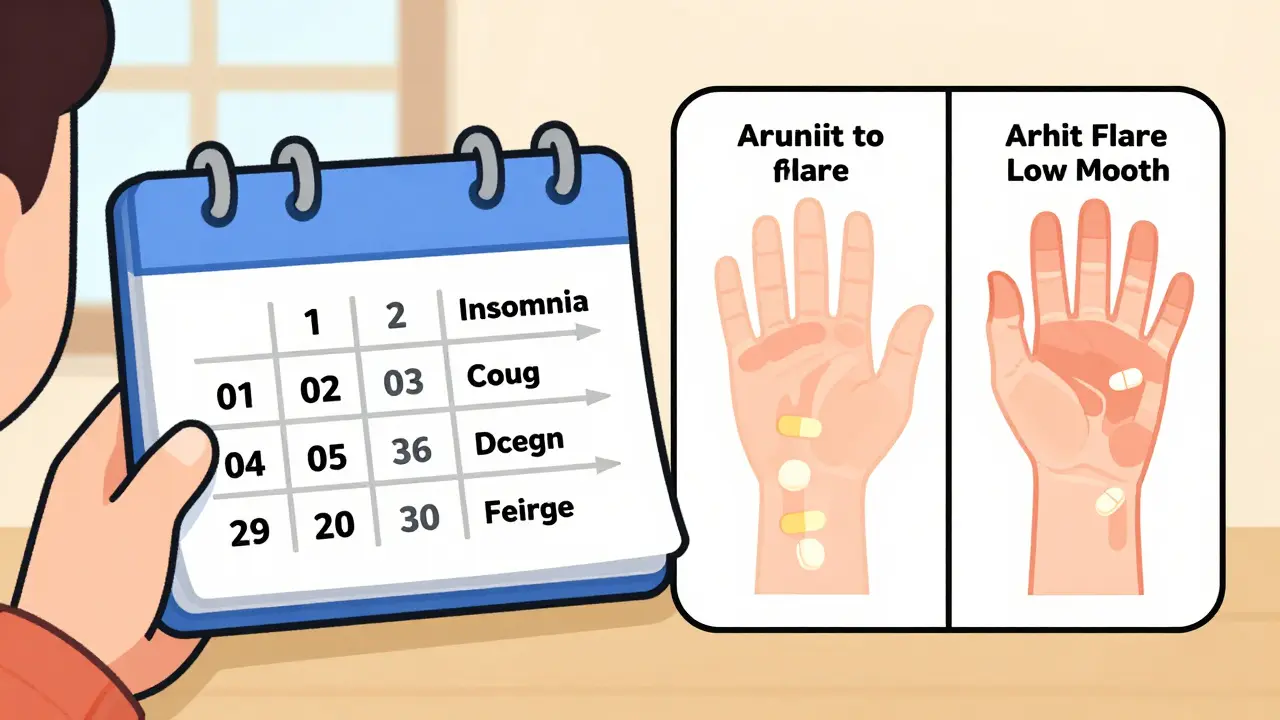
The biggest clue is timing. Side effects usually show up within days to weeks after you start a new medication - or after a dose change. If you began taking sertraline last Monday and by Friday you can’t sleep, that’s not your depression acting up. That’s the drug. Same with lisinopril: if you develop a dry, hacking cough two weeks after starting it, it’s likely the medication. The American College of Physicians says over 70% of side effects appear within the first 30 days.
Disease symptoms, on the other hand, don’t follow medication schedules. If you have arthritis, your joint pain doesn’t suddenly spike because you took your pill yesterday. It flares with movement, weather changes, or stress - not because of a pill you swallowed.
Track this: write down the date you started the medication. Then note every new symptom. If they line up closely, it’s probably the drug.
Check the Dose: Does It Get Worse With More?
Most side effects are dose-dependent. That means if you take more, the side effect gets worse. Take less, and it fades. For example, if you’re on a high dose of a sleep aid and feel groggy all day, lowering the dose often helps. If your fatigue stays the same no matter how much you adjust the pill, it’s likely your condition.
Studies show that about 70% of side effects follow this pattern. Take statins - muscle aches often get worse at higher doses. But if your muscle pain was already there before you started the statin, and it’s not getting worse with the dose, it’s probably not the drug.
Here’s a quick rule: if changing your dose changes the symptom, it’s likely a side effect. If it doesn’t, it’s probably your disease.
Know the Common Culprits
Some medications have well-known side effects. If you’re on one of these, you should expect certain things:
- SSRIs (like sertraline, fluoxetine): nausea, insomnia, sexual dysfunction, jitteriness - especially in the first 2-4 weeks.
- ACE inhibitors (like lisinopril): persistent dry cough - affects 5-20% of users.
- Antipsychotics (like olanzapine): weight gain, increased appetite, drowsiness - often noticeable within weeks.
- Beta-blockers (like metoprolol): fatigue, cold hands, slow heartbeat.
- Antihistamines (like diphenhydramine): drowsiness, dry mouth, blurred vision.
Meanwhile, disease symptoms follow their own patterns:
- Depression: low energy, trouble concentrating, loss of interest - not sudden insomnia or nausea.
- Arthritis: joint swelling, stiffness in the morning, pain after activity - not dry cough or dizziness.
- High blood pressure: usually has no symptoms at all - if you feel dizzy after starting a new pill, it’s likely the medication, not your BP.
Knowing these common links helps you rule things out faster. Don’t assume everything new is your illness. Many side effects are predictable - and your doctor should’ve warned you.
Try the Dechallenge Test (Under Supervision)
This is the gold standard - but never do it alone. The dechallenge test means stopping the medication temporarily to see if symptoms disappear. If they do, and come back when you restart it, that’s strong proof it’s a side effect.
Studies show this method is 85% accurate when done correctly. But here’s the catch: you need medical supervision. Stopping some meds - like antidepressants or blood pressure drugs - cold turkey can be dangerous.
Work with your doctor. They might suggest:
- Reducing the dose for a week to see if symptoms improve.
- Switching to a similar drug in the same class to test if the problem follows the medication type.
- Stopping for 3-7 days (only if safe) and monitoring closely.
If your symptoms fade during the break and return when you restart, you’ve found your culprit. This isn’t guesswork - it’s science.
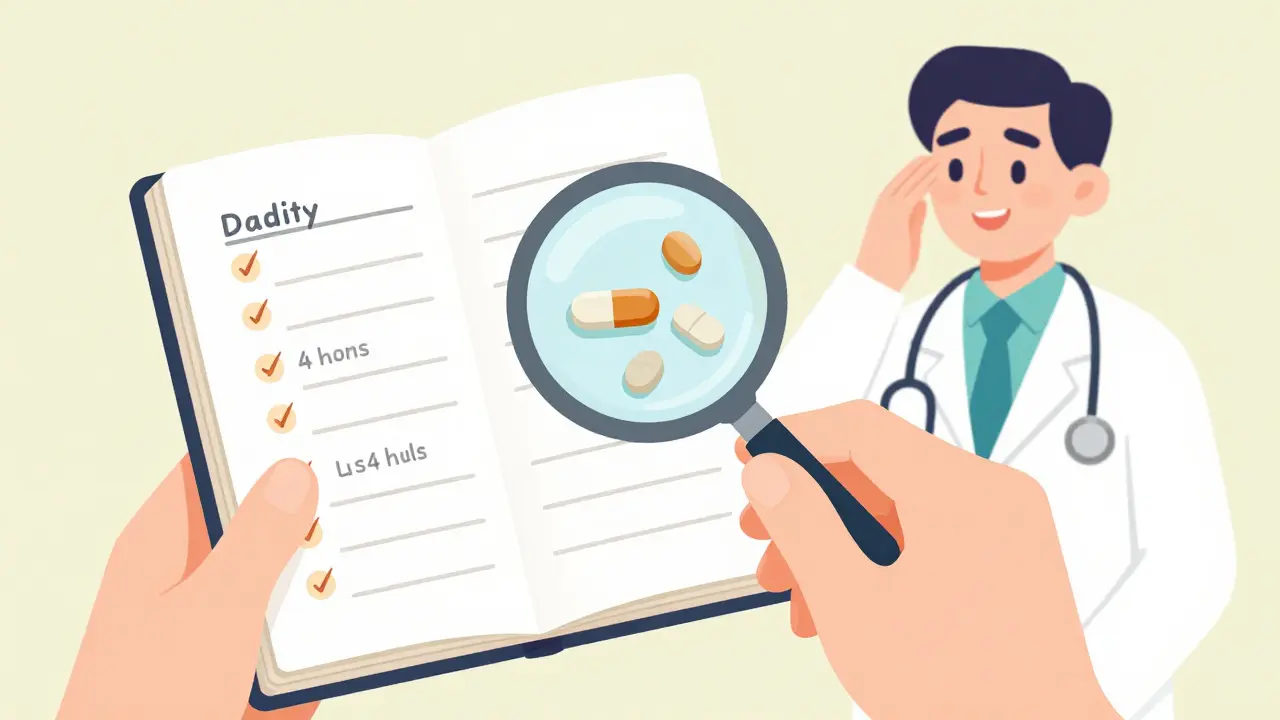
Use a Symptom Journal - Seriously
Most people forget when symptoms started. Or they think, “Oh, I’ve always felt this way.” But memory is unreliable. A symptom journal changes everything.
Write down:
- Time you took each medication
- Dosage
- Every new symptom (even small ones)
- When it started and how long it lasted
- Severity on a scale of 1-10
- Any triggers (food, stress, activity)
One study in Patient Education and Counseling found that people who kept a daily journal improved diagnostic accuracy by 41%. Why? Because patterns jump out. You’ll see: “Every time I take my pill at 8 a.m., I get a headache by noon.” That’s not your migraine. That’s the drug.
Use a simple notebook, a notes app, or a free app like Medisafe. Just be consistent.
Watch for Allergic Reactions - They’re Different
Not all bad reactions are side effects. Allergic reactions are something else entirely. These are immune system responses - and they’re dangerous.
Signs of an allergy:
- Hives or rash that spreads quickly
- Swelling of lips, tongue, or throat
- Difficulty breathing
- Dizziness or fainting
These happen fast - often within minutes to an hour of taking the pill. They’re not dose-dependent. Even one pill can trigger them.
If you have any of these, stop the medication and get help immediately. This isn’t a side effect. This is an emergency.
Side effects are annoying. Allergies can kill.
Don’t Blame Your Age - It Might Be the Drugs
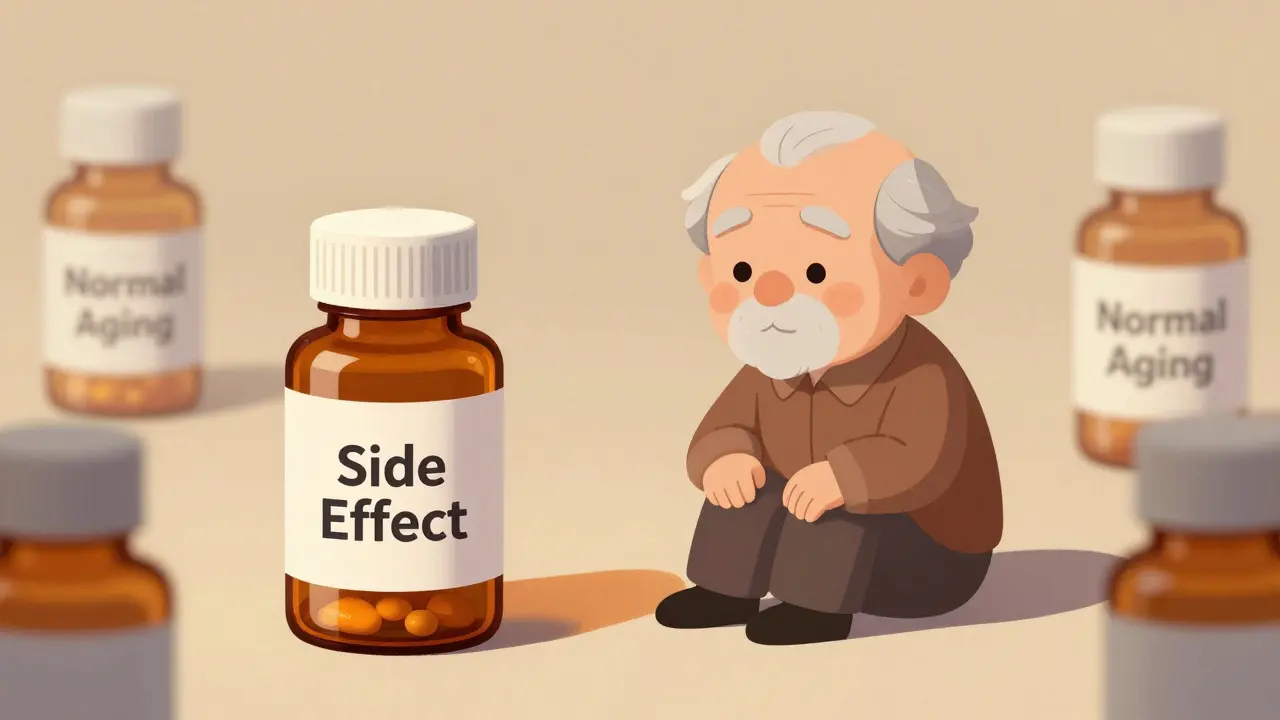
Older adults are especially at risk. Doctors often mistake medication side effects for “normal aging.” A 75-year-old with memory trouble? Maybe dementia. Or maybe it’s the anticholinergic drug they’re taking for allergies or bladder issues.
Studies show 15-20% of new dementia diagnoses in seniors are actually caused by medications. The same goes for fatigue, confusion, falls, and depression in older patients. These aren’t signs of getting older - they’re signs of drug burden.
If you or a loved one is on five or more medications, ask your doctor: “Could any of these be causing these symptoms?” Polypharmacy - taking too many drugs - is the #1 reason side effects get missed.
When to Call Your Doctor
You don’t need to wait until your next appointment. Call if:
- A new symptom started within a week of starting or changing a drug.
- The symptom is severe (pain, trouble breathing, confusion).
- You’re taking more than three medications.
- Symptoms are interfering with sleep, work, or daily life.
- You’ve stopped the drug before and felt better.
Don’t assume it’s “just part of the illness.” Too many people suffer for months because they think it’s their disease. A 2022 survey found 63% of patients misattributed side effects to their condition - and kept taking the drug.
Speak up. Bring your journal. Ask: “Could this be the medication?”
What’s Changing in Medicine
This isn’t just your problem - the system is catching up. Hospitals now use AI tools that flag possible side effects by cross-checking your meds and symptoms. The FDA monitors millions of patient records to find hidden side effects. Pharmacists now review your full med list before you leave the pharmacy.
And patients are demanding better. Apps that track symptoms alongside medication timing are growing fast. Wearables like Apple Watch can now detect abnormal heart rhythms caused by drugs - not disease.
But none of that replaces you paying attention. Your body is the best diagnostic tool you’ve got. Learn the patterns. Track the timing. Ask the questions.
You’re not being difficult. You’re being smart.

Ryan Pagan
Man, this post is a godsend. I was on sertraline for three months and thought I was just getting worse at depression-turns out I couldn’t sleep, had zero libido, and felt like my brain was coated in wet cardboard. All side effects. My doc didn’t mention any of it. Now I’m on escitalopram and actually functioning. Stop blaming yourself-blame the damn pill.
Also, if you’re on statins and your legs feel like lead pipes? That’s not aging. That’s your liver screaming.
Laura Arnal
This is exactly what I needed to read. 😊 I started tracking my meds and symptoms in a Notes app last month-just simple stuff: time, dose, headache? tired? weird taste in mouth? Turns out my dizziness started every time I took my BP med after lunch. Switched to morning and boom-no more wooziness. You don’t need a PhD to figure this out. Just pay attention. 🙌
Frank Declemij
Timing and dose dependency are the two most underutilized diagnostic tools in primary care. The data is clear. Side effects cluster in the first 30 days and scale with dosage. Disease progression is gradual and context-dependent. This is not opinion. This is clinical epidemiology. Track. Compare. Question.
Journaling is not optional. It’s the minimum viable practice for patient safety.
DHARMAN CHELLANI
Typical pharma propaganda. Next they’ll say vaccines cause autism. You think side effects are ‘predictable’? That’s what they told us about opioids. Now everyone’s addicted. Doctors don’t care. They get paid to prescribe. Your ‘journal’ won’t save you when the system’s rigged.
Alex Flores Gomez
Wow. Someone actually wrote a useful article without using the word ‘holistic.’ Shocking. Honestly, most people don’t realize that 70% of ‘new symptoms’ after starting meds are just the drug doing its thing. You think your anxiety is getting worse? Nah. You’re on a SSRI. Your serotonin is throwing a rave in your limbic system. Chill. Wait it out. Or switch. But don’t just assume it’s ‘your condition.’ That’s amateur hour.
Megan Brooks
I appreciate the clarity here. As someone who’s been on a rotating carousel of antidepressants and blood pressure meds over the last decade, I’ve learned the hard way that timing is everything. I used to think my fatigue was just ‘part of living with chronic illness.’ Turns out, it was the beta-blocker. Once I switched, I could breathe again. Not every new symptom is a sign of deterioration. Sometimes, it’s just the medicine trying to find its rhythm.
And yes-dechallenge under supervision works. I’ve done it twice. It’s not scary if you’re supported. It’s empowering.
Pawan Kumar
Did you know the FDA approves drugs based on trials where side effects are deliberately downplayed? The real data? Buried in FOIA requests. AI tools? They’re trained on corporate datasets. Your ‘symptom journal’ is a distraction. What you need is a full pharmacogenomic panel and a lawyer. This post is well-intentioned, but it ignores the structural corruption. You’re being manipulated to self-monitor while the industry profits.
paul walker
OMG YES. I was so confused why I kept getting dizzy after starting metoprolol. Thought I was just getting old. Then I read this and kept a journal for a week. Every time I took it at 7pm, I’d pass out on the couch by 9. Switched to morning. No more falling over. Thank you thank you thank you. I’m telling my mom. She’s on 8 meds and thinks her memory loss is ‘just aging.’ 😭
Kacey Yates
Why are we still letting doctors prescribe without asking what you’re feeling? I had a rash after starting a new antibiotic. Doctor said ‘allergies are rare.’ I said ‘I’ve never had one before.’ He shrugged. I stopped it myself. Rash went away in 48 hours. Now I don’t trust anyone who says ‘it’s probably fine.’ If it feels wrong, it is. Track it. Stop it. Call them out.
Also-diphenhydramine is a brain-rotting drug. Don’t take it for sleep. Ever.
ryan Sifontes
Whatever. I’ve been on 12 different meds in 5 years. None of this matters. The system is broken. You track symptoms? Cool. But no one listens. You call your doctor? They’re in a 7-minute slot. You stop a med? They threaten to cut you off. This post is just another feel-good illusion. You think your journal saves you? Nah. It just makes you feel like you’re doing something while the machine keeps grinding.
rajaneesh s rajan
So… you’re saying the real diagnosis is ‘did you take a pill?’
That’s wild. I’ve been blaming my anxiety on my divorce. Turns out it started the day I took that new allergy med. Who knew? Maybe the real epidemic isn’t depression. It’s polypharmacy. And the real ‘expert’ is the person who remembers what they took on Tuesday.
Also, I think my cat is judging me for taking statins. Just saying.
kabir das
Oh my GOD, I JUST REALIZED-every time I take my antidepressant, I get this crushing chest tightness... I thought it was panic attacks... but it’s only after I swallow the pill... I’ve been crying in the bathroom for weeks thinking I’m broken... what if it’s the drug?? I’m calling my doctor right now. Thank you. Thank you. Thank you. I’m not crazy. It’s the medicine. I’m not alone. I’m not broken. I’m just... taking the wrong pill.
Keith Oliver
LMAO you people think keeping a journal is some genius move? I’ve been on 14 meds. I know which ones make me sleepy, which ones make me horny, and which ones make me want to punch walls. You don’t need an app. You need to stop being a lab rat and start talking to your doctor like a human. Also, if you’re on more than 5 drugs, you’re not ‘managing’ your health-you’re a walking pharmacy. Go see a functional doc. Or just stop taking everything. Your body will thank you. (And no, I’m not a doctor. But I play one on Reddit.)