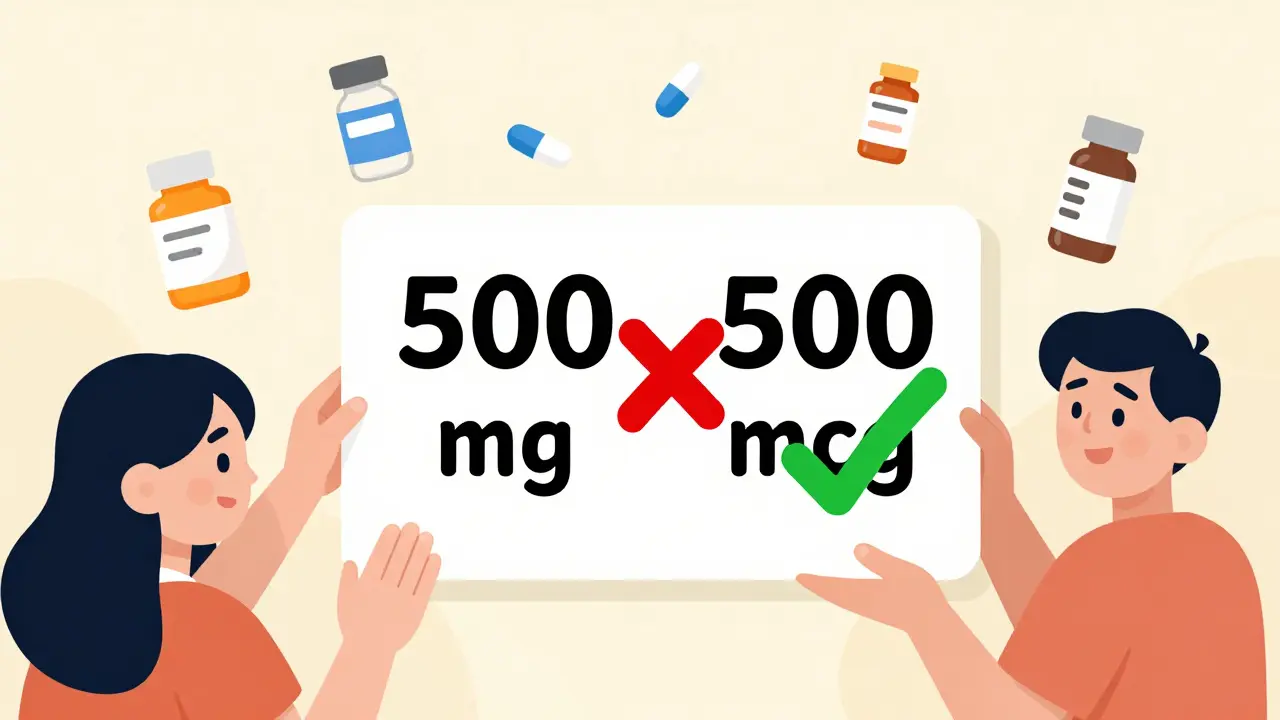
When you pick up a prescription, you might not think twice about the small print on the label. But that tiny text could be the difference between taking the right dose and a dangerous mistake. Every year, over 1.3 million medication errors happen in the U.S., and nearly a quarter of them involve medication strength being misread. That’s not just a statistic - it’s a real risk you can protect yourself from by learning how to read your prescription label properly.
What Medication Strength Really Means
Medication strength tells you exactly how much active drug is in each dose. It’s not just a number - it’s a measurement with units that change everything. For example, a pill labeled "500 mg" means each tablet contains 500 milligrams of the medicine. But if it said "500 mcg" instead? That’s 500 micrograms - 1,000 times less. One tiny letter change can turn a safe dose into a life-threatening one.
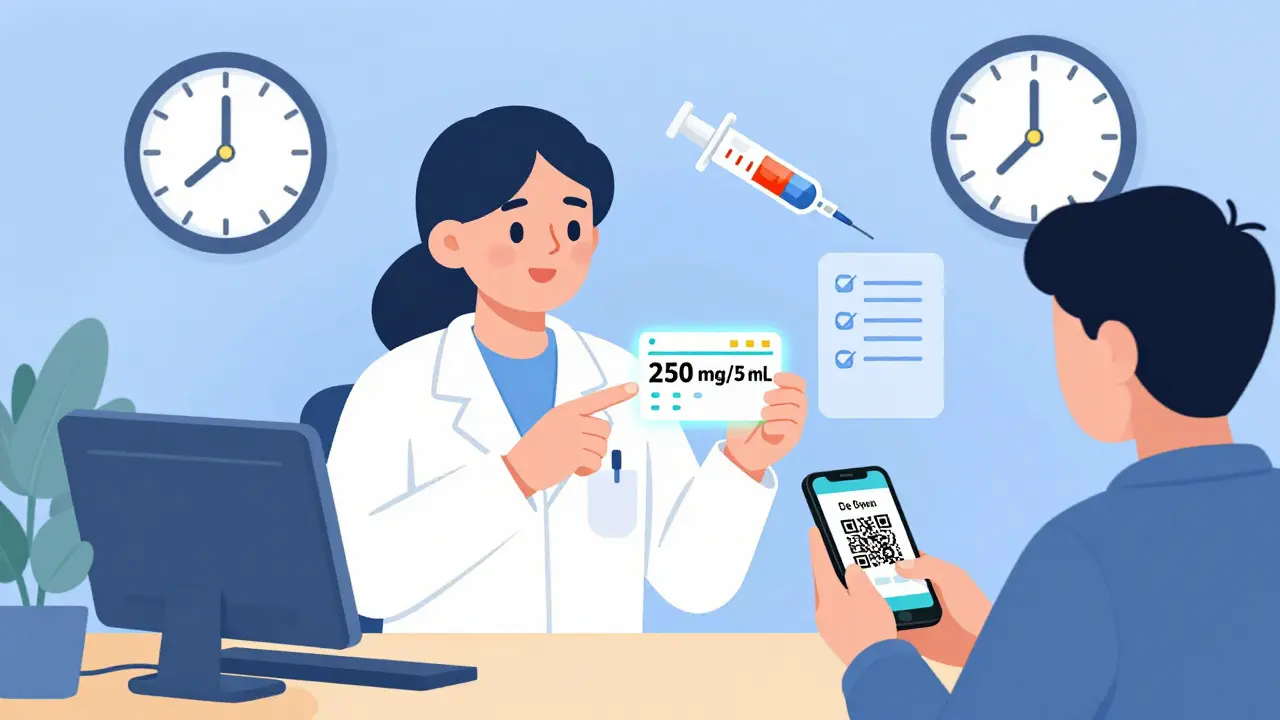
For tablets and capsules, the strength is simple: it’s the amount per pill. But liquids are trickier. You’ll see something like "250 mg/5 mL". That means every 5 milliliters of liquid - about one teaspoon - contains 250 milligrams of the drug. If you mix this up and think the whole bottle is 250 mg, you could give yourself five times too much. That’s why you need to look at both numbers: the dose amount and the volume it’s in.
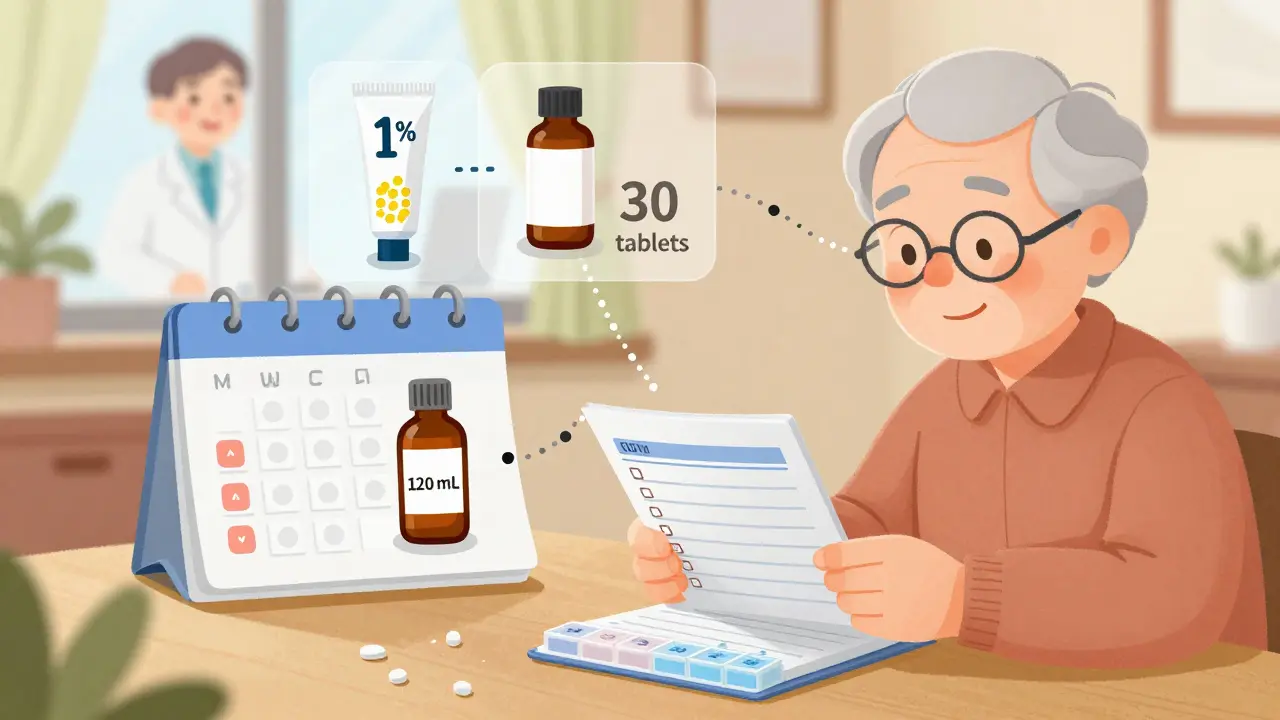
Topical creams and ointments use percentages. "Hydrocortisone 1% cream" means 1 gram of medicine per 100 grams of cream. It sounds simple, but patients often assume "1%" means it’s weak - when it’s actually the full prescribed strength. Never guess. Always read the number and unit exactly as written.
How Quantity Is Listed - And Why It Matters
The quantity tells you how much the pharmacy gave you total. It’s not how much to take each time - it’s how many pills, how many milliliters, or how many grams are in the whole bottle.
For pills: "30 tablets" means you got 30 pills. If your doctor told you to take one daily, that’s a 30-day supply. If you see "60 tablets", you got double. That’s not always a mistake - sometimes refills are combined. But if you didn’t ask for two months’ supply, you should double-check with the pharmacist.
Liquids: "120 mL" means 120 milliliters total. If the dose is 5 mL three times a day, that’s 15 mL per day. That means the bottle should last about 8 days. If you think it’s supposed to last 30 days and it’s only 120 mL, something’s off.
Creams and ointments: "30 grams" is the total amount. A gram is about the size of a pea. So 30 grams is roughly 30 pea-sized amounts. If your doctor said to use a pea-sized amount twice a day, that’s 60 pea-sized doses per month - meaning you got a half-month supply. If you expected a full month, ask why.
Never assume the quantity matches your needs. Always calculate: How many doses per day? × How many days? = Expected total quantity. If the label doesn’t match, speak up.
Where to Find Strength and Quantity on the Label
Pharmacies don’t always put the strength in the same spot. CVS puts it right under the drug name. Walgreens puts it in parentheses after the name. Kaiser Permanente adds a small box with a QR code you can scan to verify it. But no matter where it is, it’s always near the drug name - usually within half an inch.
Look for these patterns:
- Tablets/Capsules: "AMOXICILLIN 500 MG" - the number comes right after the drug name.
- Liquids: "IBUPROFEN 100 MG/5 ML" - you’ll see two numbers with a slash. Both matter.
- Creams: "TRIAMCINOLONE 0.1% OINTMENT" - the percentage is the strength.
Quantity is always listed separately. It won’t be mixed with the strength. It’ll say something like "Dispense: 30 tablets" or "Quantity: 120 mL". If you don’t see a clear quantity, ask the pharmacist to point it out.
Common Mistakes People Make - And How to Avoid Them
Most errors aren’t due to carelessness. They’re due to confusion over small details.
- Misreading decimals: "0.25 mg" looks like "25 mg" if you glance too fast. That’s a 100-fold difference. Use your phone’s magnifier app to zoom in. Many pharmacists now recommend this.
- Confusing total quantity with daily dose: "Take 1 tablet daily" and "Dispense: 30 tablets" doesn’t mean you take 30 at once. It means you take one per day for 30 days. Write it down: "1 per day × 30 days = 30 total".
- Missing units: "5" could mean 5 mg, 5 mcg, or 5 mL. Units are non-negotiable. If they’re missing or smudged, don’t take it. Go back.
- Assuming brand names mean stronger doses: Brand names like "Lipitor" or "Zoloft" don’t tell you strength. The number does. Generic versions have the same strength - same number, same effect.
One patient in Arizona caught a mistake after her blood pressure pill was filled as 10 mg instead of 2.5 mg. The pills looked different - but she didn’t know why. Only after checking the label did she realize the strength was wrong. She called the pharmacy. They fixed it. She says now: "I check every label. Every time. I don’t trust my memory. I trust the numbers."
What to Do If Something Looks Wrong
If the strength or quantity doesn’t match what your doctor told you - or if it just feels off - don’t take the medicine. Don’t guess. Don’t assume it’s fine.
Here’s what to do:
- Compare the label to your prescription receipt or paper copy. If you don’t have one, call your doctor’s office and ask them to confirm the strength and quantity they prescribed.
- Call the pharmacy. Say: "I’m checking my prescription. Can you confirm the strength and quantity on this label?" Ask them to read it back to you.
- If they say it’s correct but you still feel unsure, ask to speak with the pharmacist directly. Pharmacists are trained to catch these errors. Use their expertise.
- If the pharmacy refuses to double-check, go to another pharmacy. You have the right to get your prescription filled correctly.
Don’t feel embarrassed. In 2023, a survey of over 10,000 patients found that 78% of those who checked their labels caught an error - and 92% of pharmacists said they welcomed it. You’re not being difficult. You’re being safe.
Tools and Tips to Make Verification Easier
Most pharmacies now offer tools to help you verify your meds:
- QR codes: Scan the code on your label with your phone. It links to the FDA’s official medication guide with dosage info, side effects, and warnings. Over 94% of major chains now include these.
- Mobile apps: CVS, Walgreens, and Rite Aid have apps that let you scan your prescription barcode to instantly verify strength and quantity against pharmacy records. It takes 8 seconds instead of 47.
- High-contrast labels: If you have trouble reading small print, ask for large-font or high-contrast labels. 89% of chain pharmacies offer this for free.
- Visual aids: Many pharmacies give out "look-alike/sound-alike" charts showing pills that look similar but have different strengths. Take one. Keep it with your meds.
Also, keep a simple written log: write down each medication, its strength, and how many you got. Update it every time you refill. In a pinch, this becomes your backup.
Why This Matters - Real Consequences
In 2021, the FDA found that 18.7% of fatal dosing errors in children came from decimal point mistakes - like reading "0.5 mg" as "5 mg". That’s a tenfold overdose. One mistake. One misread number.
Older adults are at highest risk. Over 37% of strength errors happen in people over 65. Why? Vision changes, multiple medications, and complex dosing schedules. But studies show that when older patients are taught to check their labels, their error rate drops by 41%.
And it’s not just about pills. Liquid medications cause 32.4% of errors because caregivers misread the concentration. One parent gave their child 10 mL of a liquid meant to be 5 mL per dose - because they thought the whole bottle was the dose. That child ended up in the ER.
You don’t need to be a pharmacist to prevent this. You just need to know where to look - and the courage to ask.
Final Checklist: Your Quick Verification Routine
Before you take any new medication, run through this:
- Find the drug name. Make sure it matches what your doctor prescribed.
- Locate the strength. Look for the number + unit right next to the name. Is it mg, mcg, or %?
- For liquids, find both numbers. "X mg/Y mL" - confirm both.
- Check the quantity. "30 tablets" or "120 mL" - does that match your prescription duration?
- Compare to your records. Does it match your doctor’s note or previous prescription?
- Use your phone. Zoom in. Scan the QR code. Call the pharmacy if unsure.
If even one thing feels off - stop. Ask. Double-check. You’re not overreacting. You’re protecting yourself.
What if the prescription label doesn’t list the strength clearly?
If the strength is missing, smudged, or unclear, do not take the medication. Return to the pharmacy immediately. By law, all U.S. prescription labels must clearly display the drug name, strength, and quantity. A pharmacy that fails to do this is not following federal regulations. Ask to speak with the pharmacist and request a corrected label. If they refuse, go to another pharmacy. Your safety is non-negotiable.
Can generic medications have different strength than brand names?
No. Generic medications must have the same strength, dosage form, and active ingredient as their brand-name counterparts. The only difference is the inactive ingredients and cost. If a generic pill says "500 mg" and the brand says "500 mg", they are identical in strength. Always check the number - not the name. The brand name doesn’t change the dose.
Why do some labels say "mg/mL" and others say "mg per mL"?
They mean the same thing. "mg/mL" is shorthand for "milligrams per milliliter". The FDA requires units to be spelled out in full (like "milligram" instead of "mg") on printed patient materials, but on pharmacy labels, abbreviations are allowed as long as they’re standardized. "mg/mL" is the accepted format. Just make sure you understand it means "how many milligrams are in each milliliter of liquid". Never assume - if unsure, ask the pharmacist to explain it in plain words.
Is it normal for my prescription to have a different strength than last time?
Yes - but only if your doctor changed your dose. Always check. For example, if you’ve been on 10 mg of a blood pressure pill and now you get 5 mg, that’s a reduction. If you get 20 mg instead, that’s an increase. Either way, you should have been told. If you didn’t get a call or note from your doctor, call them to confirm. Changes in strength are common as your condition changes - but you should never be surprised by it.
What should I do if I already took the wrong dose?
If you realize you took the wrong dose - even if you feel fine - call your pharmacist or doctor immediately. Do not wait for symptoms. If you took too much, they may advise you to go to urgent care. If you took too little, they’ll tell you whether to take the next dose early or wait. Never ignore a dosing error. Even if you feel fine, some medications build up in your system over time. It’s better to be safe than sorry.
